Nostalgia
Formula 1
The first appearance of wings on Formula 1 cars
The first wings appeared on Formula 1 cars back in 1968, although these elements has been seen before on other race cars of other categories.
René Fagnan
Edited: Jan 31, 2018, 2:40 PM
Copy link
Share on Viber


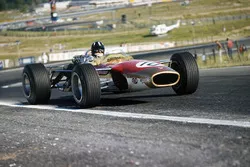

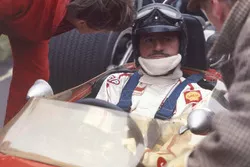
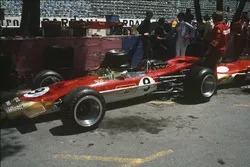
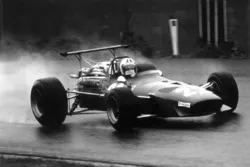


During the ‘60s, aerodynamics was some sort of black art. The lack of sophisticated wind tunnels and appropriate tools explained why certain aero solutions worked miraculously while others, failed poorly.
During that same period, Formula 1 engines stepped up from being small, 1.5 litre, and underpowered motors to normally aspirated three-litre power plants. Power reached 450 horsepower and the lack of traction and grip generated slow lap times, accentuated the fact that the tires were still pretty narrow and made of relatively hard rubber.
Engineers looked for ways to increase tire grip so that the cars would take the corners at higher speeds, therefore lapping the circuits faster. They knew that the easiest way to increase grip was to apply some sort pressure on each tire. But how that could be achieved?
The stunning Chaparral
The solution came from Texas where Jim Hall, a former Grand Prix driver, cleverly understood that if a normal wing could make an airplane fly, an inverted wing should create a similar force, but in the other direction. The negative lift should be capable to increase tire grip.
Hall engineered and created the legendary Chaparral 2F in the mid-60s; a sport car (that raced with a licence plate!) fitted with a huge wing at the back, mounted on the wheel hubs and not on the bodywork. The wing is also moveable, a bit like the DRS [Drag Reduction System] on today’s F1 cars. When the driver pushed on a pedal, the angle of the wing flatted, reducing drag on the straightaways. When braking for a corner, the driver would let go the wing pedal, which put the rear wing back in the high downforce position.
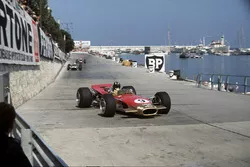
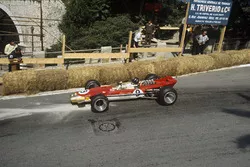
Colin Chapman of Lotus looked at this, and fitted much simpler wings on one of his Lotus 49 at the 1968 Monaco Grand Prix. Chapman knew he needed to balance his F1 car, and decided the fit small winglets at the front of Graham Hill’s Lotus and a curved sheet metal at the rear.
Hill captured pole position on the streets of Monaco with an advantage of six-tenths of a second over the second placed Johnny Servoz-Gavin in a Matra-Cosworth. Hill also won the race, sending a clear signal all along the pit lane.
Forghieri gave wings to his Ferrari
The next race was staged two weeks later on the long, fast and terrifying, 14.1-km long circuit of Spea-Francorchamps. Ferrari’s Mauro Forghieri designed a rear wing that was bolted to the Ferrari 312/67 of Chris Amon. Unlike Chapman’s bend steel sheet, Forghieri designed a genuine inverted wing that was supported by two posts linked to the wheel hubs.
Amon captured pole position with a time of 3:28.6 while Belgian Jacky Ickx, in the wingless sister Ferrari, can do no better than a time of 3:34.3, which was five seconds slower.
At the next race held on the circuit of Zandvoort in the Netherlands, almost every car was fitted with wings of various shapes.
However, Chapman came up with another idea. He designed a rear wing of full width, and planted it on long supports so that the wing would be fed by undisturbed air to be more efficient. This forced the Lotus fabricators to produce new wishbones for the suspensions and new drive shafts.
This thing with wings then became out of control. Cars showed up and raced with rear wings that we very highly perched on thin tubes that could barely withstand the forced that were generated. As expected, some wings began to crack, bend and even break, producing accidents of alarming seriousness.
The governing body then changed the rules about the wings to make then safer, and less efficient, leading to the wings we see today on the current F1 machinery.
We want your opinion!
What would you like to see on Motorsport.com?
Take our 5 minute survey.
- The Motorsport.com Team
Read and post comments
Read also :
Share Or Save This Story
Copy link
Share on Viber
Previous article Formula 1 to drop grid girls for 2018
Next article McLaren must keep expectations under control - Boullier
Top Comments
There are no comments at the moment. Would you like to write one?
View More & Comment
More from
René Fagnan

Alex Labbe returns to NASCAR Pinty’s and Xfinity Series
NASCAR O'Reilly
NASCAR O'Reilly
Alex Labbe returns to NASCAR Pinty’s and Xfinity Series

New Canadian Grand Prix pit building revealed in Montreal
Formula 1
Formula 1
Canadian GP
New Canadian Grand Prix pit building revealed in Montreal
Jacques Villeneuve: Zolder track debut will be “important to me”
NASCAR Euro
NASCAR Euro
Jacques Villeneuve: Zolder track debut will be “important to me”
Latest news
WEC drivers question lack of full-course yellow after heavy Monza crash
WEC
WEC WEC
Monza
59 min
WEC drivers question lack of full-course yellow after heavy Monza crash
Kyle Larson, Cliff Daniels and the Hendrick 5 are who we say they are
NASCAR Cup
NAS NASCAR Cup
Homestead-Miami
3 h
Kyle Larson, Cliff Daniels and the Hendrick 5 are who we say they are
Final NASCAR Cup points standings after 2026 Homestead finale
NASCAR Cup
NAS NASCAR Cup
Homestead-Miami
7 h
Final NASCAR Cup points standings after 2026 Homestead finale
Feature
Discover prime content


Subscribe and access Motorsport.com with your ad-blocker.
From Formula 1 to MotoGP we report straight from the paddock because we love our sport, just like you. In order to keep delivering our expert journalism, our website uses advertising. Still, we want to give you the opportunity to enjoy an ad-free and tracker-free website and to continue using your adblocker.
You have 2 options:
- Become a subscriber.
- Disable your adblocker.
Subscribe now Already subscribed? Sign in here
Already disabled your adblocker?
Reload page
Manage Alerts
Subscribe