Analysis
Formula 1
Tech analysis: Mercedes' radical approach to nose upgrades
From a design point of view, Mercedes has had an aggressive car for the last few years, but 2017 has ramped that complexity up even further.
Matt Somerfield Giorgio Piola
Edited: May 17, 2017, 12:03 PM
Copy link
Share on Viber
Giorgio Piola's F1 technical analysis
Giorgio Piola is the preeminent Formula 1 technical journalist. View our full selection of Giorgio's technical illustrative content
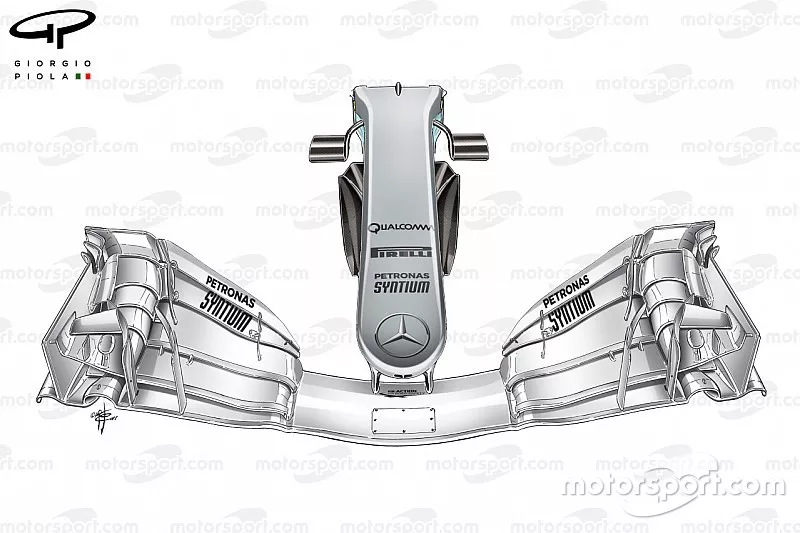
Mercedes' introduction of a new nose at round five of the championship shows the level of planning that goes into the development of these large-scale update packages, given the need to pass a new crash test for the nose ahead of its use in a grand prix weekend.
A crash test was needed, as the nose is much narrower than its predecessor, slimming in the central portion before arching outward to meet with the chassis.
The challenge of designing a slimmer nose is no mean feat given the need to maintain its ability to pass the crash test - decelerating the car over the same distance in the event of an accident, without significantly increasing its weight either.

Mercedes W08 narrow nose, Spanish GP
Photo by: Giorgio Piola
The team's desire to reduce the width of the nose is due to the other more radical solution that was mounted to the W08 in Spain - the turning vane cape (red arrow).
We've not seen anything used like this before, at least not around the nosecone, with the bold design draped around and under the nose creating a significant aerodynamic surface with which to shape and caress the airflow as it passes by.
Of course, this structure is in a particularly sensitive area of the car, helping to guide the Y250 vortex and limiting the impact of the front tyre wake by sheer virtue of its physical tunnel-like presence and the aerodynamic effect it'll undoubtedly have.

Mercedes AMG F1 W08 front detail
Photo by: Sutton Images
It's important at this point to show an image of the 'cape' from behind, illustrating the reason why some have compared it to a mini-diffuser.
Clearly it's not in close enough proximity to the ground to fulfill exactly the same purpose but the vortex that is generated at the edge of a diffuser is perhaps being generated here, too.

Mercedes W08 narrow nose
Photo by: Sutton Images
It's also important to note the geometry of the 'cape' side-on, with air being directed centrally under the nose and over the flat trailing edge of the cape with a vertical divider forcing the direction of the airflow as it meets on the centreline.
The winglet mounted behind (red arrow), which evolved from the team's previous use of a bat-wing, also fits in with this airflow scheme, guiding the airflow under the car's chassis toward their next set of aerodynamic structures around the sidepod.
It's worth noting that with the arrival of the turning vane cape the ride height sensor has been removed from the centre on this winglet to improve both surfaces' performance.
Micro detailing

Mercedes W08 front brake duct
Photo by: Giorgio Piola
One of the smaller details that was revised on the W08 in Spain was the winglet mounted on the front suspension's upright extension. A single-element winglet sprung up here in Australia but in Spain the team decided to revise that, changing it for a two-piece affair.
This might seem like a very small change but it just goes to show the level of detail that teams go into as they strive to improve performance.
We want your opinion!
What would you like to see on Motorsport.com?
Take our 5 minute survey.
- The Motorsport.com Team
Read and post comments
Read also :
Share Or Save This Story
Copy link
Share on Viber
Previous article Red Bull and Force India deny they will be rivals
Next article Brawn in talks to avoid F1/MotoGP date clashes
Top Comments
There are no comments at the moment. Would you like to write one?
View More & Comment

More from
Matt Somerfield

Gallery: How F1 tech evolved during the 2024 season
Formula 1
Formula 1
Gallery: How F1 tech evolved during the 2024 season
How McLaren’s rear wing push changed the game in F1
Formula 1
Formula 1
How McLaren’s rear wing push changed the game in F1
How 2026 F1 rules will help avoid identikit designs
Formula 1
Formula 1
How 2026 F1 rules will help avoid identikit designs
Latest news

McLaren held fresh talks after Singapore GP clash as Lando Norris promises to "make better decisions"
Formula 1
F1 Formula 1
United States GP
58 min
McLaren held fresh talks after Singapore GP clash as Lando Norris promises to "make better decisions"
2026 MotoGP Australian Grand Prix – How to watch, session times & more
MotoGP
MGP MotoGP
Indonesian GP
3 h
2026 MotoGP Australian Grand Prix – How to watch, session times & more

Zane Smith fined $50,000 by NASCAR for ramming Carson Hocevar after Phoenix Cup race
NASCAR Cup
NAS NASCAR Cup
Phoenix II
10 h
Zane Smith fined $50,000 by NASCAR for ramming Carson Hocevar after Phoenix Cup race
FIA expects F1 races in Qatar and Abu Dhabi to continue as planned
Formula 1
F1 Formula 1
United States GP
15 h
FIA expects F1 races in Qatar and Abu Dhabi to continue as planned
Feature
Discover prime content


Subscribe and access Motorsport.com with your ad-blocker.
From Formula 1 to MotoGP we report straight from the paddock because we love our sport, just like you. In order to keep delivering our expert journalism, our website uses advertising. Still, we want to give you the opportunity to enjoy an ad-free and tracker-free website and to continue using your adblocker.
You have 2 options:
- Become a subscriber.
- Disable your adblocker.
Subscribe now Already subscribed? Sign in here
Already disabled your adblocker?
Reload page
Manage Alerts
Subscribe