Analysis
Formula 1 Saudi Arabian GP
Does F1 have a dirty air problem?
One of Formula 1’s dreaded buzz phrases has re-emerged in the championship’s collective vocabulary at the start of the 2024 season: dirty air.

Alex Kalinauckas
Edited: Mar 12, 2024, 7:35 PM
Copy link
Share on Viber
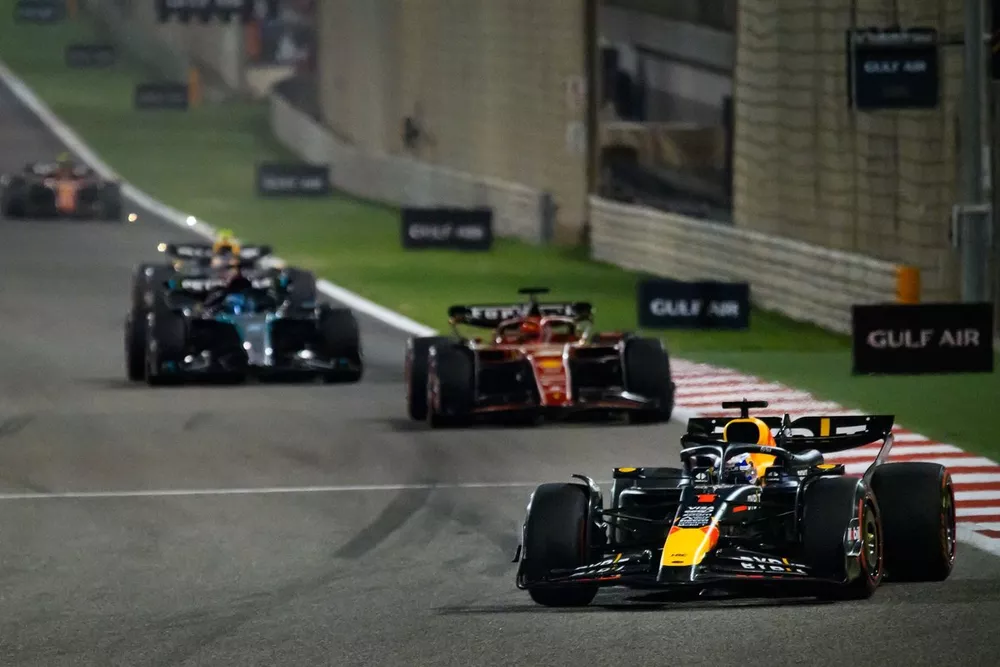
The phenomenon of boiling, twisting vortices being generated by winged F1 machines has been an issue through the generations.
But in the championship’s moves to improve its entertainment spectacle, particularly over the last 20 years or so, the desire to clean-up outwash airflow generated by cars to allow following drivers to stay close behind a rival and not slide in the unstable air buffeting their own machines has regularly been cited.
The move to ground-effect rules for the current era, with airflow sent higher and wider by such designs plus the desired slashed reduction of the outwash effect through simplified front wings, had a clear target of eliminating as much dirty air as possible as the cars traversed corners to improve racing.
The initial feedback from the drivers was generally positive on this factor, with the feeling the airflow from following another new ground-effect car reduced the unpredictable handling snaps that meant a chasing driver struggled to make ground.
In broad strokes terms, it was felt that rather than losing 50% of their downforce in such snaps when running one car length back from a rival, this was reduced to losing approximately 20% in 2022 before team aerodynamic developments – particularly around the front wing endplates and brake ducts – meant the downforce ‘loss’ rose back to around 35% in 2023.
But after the 2024 season opener in Bahrain, the start of the third year of development for the current car generation, the topic of dirty air and drivers perhaps struggling to follow as they had done in the last two years surfaced once again.
Lando Norris, McLaren MCL38
Photo by: Sam Bloxham / Motorsport Images
The suggestion was that it has become even harder in 2024.
“The pace [with Mercedes] was so similar that as soon as I got into the dirty air, I didn't have enough of an advantage to have a chance to overtake or even get within DRS,” said McLaren’s Lando Norris.
His team principal, Andrea Stella, suggested his charge’s struggles had more to do with McLaren lacking grip compared to George Russell’s Mercedes, but did wonder if “over the season whether there's this trait, where with the improvement of the cars, then the dirty air becomes a factor which actually makes overtaking more difficult”.
Ahead of this weekend’s Saudi Arabian round, Motorsport.com canvased opinion from the F1 driving corps on this topic.
Sauber’s Zhou Guanyu said: “I really agree with this feedback because I think every year people improve their general downforce and it makes the car harder to follow. I don’t think it’s something that teams change to make it difficult in dirty air.
“It’s just everyone with the aero of this generation of cars will get to a state where it’s super difficult to stay close by when you’re in qualifying and [all cars] are within a tenth, so for drivers it’s difficult in the race to keep the pace up.
“You almost need more than 0.8s advantage to be able to do something in the race.”
George Russell, Mercedes F1 W15 and Charles Leclerc, Ferrari SF-24
Photo by: Andy Hone / Motorsport Images
Russell explained “there are some thoughts of this” and that he “wouldn't say it's getting easier”.
“It's either staying the same or getting slightly worse,” he added. “But I think it's only natural as we're all moving further and further away from the initial regulation.”
Haas driver Nico Hulkenberg feels “very much the same”, but added, “it's probably car dependent. Some cars take it better than others. [It’s] definitely not getting better, maybe slightly worse.
“But it also depends, if you have a bunch of cars in front, so two/three, it makes it worse than just one. So, several factors play into that.”
But Ferrari driver Charles Leclerc, speaking alongside Russell and Hulkenberg in the pre-event press conference in Jeddah, reckons “on our side, this year is a little bit better compared to last year”.
“I've heard that,” Leclerc said of the renewed dirty air discussion. I don't know if it's part of the characteristics we have improved compared to last year, which made our [2023] car very difficult to drive. But this year, it's quite a bit better for us to follow [other cars].”
Mechanics push the car of Lewis Hamilton, Mercedes F1 W15 into the garage
Photo by: Simon Galloway / Motorsport Images
The outwash effect was a topic in pre-season testing – in the case of Mercedes’ novel new front wing approach.
That is aimed at directing turbulent air to increase downforce further down the W15, but F1's chief technical officer, Pat Symonds, questioned if it was "really within the spirit of the rules" regarding minimising the outwash effect while remaining legally compliant.
The FIA has said that it will not close potential rules loopholes to stop teams making developments in areas such as front wings, endplates and brake ducts before the new chassis and engine rules arrive for 2026.
Some drivers, meanwhile, suggested other factors could have been at play that raised the dirty air topic in Bahrain for a different reason.
Norris first insisted that it is actually “way too early to tell” and feels “like people make too many judgements in the paddock after one race”.
“Everyone needs to chill out and see what happens over two/three/four/five races before you can start to make guesses of where teams stand and who stands where and how much quicker they are,” he added.
“Things change too much and it's tough to say. I think we saw last week that our pace compared to Mercedes is very similar.
“And when your half a tenth quicker or one tenth quicker, that's nowhere near enough to get, and it hasn't been for years, suddenly into DRS and just pass someone.
“So, I think for certain cars that we were racing against the gaps were smaller than previous years, therefore [making it] harder to make some decent time gains, and therefore it was harder to race.
“But not because necessarily the cars are much harder to follow; just because the gaps between cars were smaller than in previous years.”
Red Bull racer Sergio Perez also pointed out that Bahrain’s abrasive track surface means drivers must really consider their tyre management when trying to race there.
The dirty air factor can make this more difficult when air is not as cool passing to a following rival, which increases the challenge of minimising car sliding to preserve tyre life.
“Bahrain obviously over exaggerates things,” Perez concluded. “So, it will be interesting to see here also [what happens in Jeddah]. I think the racing will be a lot closer and it will be an interesting race.”
Read Also:
We want your opinion!
What would you like to see on Motorsport.com?
Take our 5 minute survey.
- The Motorsport.com Team
Read and post comments
Read also :
Share Or Save This Story
Copy link
Share on Viber
Previous article F1 Saudi Arabian GP: Verstappen pips Alonso to lead first practice
Next article F1 live: Saudi Arabian GP practice as it happened
Top Comments
There are no comments at the moment. Would you like to write one?
View More & Comment

More from
Alex Kalinauckas
Who is Kimi Antonelli, F1 sprint polesitter at just 18?
Formula 1
Formula 1
Who is Kimi Antonelli, F1 sprint polesitter at just 18?

Why Bottas has the edge over Perez in 2026 F1 return race
Formula 1
Formula 1
Japanese GP
Why Bottas has the edge over Perez in 2026 F1 return race

What if Red Bull solved its second-car problem with a paint job?
Formula 1
Formula 1
Japanese GP
What if Red Bull solved its second-car problem with a paint job?
Latest news
Truck Series championship down to two with two to go
NASCAR Truck
NSTR NASCAR Truck 2 min
Truck Series championship down to two with two to go
MotoGP Australian GP: Marc Marquez recovers from crash to take pole at wet Phillip Island
MotoGP
MGP MotoGP
Australian GP
1 h
MotoGP Australian GP: Marc Marquez recovers from crash to take pole at wet Phillip Island
No factory Honda bikes in Australian GP as Luca Marini withdraws due to virus
MotoGP
MGP MotoGP
Australian GP
2 h
No factory Honda bikes in Australian GP as Luca Marini withdraws due to virus
Feature
Discover prime content


Subscribe and access Motorsport.com with your ad-blocker.
From Formula 1 to MotoGP we report straight from the paddock because we love our sport, just like you. In order to keep delivering our expert journalism, our website uses advertising. Still, we want to give you the opportunity to enjoy an ad-free and tracker-free website and to continue using your adblocker.
You have 2 options:
- Become a subscriber.
- Disable your adblocker.
Subscribe now Already subscribed? Sign in here
Already disabled your adblocker?
Reload page
Manage Alerts
Subscribe