Analysis
Formula 1
Analysis: The F1 rule change that is actually working
The farce surrounding Formula 1’s brief foray into elimination qualifying has dominated the off-track agenda during the start to the season, and overshadowed the two good races we had been treated to.

Kate Walker
Edited: Apr 8, 2016, 10:54 AM
Copy link
Share on Viber

But with a reversion to the 2015 qualifying system now confirmed, there is no reason to believe that the action on Sundays is going to be any way compromised.
For there is one rule change that appears to be central to the Sunday excitement levels of 2016 and it is one the FIA believes will continue to throw up excitement for the remainder of the campaign.
More freedom
New for 2016, teams and drivers have a pretty much open choice of the three dry compounds from which to make up their 13 sets of tyres.
The rule was originally aimed at opening up strategic variation within teams, and appears to have contributed to closer racing on track. But it has also delivered a secondary boost: lap records.
Last weekend in Bahrain, Lewis Hamilton’s V6 hybrid-powered pole lap was the fastest ever delivered on the current Grand Prix track configuration - edging out by one tenth a 1m29.527s that Mark Webber delivered in practice there in 2005.
FIA F1 technical and sporting director Marcin Budkowski believes that the extra choices of tyres has contributed a great deal to the unintended consequence of faster lap times.
“The third compound available at every race is generally a step softer than the two available in 2015, which has increased the tyre grip both in race and qualifying trim,” he told Motorsport.com.
“The effect on lap times is obviously variable depending on compound, track, conditions, etc, but this is roughly one second per lap in qualifying and six-tenths per lap in race conditions - for free!”

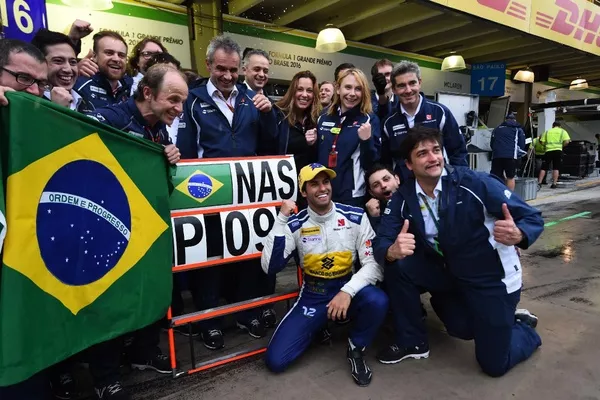
Felipe Nasr, Sauber C35
Photo by: XPB Images
Sunday delivery
But as well as the boost to speed, the new tyre rules have produced where they were expected to - in ensuring more exciting Sundays through strategic variation.
In Australia, the key to the outcome of that race was the varied tyre choices that Ferrari and Mercedes opted for after the red flag. In Bahrain, Romain Grosjean’s charging drive through the pack in Bahrain showed how an aggressive tyre choice can help spice things up.
“At the first two races, we have seen different teams and drivers within the same teams on different strategies and all three compounds have been used,” Budkowski pointed out.
“This has created not only more differences in strategies - and hence the number of stops and stop laps - but also more differences in the cars’ pace at different stages of the race.
“[There are] clear examples of a better show: the Ferrari/Mercedes different strategies post-red flag in Melbourne that decided the race win, and teammates racing each other on different strategies, etc. It has created good stories.”

Sergio Perez, Sahara Force India F1 VJM09 and Pascal Wehrlein, Manor Racing MRT05
Photo by: XPB Images
Paying the price
The tyre options not only allow teams to get thing right and become stars, but also punish those who get it wrong.
In Bahrain, Williams paid the price for a conservative strategy on medium tyres, as early running in a potential podium slot faded away over the course of the race.
As Felipe Massa said afterwards: "Definitely our strategy didn't work, to go for two stops compared to all of the other teams.
“I think the race pace on the medium tyres was really disappointing compared to the race pace from the other cars. The first stint was OK, the supersoft feeling, but after not."
So what did Budkowski make of Williams’ race?
“I am not a strategist, so I’m not much more qualified than you are, apart from saying that judging from the final result it could have been better!
“If I want to risk an analysis, looking at the pre-race table [of tyre allocations], Williams had no new soft tyres available and only one used set and therefore could have used the mediums instead, as they had two new sets, and bet on a two-stop.
"But Felipe said in the press that the softs were only scrubbed, so…
“There were many nearly-equivalent strategy options, on paper at least. Several drivers used the mediums in a three-stop strategy: Lewis used mediums on his second stint and swapped them after 15 laps, while Nico used softs and kept them for 17, so the long stint on mediums just didn’t seem to have good enough pace and the three-stop strategy was just better.
“The more options you give to the teams, the more chances for variability and mistakes.”

Valtteri Bottas, Williams FW38 and Daniel Ricciardo, Red Bull Racing RB12
Photo by: XPB Images
Variation to stay
F1 teams are famed for their ability to adapt to any of the regulatory challenges thrown at them, and for doing so at speed.
One concern that has been voiced by several people is that while the tyre strategies are variable at the moment, teams could well converge on their choices further down the line: negating the excitement we have seen so far.
But Budkowski says that there is no evidence of the variability ending - and he should know as he is in the privileged position of knowing what future choices have been made.
“At the moment I have visibility of drivers tyre choices until Baku,” he said. “And I can tell you without revealing secrets that there are still clear differences between teams, and occasional differences between drivers in the same team.
“It is true that most of these choices had to be made before the first races and that it could start converging, but there are no signs of it so far.
“There are circuits where the number of competitive strategy options is very low and therefore the compound choices are more predictable.
“But there are others - like Bahrain - where there are many strategies offering a very similar total race time and hence more options.
“In general, you will see that, from quite different choices pre-GP weekend, the teams converge towards a pretty similar range of tyres available for the race. See the Bahrain example - there were many different race strategies on Sunday!”
With F1’s qualifying controversy at an end, F1 may soon be able to focus on the positives of a tweak to the format that is really delivering right now.

Romain Grosjean, Haas F1 Team VF-16 and Daniil Kvyat, Red Bull Racing RB12 send sparks flying
Photo by: XPB Images
We want your opinion!
What would you like to see on Motorsport.com?
Take our 5 minute survey.
- The Motorsport.com Team
Read and post comments
Read also :
Share Or Save This Story
Copy link
Share on Viber
Previous article Haas competitiveness a good thing for F1, says Horner
Next article Honda prepares push for more F1 power
Top Comments
There are no comments at the moment. Would you like to write one?
View More & Comment

More from
Kate Walker

How local knowledge and data are keys to F1 growth in Asia
Formula 1
Formula 1
How local knowledge and data are keys to F1 growth in Asia
Insight: How race promoters benefit from F1’s marketing push
Formula 1
Formula 1
Insight: How race promoters benefit from F1’s marketing push

Analysis: Assessing Formula 1's financial prospects
Formula 1
Formula 1
Analysis: Assessing Formula 1's financial prospects
Latest news
Five drivers set for grid penalties for engine changes at F1 Las Vegas GP
Formula 1
F1 Formula 1
Las Vegas GP
13 min
Five drivers set for grid penalties for engine changes at F1 Las Vegas GP
Cadillac scraps V6 F1 engine, delays entry as PU manufacturer
Formula 1
F1 Formula 1
Las Vegas GP
1 h
Cadillac scraps V6 F1 engine, delays entry as PU manufacturer
LIVE: F1 Las Vegas GP updates - George Russell jumps to top of FP2 times at session end
Formula 1
F1 Formula 1
Las Vegas GP
1 h
LIVE: F1 Las Vegas GP updates - George Russell jumps to top of FP2 times at session end
F1 Las Vegas GP: Rain ruins FP1 running
Formula 1
F1 Formula 1
Las Vegas GP
3 h
F1 Las Vegas GP: Rain ruins FP1 running
Feature
Discover prime content

Top 10 F1 cars of the 1980s
Formula 1
By Kevin Turner
Top 10 F1 cars of the 1980s


Subscribe and access Motorsport.com with your ad-blocker.
From Formula 1 to MotoGP we report straight from the paddock because we love our sport, just like you. In order to keep delivering our expert journalism, our website uses advertising. Still, we want to give you the opportunity to enjoy an ad-free and tracker-free website and to continue using your adblocker.
You have 2 options:
- Become a subscriber.
- Disable your adblocker.
Subscribe now Already subscribed? Sign in here
Already disabled your adblocker?
Reload page
Manage Alerts
Subscribe