Analysis
Formula 1
Analysis: The real cost of PDVSA sponsoring Pastor Maldonado
Lotus Formula 1 driver Pastor Maldonado may enjoy millions of dollars worth of backing from Venezuelan state oil giant PDVSA, but the cost of such largesse is felt keenly by his compatriots back home, as Kate Walker explains.

Kate Walker
Edited: Dec 23, 2015, 12:50 PM
Copy link
Share on Viber

In recent years, extreme inflation, financial mismanagement, and shortages of basic goods and services have made daily life challenging for the average Venezuelan citizen.
Recent elections have caused a shift in political power, but life on the ground will be slow to change.
While the opposition party now has control of Venezuela’s National Assembly, President Nicolas Maduro has announced the creation of a parallel ‘people’s parliament’, which political observers have called a last-ditch attempt to hold on to some form of legislative authority.
But the election results are not the only challenge currently being faced by Maduro and his allies, thanks to ongoing investigations into allegations that the Venezuelan government used PDVSA to “loot billions of dollars from the country through kickbacks and other schemes”, while also “attempting to determine whether PDVSA and its foreign bank accounts were used for other illegal purposes, including black-market currency schemes and laundering drug money”.
Corruption rife
Venezuelan petro-chemical giant PDVSA has been a significant - if silent - player in global motorsports in recent years. In addition to their personal sponsorship of Pastor Maldonado in Formula 1, PDVSA have in the past backed GP2’s Rodolfo Gonzalez and IndyCar’s EJ Viso.
The current US investigations do not allege any impropriety in PDVSA’s sports sponsorship, but instead focus on corruption at every level within the company.
According to reports in the Wall Street Journal, when the directors of an unnamed Spanish construction firm secured a meeting with then-PDVSA president Rafael Ramirez (now Venezuela’s ambassador to the United Nations) to discuss an electro-power project, they were told that if they did not have $150 million in kickbacks to hand, they may as well go straight back to the airport.
Ramirez is believed to be one of the main targets of the current investigations. A committed Chavista who once threatened to “liquidate the enemies of the revolution” should Hugo Chavez lose a forthcoming election, the UN ambassador built up a substantial private fortune during his time leading PDVSA, and was dogged by widespread accusations of corrupt business practices, including filling senior PDVSA roles with family members.
Federal prosecutors from four US states met earlier this year to share evidence across a number of PDVSA-related enquiries, and that meeting also involved officials from the Drug Enforcement Agency, the Department of Homeland Security, and the FBI.
Investigations into corruption at PDVSA are ongoing, but the DEA has filed drug-trafficking charges against two of Maduro’s nephews by marriage, and the chief of Venezuela’s border agency is reportedly next in the firing line for his alleged role in easing the flow of narcotics through the country.
A defiant President
For Maduro, the charges and investigations have provided yet more fuel with which to fan the flames of anti-American sentiment in the socialist country.
Like Chavez before him, Maduro has found it convenient to blame both the United States and his own opposition for creating an “economic war”, which has led to annual inflation of at least 70 percent (although the International Monetary Fund estimates 160 percent) and an economy expected to contract by 10 percent this year.
Ramirez himself has already used that approach, taking to Twitter to deny allegations of corruption, saying media reports into the matter attacks were propagated “by enemies of the people”, aimed at destabilising the regime in retaliation for Chavez having re-nationalised the oil firm with a view to directing its profits back to the Venezuelan people.
It is unlikely that any consequences of the investigations will be felt in the F1 paddock. American jurisdiction over Venezuelan companies is non-existent, after all.
But the perilous state of the Venezuelan economy means that a trickle-down effect is likely to be felt throughout the population as the international community’s faith in the country’s ability to pay its bills plummets further still.
To sponsor, or not to sponsor?
PDVSA has long been viewed as the financial arm (read: cash cow) of the United Socialist Party of Venezuela (PSUV), and with the oil giant in trouble, it will be nigh-on impossible for the Venezuelan government to secure the necessary credit to keep up the current paltry flow of foodstuffs and medicines into the country.
The lack of basic necessities in Venezuela has been causing social unrest for over a year, with reports of citizens dying in knife fights over the last packets of toilet paper and loaves of bread left on store shelves.
The PSUV maintained a certain degree of popular support from those who benefited from PDVSA’s riches during the Chavez years, but as the recent parliamentary elections have shown, that popular support has waned in the face of vital shortages and increasing violent crime in a desperate country.
The effect on Venezuela’s political landscape of the creation of Maduro’s new ‘people’s parliament’ remains to be seen.
But with public sentiment now focused on repairing the damage done to the national economy in recent years, the government will be forced to choose between using PDVSA sponsorship to promote Venezuela in F1 through Maldonado, or diverting those funds into keeping Venezuelans happy at home.
We want your opinion!
What would you like to see on Motorsport.com?
Take our 5 minute survey.
- The Motorsport.com Team
Read and post comments
Read also :
Share Or Save This Story
Copy link
Share on Viber
Previous article Horner: F1's 'sleeping dogs' woken up to sport's problems
Next article Stevens "100 percent confident" of 2016 Manor seat
Top Comments
There are no comments at the moment. Would you like to write one?
View More & Comment
More from
Kate Walker

How local knowledge and data are keys to F1 growth in Asia
Formula 1
Formula 1
How local knowledge and data are keys to F1 growth in Asia
Insight: How race promoters benefit from F1’s marketing push
Formula 1
Formula 1
Insight: How race promoters benefit from F1’s marketing push

Analysis: Assessing Formula 1's financial prospects
Formula 1
Formula 1
Analysis: Assessing Formula 1's financial prospects
More from
Pastor Maldonado
Maldonado "expected" to join Ferrari after 2013 talks
Formula 1
Formula 1
Maldonado "expected" to join Ferrari after 2013 talks
Maldonado drops out of JOTA LMP2 line-up
WEC
WEC
Maldonado drops out of JOTA LMP2 line-up
Davidson, Maldonado switch to JOTA for 2019/20 WEC
WEC
WEC
Davidson, Maldonado switch to JOTA for 2019/20 WEC

More from
Lotus F1 Team
The Lotus 72 was "an extension of my body," Emerson Fittipaldi reveals
Formula 1
Formula 1
Canadian GP
The Lotus 72 was "an extension of my body," Emerson Fittipaldi reveals
Romain Grosjean turns 40 – here’s his career in 10 key moments
Formula 1
Formula 1
Romain Grosjean turns 40 – here’s his career in 10 key moments
Ayrton Senna's 1986 Lotus F1 car hits auction for eight-figure estimate
Formula 1
Formula 1
Bahrain Pre-Season 2
Ayrton Senna's 1986 Lotus F1 car hits auction for eight-figure estimate
Latest news
The ten closest finishes from the 2026 NASCAR season
NASCAR Cup
NAS NASCAR Cup 12 h
The ten closest finishes from the 2026 NASCAR season
‘Lewis suspected a conspiracy’ – Nico Rosberg explains how Lewis Hamilton F1 rivalry went awry at Mercedes
Formula 1
F1 Formula 1 12 h
‘Lewis suspected a conspiracy’ – Nico Rosberg explains how Lewis Hamilton F1 rivalry went awry at Mercedes
BMW "proud of what we achieved" after securing runner-up in 2026 WEC
WEC
WEC WEC
Monza
14 h
BMW "proud of what we achieved" after securing runner-up in 2026 WEC
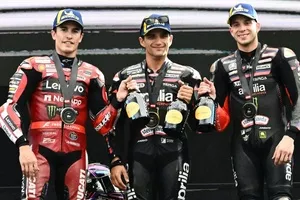
The numbers that reveal how sprint races have turned the MotoGP title fight upside down
MotoGP
MGP MotoGP
Qatar GP
16 h
The numbers that reveal how sprint races have turned the MotoGP title fight upside down
Feature
Discover prime content

Top 10 F1 cars of the 1970s
Formula 1
By Kevin Turner
Top 10 F1 cars of the 1970s
Subscribe and access Motorsport.com with your ad-blocker.
From Formula 1 to MotoGP we report straight from the paddock because we love our sport, just like you. In order to keep delivering our expert journalism, our website uses advertising. Still, we want to give you the opportunity to enjoy an ad-free and tracker-free website and to continue using your adblocker.
You have 2 options:
- Become a subscriber.
- Disable your adblocker.
Subscribe now Already subscribed? Sign in here
Already disabled your adblocker?
Reload page
Manage Alerts
Subscribe