Analysis
Formula 1 Canadian GP
Bite-size tech: Ferrari SF16-H front brakes
This image of the SF16-H during the build-up in Canada shows us the importance of thermal management, not only for the brakes but also for how Ferrari intends to deal with the heat that radiates into the wheel rim and tyre.
Giorgio Piola Matt Somerfield
Published: Jun 10, 2016, 8:30 AM
Copy link
Share on Viber

Giorgio Piola's F1 technical analysis
Giorgio Piola is the preeminent Formula 1 technical journalist. View our full selection of Giorgio's technical illustrative content
Managed correctly, the dissipation of heat from the brakes can be used to cycle the tyres into their temperature range and maintain it to directly influence performance and degradation.
The large inlet scoop is responsible for feeding several internal pathways, cooling the disc and calipers, whilst airflow also bypasses these responsibilities in order to pass through the crossover pipe and hollow blown axle to improve the shape of the airflow around the front tyre.
You'll note that a metal insert is placed atop the disc, which not only adds structural integrity but also acts as a heat sink, targeting a specific part of the wheel rim.
This promotes the radiation of heat from the brakes into a specific area of the tyre in order to change its temperature and improve performance.
Meanwhile, the caliper, housed at the bottom of the assembly, is encased in metallised pipework which will also thermally engage with the wheel rim and gas within the tyre to change its characteristics.
The crossover pipework once again features the tear-drop outlets which help to shape the passage of airflow and temperature transfer between the brakes and wheel rim.
Meanwhile, the brake disc features the maximum drill holes in its surface (1200) to dissipate heat when energy is transferred through them at the most critical braking event.
We want your opinion!
What would you like to see on Motorsport.com?
Take our 5 minute survey.
- The Motorsport.com Team
Read and post comments
Read also :
Share Or Save This Story
Copy link
Share on Viber
Previous article Ecclestone: Heineken deal will "wake me up" to social media
Next article Rosberg confident Monaco woes were a one-off
Top Comments
There are no comments at the moment. Would you like to write one?
View More & Comment
More from
Giorgio Piola

The fascinating story behind McLaren's most iconic F1 car
Formula 1
Formula 1
The fascinating story behind McLaren's most iconic F1 car

Emilia Romagna GP: F1 technical images from Imola's pitlane
Formula 1
Formula 1
Emilia Romagna GP
Emilia Romagna GP: F1 technical images from Imola's pitlane

The F1 downforce choices that proved key at the Saudi GP
Formula 1
Formula 1
Saudi Arabian GP
The F1 downforce choices that proved key at the Saudi GP
More from
Ferrari
F1 United States GP: Charles Leclerc completes perfect Friday by topping FP2
Formula 1
Formula 1
United States GP
9 h
F1 United States GP: Charles Leclerc completes perfect Friday by topping FP2
Exploring Ferrari's 'less than a tenth' US GP update package
Formula 1
Formula 1
United States GP
11 h
Exploring Ferrari's 'less than a tenth' US GP update package
Latest news
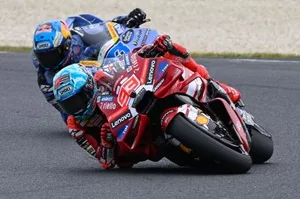
Alex Marquez says overtaking Marc Marquez was “too risky” in Australian GP sprint
MotoGP
MGP MotoGP
Australian GP
8 min
Alex Marquez says overtaking Marc Marquez was “too risky” in Australian GP sprint
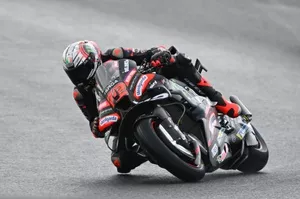
Jorge Martin declared unfit for Australian GP after suffering fracture in sprint
MotoGP
MGP MotoGP
Australian GP
42 min
Jorge Martin declared unfit for Australian GP after suffering fracture in sprint

Raul Fernandez ruled out of Australian GP, adding to Phillip Island absences
MotoGP
MGP MotoGP
Australian GP
53 min
Raul Fernandez ruled out of Australian GP, adding to Phillip Island absences

Marc Marquez: Jorge Martin was faster but overriding in Australian GP sprint
MotoGP
MGP MotoGP
Australian GP
1 h
Marc Marquez: Jorge Martin was faster but overriding in Australian GP sprint
Feature
Discover prime content



Subscribe and access Motorsport.com with your ad-blocker.
From Formula 1 to MotoGP we report straight from the paddock because we love our sport, just like you. In order to keep delivering our expert journalism, our website uses advertising. Still, we want to give you the opportunity to enjoy an ad-free and tracker-free website and to continue using your adblocker.
You have 2 options:
- Become a subscriber.
- Disable your adblocker.
Subscribe now Already subscribed? Sign in here
Already disabled your adblocker?
Reload page
Manage Alerts
Subscribe