Analysis
Formula 1
Is a blown wing trick helping Ferrari's speed advantage?
Quick through the corners and faster on the straights, Ferrari's SF71H certainly seems to be delivering performance beyond the level of what it rivals expected.

Matt Somerfield
Edited: Jul 27, 2018, 1:19 AM
Copy link
Share on Viber

And with Mercedes in particular left scratching its head over just how much performance its Maranello opposition has managed to put on since Canada, there has been much intrigue about what Ferrari is doing with its engine.
Thus far the finger has been pointed at the Scuderia unlocking something on it ERS that the others have missed, such as a battery trick or a use of the turbo, MGU-H or MGU-K in a different way.
But a new design avenue that the team tested out at the German Grand Prix could give us a clue that the answer may not lie entirely with its power unit.
Did its experiments with a remounting of its exhaust pipes near the rear wing suggest the possibility of a blown wing concept?
Wing levels
Closer analysis of its wing set-ups has suggested that Ferrari has not been needing to trim off its downforce levels to maintain its straightline gains – and has even been able to do so with more angle of attack than Mercedes.
Could the team therefore have found a way to stall its rear wing to help with a straightline speed advantage, which would then also not hurt it in high-speed corners?
It wouldn't be the first time such a solution had been used to increase top speed. The F-duct in 2010, and the DRS (Drag Reduction Device, see below) were both introduced to achieve a similar benefit: reduce drag and increase top speed.

Lotus E20 DRD (Drag Reduction Device) Internal pipework works like a fluidic switch, at low speed it ejects out of the main cooling outlet (red arrows), at high speed it ejects out of pylon to 'stall' the rear wing and reduce drag (blue arrow)
Photo by: Giorgio Piola
DRD was a passive device which tangentially blew the central section of the wing to 'stall' it. It wasn't as powerful as the F-duct and took a while to set up for each circuit.
Several teams, including Mercedes, Red Bull, Sauber and Lotus all had their own versions and spent time trying to make it work.
There seems to be some evidence to suggest that blowing the rear wing with wastegate pipes could be a way to achieve this aero benefit once again.
A technical directive issued in 2015 was of particular interest because it tried to clamp down on the possibility of using the then newly-separated wastegate pipework to turn on and off an external system with a fluidic switch.
This was much like the one used in for the F-duct, that would have allowed DRD to be controllable, rather than passive.
The technical directive was issued in response to a request from James Allison, then technical director at Ferrari and someone who had intimate knowledge of the F-duct and DRD designs from his time with Renault/Lotus.
Wastepipe tower
The thing with ideas that have produced performance in the past is that they never really go away and often get reinterpreted at a later date.
It could be then that Ferrari has done just that, opting to use the gasflow created by the wastegate pipework as a method of disturbing the exhaust plume and localised airflow, which in-turn 'stalls' the rear wing to increase their straightline speed.
You might argue that everyone has their wastegate pipework in roughly the same place as Ferrari, which would be true, but that's not to say that everyone else is mapping the wastegate and MGU-H in the same way.
In fact, they may be trying to do the exact opposite to Ferrari on this front, as other teams look to recover more electrical energy and/or reduce disturbance to the rear wing by minimising the flow of gases out the back, not thinking of the incidental benefits.
Piling on the pressure
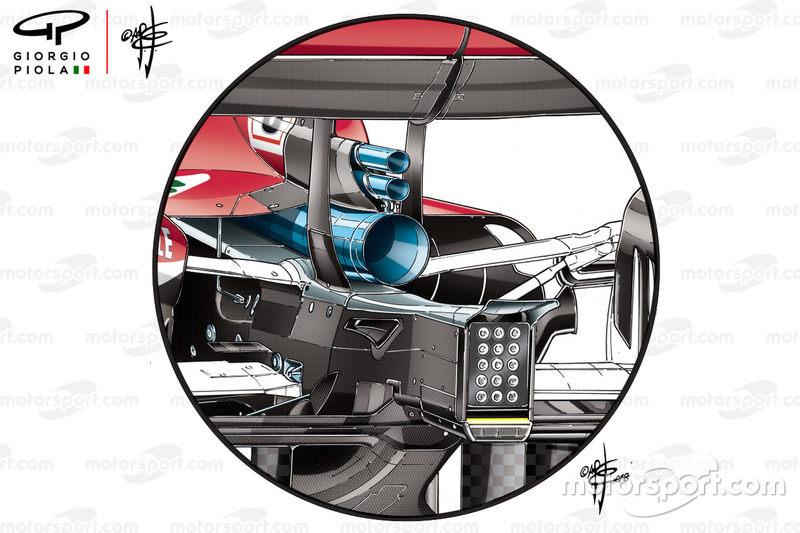
Ferrari SF71H new exhausts, German GP
Photo by: Giorgio Piola
If Ferrari has found a way to use the wastegate and exhaust to stall the rear wing then it would also make sense that what we've seen so far is their opening salvo, with more potential gains in the pipeline.
As such, it would make sense to see the development tested in Germany as part of that next stepping stone.
The update saw the wastegate outlets inverted and placed on top of the main exhaust outlet, in closer proximity to the rear wing, whilst the rear wing itself not only had a revised leading edge when viewed from the front (below), but also a revised camber on the rear face.
Furthermore, it became apparent from shots taken when the solution was being taken off the car that the lower of the two wastegate pipes merges with the upper one solely for legality reasons meaning it likely gets little flow, empowering the upper one.

Ferrari SF71H engine view
Photo by: Giorgio Piola
For now this merely represents a theory, as rival teams try to get to the bottom of an understanding of whether Ferrari's advantage comes from an unexplained advantage with energy recovery, or the counter viewpoint that Ferrari is actually blowing is rear wing for extra downforce.
One thing is for certain though, this is a solution that's helping all of the teams with a Ferrari power unit, and everyone else has been left searching for answers.
We want your opinion!
What would you like to see on Motorsport.com?
Take our 5 minute survey.
- The Motorsport.com Team
Read and post comments
Read also :
Share Or Save This Story
Copy link
Share on Viber
Previous article Toro Rosso tech chief Key set for McLaren move
Next article Force India's "critical" finances key in '19 decision - Perez
Top Comments
There are no comments at the moment. Would you like to write one?
View More & Comment

More from
Matt Somerfield

Gallery: How F1 tech evolved during the 2024 season
Formula 1
Formula 1
Gallery: How F1 tech evolved during the 2024 season
How McLaren’s rear wing push changed the game in F1
Formula 1
Formula 1
How McLaren’s rear wing push changed the game in F1
How 2026 F1 rules will help avoid identikit designs
Formula 1
Formula 1
How 2026 F1 rules will help avoid identikit designs
Latest news

George Russell: F1 2026 season a test of "character and resilience"
Formula 1
F1 Formula 1
United States GP
7 min
George Russell: F1 2026 season a test of "character and resilience"
Marc Marquez: ‘Jorge Martin rides on instinct; he just attacks, and that’s his strength’
MotoGP
MGP MotoGP
Australian GP
1 h
Marc Marquez: ‘Jorge Martin rides on instinct; he just attacks, and that’s his strength’
Lamborghini Super Trofeo | North America, Race 2: Bamber dominates to take the win
Lamborghini Super Trofeo
LBST Lamborghini Super Trofeo
World Finals - Monza 2026
1 h
Lamborghini Super Trofeo | North America, Race 2: Bamber dominates to take the win

Belgian firm to take over Renault/Alpine engine facility in Viry
WEC
WEC WEC 1 h
Belgian firm to take over Renault/Alpine engine facility in Viry
Feature
Discover prime content




Subscribe and access Motorsport.com with your ad-blocker.
From Formula 1 to MotoGP we report straight from the paddock because we love our sport, just like you. In order to keep delivering our expert journalism, our website uses advertising. Still, we want to give you the opportunity to enjoy an ad-free and tracker-free website and to continue using your adblocker.
You have 2 options:
- Become a subscriber.
- Disable your adblocker.
Subscribe now Already subscribed? Sign in here
Already disabled your adblocker?
Reload page
Manage Alerts
Subscribe