Formula 1
Canadian GP: Michelin preview
NEW TRACK SURFACE CHALLENGE FOR MICHELIN The Formula One world championship begins its mid-season North American tour this weekend in Montreal, Canada. Unbeaten so far in 2005, Michelin will be chasing a ninth straight grand prix victory & ...
Published: Jun 5, 2005, 2:39 PM
Copy link
Share on Viber

NEW TRACK SURFACE CHALLENGE FOR MICHELIN
The Formula One world championship begins its mid-season North American tour this weekend in Montreal, Canada. Unbeaten so far in 2005, Michelin will be chasing a ninth straight grand prix victory a dominant run that stretches back to Brazil last October.
In addition to winning the first seven races of the campaign, Michelins partner teams have recorded 18 podium finishes (from a possible 21), scored 242 of the 273 available points and annexed 49 of 56 top-eight finishes.
The Canadian Grand Prix was first staged in 1967 and has featured on the calendar for all but two seasons since. This years event will be the 37th to count towards the world championship and the 27th in Montreal. The race has also been staged twice at Mont Tremblant, 145 kilometres (90 miles) north of its current home, and eight times at Mosport Park, Ontario.
The Montreal circuit is located on the picturesque Île Notre Dame, which lies between the St Lawrence River and St Lawrence Seaway. Originally built to host the 1967 World Fair, the Île Notre Dame was also the setting for rowing events during the 1976 Olympic Games. The racing circuit was built two years later.
The track is named after legendary Canadian Gilles Villeneuve, who won the inaugural F1 race here on October 8 1978 at the wheel of a Michelin-shod Ferrari 312 T3. Jacques Laffite (Ligier-Matra, 1981), Nelson Piquet (Brabham-BMW, 1984) and Ralf Schumacher (Williams-BMW, 2001) have also won the Canadian GP on Michelin tyres. In last years corresponding fixture Jenson Button (B*A*R-Honda) was Michelins leading finisher, in third place.
Pierre Dupasquier, Michelin motorsport director:
In common with certain other circuits on the calendar, Montreal features a blend of high-speed straights, tight corners and heavy braking zones. Drivers negotiate the chicanes at relatively low speeds about 80-120 km/h (50-75 mph) and it is vital to gauge your traction control settings correctly to optimise exit speeds onto the long straights."
The absence of quick corners and the frequent need for hard acceleration places a great deal of emphasis on rear-tyre performance and the possibility of hot ambient temperatures increases the potential strain. You have to take care not to let the rear wheels spin too much, because that accelerates wear rates. To counter this phenomenon, we will offer our partner teams tyres with fairly stiff sidewall constructions."
The Montreal circuit has been completely resurfaced since last season. Our engineers have taken a look at the track and their research indicates that the asphalt wont be particularly abrasive. That said, it is completely new and has yet to be tested by any racing cars. It is likely that track conditions will evolve significantly throughout the weekend, largely due to the chemical reactions that are an unpredictable by-product of any freshly-laid surface.
Driver perspective
Mark Webber, BMW WilliamsF1 Team:
Montreal is similar to a street circuit in character, because it tends to be very dusty at the beginning of a race weekend. It incorporates several traction events, where you need the car to provide as much grip as possible under hard acceleration from slow corners."
"It is imperative to get your traction control settings and suspension configuration right, so that you dont put too much of a strain on tyres especially now that one set has to last a full race distance. Although most of the corners are fairly slow, we approach them at very high speed and that puts a premium on tyre performance during deceleration you need your front tyres to be stiff enough to enhance braking stability.
Technical focus Tyres changes during the race
Nick Shorrock, Director of Michelin F1 activities:
The FIA regulations state that Unless a precautionary tyre change is necessary for clear and genuine safety reasons, only a punctured or damaged tyre may be changed during a race.
With the regulations that are in place this year, whereby both the qualifying session and the race have to be undertaken with the same set of tyres, a certain number of measures were put into place to ensure that teams are not tempted to try to programme strategic tyre changed."
"For this reason the FIA carries out the necessary checks and maintains the right to judge the basis of any tyre changed. The FIA could for example impose a penalty if it saw fit.
As for the tyre manufacturer, it is its responsibility to ensure it provides the appropriate product, taking fully into account all aspects of safety, and to provide the necessary advice on tyre use throughout the weekend. However, the ultimate decision as to the choice of strategy to be adopted remains entirely in the hands of each teams management.
-michelin-
We want your opinion!
What would you like to see on Motorsport.com?
Take our 5 minute survey.
- The Motorsport.com Team
Read and post comments
Read also :
Share Or Save This Story
Copy link
Share on Viber
Previous article Gass looks ahead to North America
Next article No tyre decision regrets for Raikkonen
Top Comments
There are no comments at the moment. Would you like to write one?
View More & Comment

More from
Jenson Button
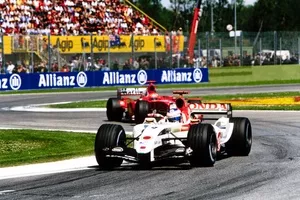
The greatest F1 campaigns with no wins
Formula 1
The greatest F1 campaigns with no wins

Fernando Alonso earns Michael Schumacher comparison from Jenson Button
Formula 1
Formula 1
Italian GP
Fernando Alonso earns Michael Schumacher comparison from Jenson Button

Who belongs on F1's Mount Rushmore? Pick your four greatest drivers
Formula 1
Formula 1
Who belongs on F1's Mount Rushmore? Pick your four greatest drivers

More from
Ferrari
Five things to look out for at F1’s Qatar GP
Formula 1
Formula 1
Qatar GP
4 h
Five things to look out for at F1’s Qatar GP
Lewis Hamilton: Ferrari’s top-speed deficit was “brutal” at F1 Las Vegas GP
Formula 1
Formula 1
Las Vegas GP
Lewis Hamilton: Ferrari’s top-speed deficit was “brutal” at F1 Las Vegas GP

Top 10 F1 cars of the 1980s
Formula 1
Top 10 F1 cars of the 1980s
Latest news

Judge denies Joe Gibbs Racing an injunction against Spire
NASCAR Cup
NAS NASCAR Cup 1 h
Judge denies Joe Gibbs Racing an injunction against Spire
Five things to look out for at F1’s Qatar GP
Formula 1
F1 Formula 1
Qatar GP
4 h
Five things to look out for at F1’s Qatar GP
AF Corse USA steps up to full-season IMSA GTD campaign in 2027
IMSA
IMSA IMSA 4 h
AF Corse USA steps up to full-season IMSA GTD campaign in 2027
Williams, Alpine fall foul of F1's 2025 cost cap
Formula 1
F1 Formula 1 4 h
Williams, Alpine fall foul of F1's 2025 cost cap
Feature
Discover prime content
Top 10 F1 cars of the 1990s
Formula 1
By Kevin Turner
Top 10 F1 cars of the 1990s


Subscribe and access Motorsport.com with your ad-blocker.
From Formula 1 to MotoGP we report straight from the paddock because we love our sport, just like you. In order to keep delivering our expert journalism, our website uses advertising. Still, we want to give you the opportunity to enjoy an ad-free and tracker-free website and to continue using your adblocker.
You have 2 options:
- Become a subscriber.
- Disable your adblocker.
Subscribe now Already subscribed? Sign in here
Already disabled your adblocker?
Reload page
Manage Alerts
Subscribe