Press release
Formula 1 Tata Connectivity Challenge
Challenge one winners announced for Tata Connectivity prize
Tata Communications on Friday announced the three winners of the 2015 F1 Connectivity Innovation Prize Challenge One.
Edited: Jul 31, 2015, 3:11 PM
Copy link
Share on Viber


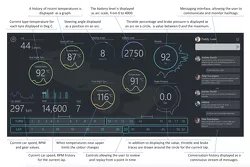


The challenge one was set by the Mercedes team, where they asked the entrants to design a new approach for displaying critical race car telemetry and data collected via on-board sensors to enable engineers at the race track and at the factory in the UK to make faster decisions through real-time visualisation of data.
Three entries were chosen as the winners of the first challenge with the second challenge slated to be revealed on August 18, 2015.
Winning entries
The first entry to win was from Ravi Sawhney and Svetlana Sawhney from the UK.
Their idea goes:
Databricks is an application that combines simple, yet effective visualisation of data with machine learning that would enable the team to make more timely and accurate decisions. A databrick displays variables such as speed in a range of graphical, brick-like formats.
In addition to visualising data, a databrick can learn from what has happened in the past for a driver on an exact position on the track in similar conditions.
By comparing what it is seeing in real-time with what has happened in the past, it can alert race engineers to unusual patterns, enabling predictive decision making.
Visually, databricks live inside a canvas where they can be moved through a simple touch-based interface to allow the team to access insights as quickly as possible.
The second entry to win was from Marco EinOder and Leire Apraiz from Spain.
Ther idea goes:
This Graphic User Interface system uses a modular approach to display key variables such as tyre degradation and temperature, to help enhance the accuracy of decision making during races.
It uses high-impact colours and two different block types – a square core block for key variables, and a series of rectangular blocks to display other information to give the main data points additional context.
Race engineers are able to place the rectangular contextual blocks anywhere around the main square block, making the system scalable and customisable.
The solution taps into race engineers’ photographic memory by placing functionally relevant data together, such as information relating to tyres, driver’s actions, speed and mechanical systems.
The third entry to win was from Paul Clarke from Australia.
His idea was:
Signals and Streams is a creative combination of traditional web technologies and state-of-the-art protocols, which brings consolidated data insights to the team in real time.
The incoming data, signals, are distributed to race engineers the instant they are received. To help the team make sense of the wealth of data they receive, they would be provided with an artificial analyst called ARROW.
Powered by machine learning, ARROW guides accurate decision making in a data-saturated, high-pressure environment such as F1. To help the team communicate regarding the signals they receive, the solution is equipped with an instant communication feature called Streams.
The combination of these tools enables the team to consume the huge amounts of data they gather during each race and react as effectively as possible.
Upon unveiling the winning entries, Paddy Lowe said: “We’ve been hugely impressed by the response to the challenge we set to consider how to derive clear advantage from the considerable volume of data we generate at the track – and importantly, to provide this competitive insight both in real-time and to a high standard of accuracy.
"The winning entries are all commendable in their originality as well as their viability and represent the best of a very impressive array of submissions.”
Formula 1.com
We want your opinion!
What would you like to see on Motorsport.com?
Take our 5 minute survey.
- The Motorsport.com Team
Read and post comments
Read also :
Share Or Save This Story
Copy link
Share on Viber
Previous article Baku street layout ready for sign-off by FIA
Next article Alonso frustrated by F1 testing ban, says Dennis
Top Comments
There are no comments at the moment. Would you like to write one?
View More & Comment
Latest news
Supercars Gold Coast: Broc Feeney converts Race 2 pole to win after Saturday defeat
Supercars
SUPC Supercars
Gold Coast 500
4 min
Supercars Gold Coast: Broc Feeney converts Race 2 pole to win after Saturday defeat
Marc Marquez: Track conditions were “acceptable” despite Australian GP cancellation
MotoGP
MGP MotoGP
Australian GP
24 min
Marc Marquez: Track conditions were “acceptable” despite Australian GP cancellation
Aprilia unsure whether Australian GP cancellation good or bad for the team
MotoGP
MGP MotoGP
Australian GP
1 h
Aprilia unsure whether Australian GP cancellation good or bad for the team
How the seven NASCAR Cup title contenders perform at Talladega
NASCAR Cup
NAS NASCAR Cup
Talladega II
1 h
How the seven NASCAR Cup title contenders perform at Talladega
Feature
Discover prime content

Subscribe and access Motorsport.com with your ad-blocker.
From Formula 1 to MotoGP we report straight from the paddock because we love our sport, just like you. In order to keep delivering our expert journalism, our website uses advertising. Still, we want to give you the opportunity to enjoy an ad-free and tracker-free website and to continue using your adblocker.
You have 2 options:
- Become a subscriber.
- Disable your adblocker.
Subscribe now Already subscribed? Sign in here
Already disabled your adblocker?
Reload page
Manage Alerts
Subscribe