Feature
Formula 1
Opinion
Explaining the complicated art of F1 braking
This critical element of a car’s performance may appear straightforward but, as our columnist explains, as always in Formula 1 very little is simple

Pat Symonds
Edited: Sep 9, 2026, 12:44 PM
Copy link

Share on Viber
While Formula 1 engines attract most of the attention, the braking system is almost as critical to outright performance. Let’s consider some performance figures. A good start for an F1 car would be one that covered around 90 metres in four seconds, with 70 to 80 metres being typical. That perfect start represents an acceleration of around 1.2G. This would be pretty constant acceleration. Braking is altogether more impressive.
Approaching the Rettifilo at Monza, an F1 car will reduce speed from 209mph to 55mph in 2.75s – in just 350m. This represents an average deceleration of twice that of the startline acceleration, but more importantly it is not constant, with peak deceleration reaching around 5.5G.
The basic hardware of the braking system has not changed substantially in recent years. The discs have been universally made from carbon since the early 1980s. This is not the same as the carbon composite material used in the chassis but is instead a pure carbon, where the fibres are carbonised and densified in a solid carbon matrix capable of operating at around 1200C – the same temperature as molten lava.
Equally, the calipers are machined from a special aluminium-lithium alloy, the material of choice since the use of beryllium was banned some years ago on health grounds.
The fibres are carbonised and densified in a solid carbon matrix capable of operating at around 1200C – the same temperature as molten lava
Although the core hardware has remained familiar, detailed design has continued to evolve, particularly in cooling, with discs having multiple small diameter cooling holes and calipers sporting all sorts of complex features machined into them to increase the surface area to aid cooling.
The more significant development is brake-by-wire, a system made necessary by hybrid energy recovery. This can recover energy at anything up to 350kW. This is a significant contribution to the total 2000kW of braking power. This energy recovery comes about by switching the hybrid electric motor into a generator and using it to charge the battery. Now, if the battery is depleted this presents no problems, but if the battery is fully charged the system cannot add anything and hence the regeneration will have to be curtailed.
The brake-by-wire system takes care of this. The system is entirely conventional for the front brakes. In other words, the driver pushes on the brake pedal, which produces a pressure in the front brake lines clamping the brake pads onto the disc and slowing the car.
At the rear it is slightly different. A pressure is still produced in the rear brake line, but this can be thought of as a braking demand rather than a physical pressure at the rear calipers. A pressure sensor measures the effort the driver has imposed on the system, and the electronics will then arbitrate how the rear retardation takes place. This can be a combination of three effects: the normal braking of the discs and pads, the natural braking of the engine on a closed throttle, and the energy recovery from the hybrid electric motor.
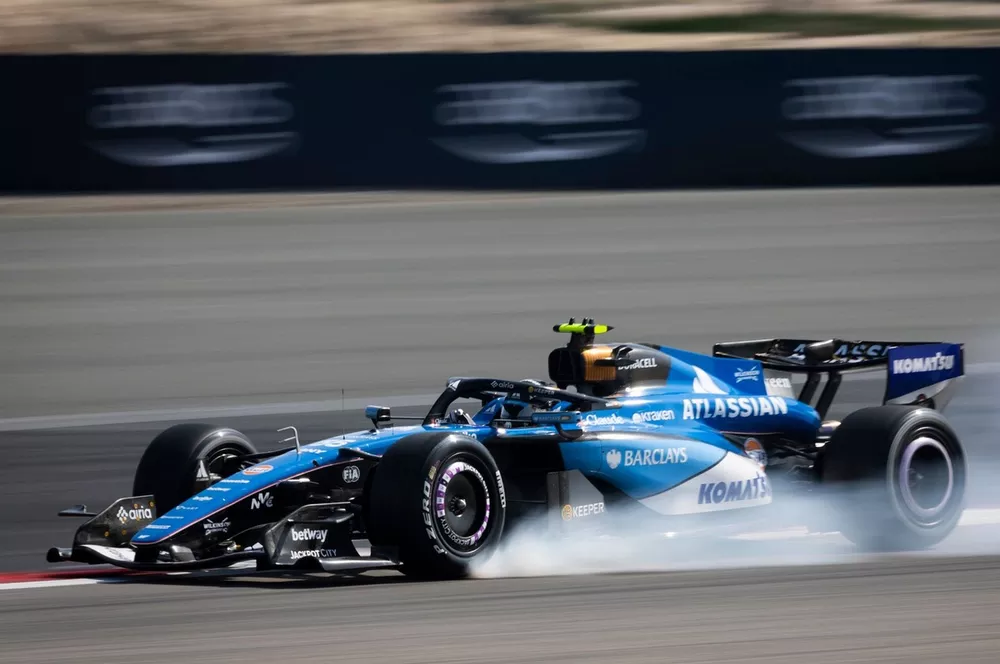
While basic hardware remains familiar, brake- by-wire is a big advance
Photo by: Alessandro Martellotta / Alessio Morgese / NurPhoto via Getty Images
The necessity of such a system leads to an opportunity to add performance to the car. The ratio of front to rear braking effort in most cars is set to a constant roughly proportional to the front to rear weight distribution. In a road car this ratio is essentially fixed and, because on the road most braking takes place in a straight line and is quite gentle, this is adequate.
A racing driver, however, is looking for maximum performance, and this dictates that they will be braking well into the corner entry, and this can lead to instability. They will also want to alter the brake balance for different types of corners and to compensate for the state of the tyres and, since an F1 car does not have anti-lock brakes, to minimise the chance of locking a wheel.
The steering wheel therefore gives the driver several controls to extract performance; not only from braking force, but also from the way braking alters the car’s handling balance. They will be looking for good initial bite so will hit the brakes hard but, as the car slows, the downforce, and hence the grip, decreases so they will have to release some pressure to avoid locking a wheel. All this is occurring as the car turns into the corner and the weight transfers towards the front and the outside wheels. Under these conditions the brake balance has a major impact on the handling balance of the car.
In general, because of the aerodynamics and architecture, and to some extent due to the tyre characteristics, an F1 car will tend to be quite unstable on the entry to a corner and then start to understeer as it reaches the apex. To counter this the brake balance will be altered dynamically, with more bias to the front on turn-in and a steady migration of the balance rearwards as the car approaches the apex of the corner. We have already seen that the driver needs to reduce brake pressure as the car loses speed, so the brake migration can easily be mapped as a function of brake pressure.
A steering wheel switch will allow the driver to select several different maps of brake balance and migration, which they will have studied before driving the car
That is not to say that all brake shaping is done by pressure modulation. The first necessity is to recover energy to the battery, and the brake arbitrator in the ECU will give this priority whenever possible. The engine braking can also be mapped along with the normal brake pressure distribution, all of which combine to give the driver the longitudinal force distribution on the tyres that best suit their requirement for maximum grip as they push lateral and longitudinal forces to the limit.
A steering wheel switch will allow the driver to select several different maps of brake balance and migration, which they will have studied before driving the car, and they will use these to compensate for differing fuel loads and tyre condition or even for a particular wind condition in a corner.
Sometimes, particularly on the entry to a very slow corner, the driver might find it hard to rotate the car and get it to turn into the corner. In these circumstances they can use an additional button, nicknamed the handbrake, which can push the brake balance rearward and open the differential to let the rear of the car slide and get the car into the corner.
As with most areas of F1, braking appears simple from the outside but is highly sophisticated in practice. These days the brakes are just as important as a handling tool as many of the more conventional means of altering the car’s balance.
This article is one of many in the monthly Autosport magazine. For more premium content, take a look at the September 2026 issue and subscribe today.
A steering-wheel switch controls brake balance – plus there’s a ‘handbrake’ button
Photo by: Steven Tee / LAT Images via Getty Images
We want to hear from you!
Let us know what you would like to see from us in the future.
Take our survey
- The Autosport.com Team
Read and post comments
Read also :
Previous article What next after Briatore’s explosive McLaren rant?
Next article LIVE: F1 Italian GP updates - Russell tops FP3 from Hamilton and Verstappen who trade blows
Top Comments
There are no comments at the moment. Would you like to write one?
View More & Comment
More from Pat Symonds
How F1’s rules got to be so complex
Formula 1
F1 Formula 1 11 d
How F1’s rules got to be so complex
How levelling the playing field isn’t antithetical to the principles of F1
Formula 1
F1 Formula 1 30 d
How levelling the playing field isn’t antithetical to the principles of F1
What an engineer with four decades of F1 experience would choose as the ideal engine rules
Formula 1
F1 Formula 1 2 mo
What an engineer with four decades of F1 experience would choose as the ideal engine rules
How F1 teams prepare for the British GP at Silverstone
Formula 1
F1 Formula 1
British GP
4 mo
How F1 teams prepare for the British GP at Silverstone
Explaining the push and pull factors of Formula 1 suspension
Formula 1
F1 Formula 1 4 mo
Explaining the push and pull factors of Formula 1 suspension
How to simplify the complex subject of F1's electrical rules
Formula 1
F1 Formula 1
Monaco GP
5 mo
How to simplify the complex subject of F1's electrical rules

The big change for F1 2026 that has been largely ignored
Formula 1
F1 Formula 1 6 mo
The big change for F1 2026 that has been largely ignored
How the F1 2026 cars produced some nice surprises amid the noise
Formula 1
F1 Formula 1 8 mo
How the F1 2026 cars produced some nice surprises amid the noise
Latest news

Racing Bulls insists that keeping "immense" Lawson doesn't contradict its mandate
Formula 1
F1 Formula 1
Las Vegas GP
14 h
Racing Bulls insists that keeping "immense" Lawson doesn't contradict its mandate
Inspiring the next generation of mechanics
Sponsored
Sponsored 15 h
Inspiring the next generation of mechanics
Honda predicts new 850cc bikes "could be as fast" as current MotoGP machines
MotoGP
MGP MotoGP
Portuguese GP
17 h
Honda predicts new 850cc bikes "could be as fast" as current MotoGP machines

39th Annual Autosport Awards to celebrate global motorsport achievements; Mario Andretti to be honoured with Gold Medal
General
MISC General 18 h
39th Annual Autosport Awards to celebrate global motorsport achievements; Mario Andretti to be honoured with Gold Medal
Subscribe and access Autosport.com with your ad-blocker.
From Formula 1 to MotoGP we report straight from the paddock because we love our sport, just like you. In order to keep delivering our expert journalism, our website uses advertising. Still, we want to give you the opportunity to enjoy an ad-free and tracker-free website and to continue using your adblocker.
You have 2 options:
- Become a subscriber.
- Disable your adblocker.
Subscribe now Already subscribed? Sign in here
Already disabled your adblocker?
Reload page
Manage Alerts
Subscribe