Formula 1
How F1's new rules era has impacted front wing philosophy
Formula 1’s regulation changes for 2022 had a significant impact on how the front wings of cars were designed.
Matt Somerfield Giorgio Piola
Edited: Feb 20, 2023, 3:14 PM
Copy link
Share on Viber

The FIA insisted on a more stringent layout, in order to prevent any elaborate concepts that might erode the foundations for good racing upon which the regulations had been framed.
Steps had already been taken in recent years to rid the front wing of outwash-generating devices, such as cascade elements, whilst the number of flap elements, which had once reached nine in total, is now limited to four.
Care was also taken to reduce the influence posed by the flap and endplate juncture. This was in order to limit vortices that might be spooled up, with an upwardly-curved transition required, complete with the flap slots reaching up into that region.
A diveplane is still permitted on the outer surface, but its dimensions and geometry are heavily constrained.
The Y250 vortex, a well-known and potent aerodynamic structure – which arrived as part of the regulation revamp in 2009 and remained in place even as changes were made in 2014, 2017 and 2019 – was eradicated too.
This, along with the aforementioned restrictions, has lessened the front wing’s role as a flow conditioning device, and revived its primary role as a means to balance the car front-to-rear. That’s not to say that teams have given up on using the front wing to help reduce the wake generated by the front wheel assembly and/or facilitate gains downstream to other aerodynamic surfaces.
A look back at their initial designs and in-season development certainly skewed in that direction, giving us a hint about how things could develop into 2023.
Red Bull RB18 front wing endplate comparison
Photo by: Giorgio Piola
Red Bull began its campaign with a more simplistic diveplane arrangement before making the switch to an ‘S’-shaped variant at the Australian Grand Prix.
Red Bull Racing RB18 front wing comparison
Flap distribution, depending on the level of rear downforce being used, was also factored into Red Bull’s setup.
Ferrari F1-75 front wing
Photo by: Giorgio Piola
As can be seen here in Ferrari’s front wing arrangement, teams had to find the sweet spot when it came to the span of the adjustable section of the upper flaps, with the distribution between them and the static outer sections also having a bearing on the flow conditioning potential of the wing too.
Mercedes W13 endplate comparison
Photo by: Giorgio Piola
Mercedes introduced a novel solution at the Miami Grand Prix, whereby the flap and endplate connections were mounted much further forward than you’d see elsewhere on the grid.
Mercedes W13 endplate inside, Miami GP
Photo by: Giorgio Piola
In order to facilitate its design, the flaps had a much more tortuous route to the endplate, with the flaps angled back steeply in order to leave the lower, rearmost section of the endplate exposed to the airflow.
This appeared to offer more outwash potential than some of the other solutions seen on the grid, and thus the FIA banned the design going into 2023 and beyond.
Mercedes W13 front wing comparison
Photo by: Giorgio Piola
As part of the team's extensive aerodynamic overhaul at the British Grand Prix, the designers also changed the height at which the diveplane was set.
Mercedes front wing detail, Mexican GP
Photo by: Giorgio Piola
Mercedes looked to introduce a new slot gap support bracket arrangement at the Mexican Grand Prix but, with other teams and the FIA concerned about the aerodynamic implications it posed when it was first seen at the US Grand Prix, it was quickly outlawed.
Alpine A522 front wing detail
Photo by: Giorgio Piola
Alpine’s front wing perhaps had the smallest footprint on the grid, with the Anglo-French outfit opting for less real estate from front-to-back on its assembly, but with a more consistent chord length across the span of each section.
It also tuned its wing level by trimming the size of the Gurney on the trailing edge of the flap, seen in this image with a full-length example.
Alpine A522 front wing endplate
Photo by: Giorgio Piola
The team made changes to its front wing endplate at the Spanish Grand Prix, as the leading edge was treated to the wave-like finish already seen over at Haas (yellow highlight), whilst the shape of the lower section of the endplate was also curved more (red arrow).
Alfa Romeo C42 front wing comparison
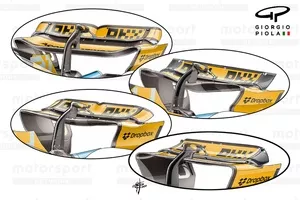
Alfa Romeo made extensive changes to its front wing at the Japanese Grand Prix as the team altered the distribution of the adjustable and non-adjustable section of the flaps.
The new design (left) had a much narrower inboard section, allowing for more of the flap to be adjustable and thus helping to provide more balance when making setup changes. The design of the endplate was also overhauled (insets), with the rearward cutout (blue arrow) discarded, as the ratio between each flap also changed (yellow highlight).
The nose and front wing of an Aston Martin AMR22 in the pit lane
Photo by: Lionel Ng / Motorsport Images
Aston Martin had one of the most transformative development cycles in 2022, as it switched aerodynamic concepts during the early part of the season. However, the front wing was relatively untouched throughout, with the team more or less resorting to different upper flap geometries as a means to trim the car front-to-rear.
Haas VF-22 front wing detail
Photo by: Giorgio Piola
Haas had some interesting ideas when it came to the design of its front wing endplate, as it adopted not only a wave-like finish to the leading edge but also added a wishbone-style diveplane.
Haas VF-22 front wing detail
Photo by: Giorgio Piola
Whilst the wave-like finish to the leading edge of the endplate was retained on the VF-22 and found its way into the Alpine design DNA, the wishbone-style diveplane was abandoned for a more simplistic, curved, diveplane at the French Grand Prix.
AlphaTauri AT03 nose detail
Photo by: Giorgio Piola
AlphaTauri made a significant change to its nose design at the Singapore Grand Prix, which worked hand-in-hand with the design of the inboard elements of the front wing too.
Its original design had the elements expose the underside of the nose to oncoming airflow, a design feature unique to it. However, the new design followed in the footsteps of its fellow competitors and saw the mainplane brought down the nose level.
AlphaTauri AT03 front wing comparison
Photo by: Giorgio Piola
This shot of the two solutions from the underside shows how it will have a very different effect on the airflow, as the mainplane is lower and forms a tip in the central section.
Williams FW44 front wing comparison
Photo by: Uncredited
Williams made wholesale changes to the FW44 at the British Grand Prix, along with the front wing. The changes revolved around the adjuster and flap pivot, as they exchanged places to help free up development of the surfaces around them to improve flow management.
Read Also:
- Why F1 teams can’t agree on the best sidepod solution
- Symonds to stay in F1 tech role for "a good while" after calling off retirement
- Miami plans F1 track resurfacing and new paddock, but no layout changes
We want your opinion!
What would you like to see on Motorsport.com?
Take our 5 minute survey.
- The Motorsport.com Team
Read and post comments
Read also :
Share Or Save This Story
Copy link
Share on Viber
Previous article Steiner: "A lot of margin" for F1 race control to improve after "nonsense" calls
Next article Russell sees no risk of Hamilton trouble even amid F1 title battle
Top Comments
There are no comments at the moment. Would you like to write one?
View More & Comment

More from
Matt Somerfield

Gallery: How F1 tech evolved during the 2024 season
Formula 1
Formula 1
Gallery: How F1 tech evolved during the 2024 season
How McLaren’s rear wing push changed the game in F1
Formula 1
Formula 1
How McLaren’s rear wing push changed the game in F1
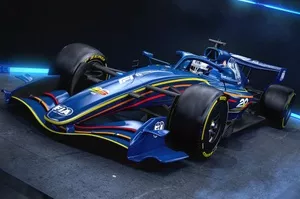
How 2026 F1 rules will help avoid identikit designs
Formula 1
Formula 1
How 2026 F1 rules will help avoid identikit designs
Latest news
Ducati says Aprilia “can do whatever they want” amid team order talks in MotoGP
MotoGP
MGP MotoGP
Australian GP
8 min
Ducati says Aprilia “can do whatever they want” amid team order talks in MotoGP

Why it's now Oliver Bearman versus Rafael Camara for the next Ferrari vacancy
Formula 1
F1 Formula 1
United States GP
29 min
Why it's now Oliver Bearman versus Rafael Camara for the next Ferrari vacancy
MotoGP Australian GP: Marco Bezzecchi leads Aprilia 1-2-4-5 in Friday Practice
MotoGP
MGP MotoGP
Australian GP
2 h
MotoGP Australian GP: Marco Bezzecchi leads Aprilia 1-2-4-5 in Friday Practice
Max Verstappen slams “unacceptable” bumps at Austin F1 track: “It's out of control”
Formula 1
F1 Formula 1
United States GP
10 h
Max Verstappen slams “unacceptable” bumps at Austin F1 track: “It's out of control”
Feature
Discover prime content




Subscribe and access Motorsport.com with your ad-blocker.
From Formula 1 to MotoGP we report straight from the paddock because we love our sport, just like you. In order to keep delivering our expert journalism, our website uses advertising. Still, we want to give you the opportunity to enjoy an ad-free and tracker-free website and to continue using your adblocker.
You have 2 options:
- Become a subscriber.
- Disable your adblocker.
Subscribe now Already subscribed? Sign in here
Already disabled your adblocker?
Reload page
Manage Alerts
Subscribe