Formula 1 Spanish GP
F1 Spanish GP analysis: Red Bull forced McLaren to unleash its full potential
While McLaren was in control during the first half of the race, Verstappen’s pace on a three-stop strategy meant it had to up the pace – showing that, despite protestations, there was still tyre performance in reserve
Gianluca D'Alessandro
Edited: Jun 3, 2025, 11:07 AM
Copy link
Share on Viber
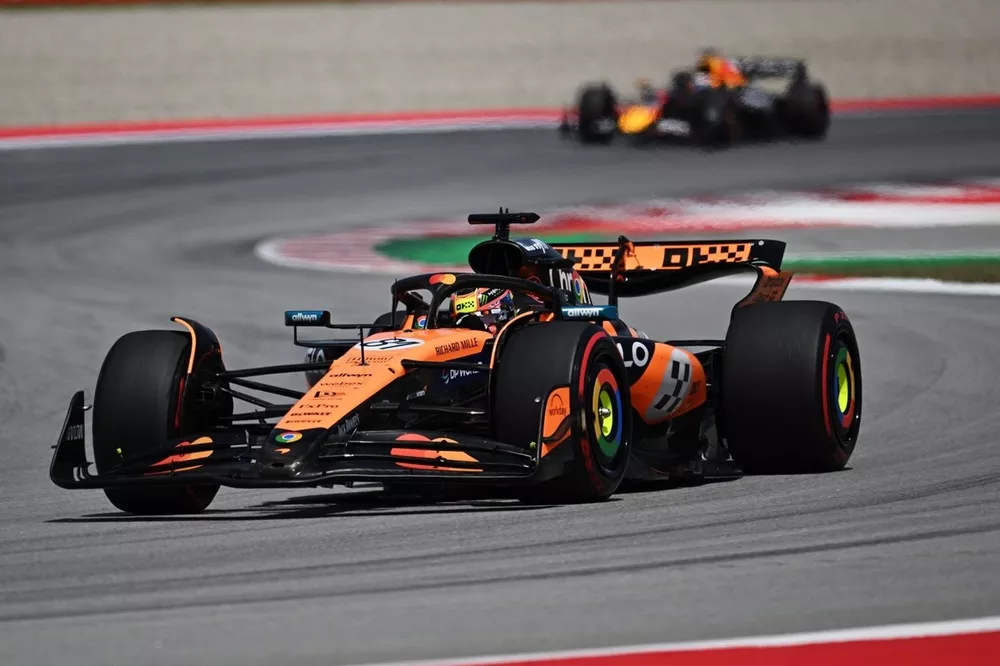
Oscar Piastri, McLaren, Max Verstappen, Red Bull Racing
Photo by: Sam Bagnall / Motorsport Images via Getty Images
Mynt
Bitcoin e criptomoedas? Invista na Mynt.com.br, a plataforma cripto do BTG Pactual
A high-degradation track with surface temperatures reaching nearly 50C laid the foundations for a Spanish Grand Prix race where tyre management would be crucial. Everything seemed set for a McLaren one-two finish, and the only way to spoil the papaya party was to act aggressively and brazenly – just as Red Bull did with its unexpected three-stop strategy.
This was aimed primarily at countering one of McLaren’s biggest strengths in Formula 1: tyre management over long stints. That’s why Red Bull saw the three-stop, all-out attack approach as the only viable option to try to challenge McLaren – and, indeed, at a certain point in the grand prix, it almost looked like it might work. Almost.
Red Bull decided early on to pursue a more aggressive tactic, especially after Lando Norris showed he had the pace to overtake Verstappen on track – a stark contrast from a year ago, when the Brit’s hesitation in overtaking was one of the key factors in the four-time world champion’s victory in 2024. It became clear this time around that something different was needed to put McLaren under pressure.
“Given how the race was unfolding, we chose to make three stops. We made that decision fairly early because we saw that in a direct battle it wouldn’t be possible to counter the pace and tyre-management advantage McLaren had,” said Horner at the end of the race.
Looking at recent races, it's often been apparent how Verstappen tries to keep up with the McLarens early on, only to eventually have no answer to the MCL39’s superior tyre management. It was precisely this aspect Red Bull focused on in building its strategy, setting up an attacking race – made possible also by the effectiveness of the soft tyre in Barcelona, which proved to be the best compound of the weekend.
That may sound counter-intuitive but the hardest compound, the C1, was nowhere: sliding all over the place because it couldn’t find mechanical grip, even though the surface here is relatively rough.
Red Bull was trying to attack on pure speed versus tyre-management capability, a possibility here because the track layout theoretically favoured the RB21’s performance characteristics, with plenty of long, fast corners. Clearly, the three-stop approach also came with its downsides: primarily, the extra 22 seconds or so spent visiting the pits a third time; secondly, traffic, which always forces drivers to use their tyres more than they’d like.
Lando Norris, McLaren, Max Verstappen, Red Bull Racing
Photo by: Andy Hone / Motorsport Images
On this front, during the second pitstop – when Verstappen switched to the medium tires – Red Bull made a very smart decision, carefully monitoring the gap to Lewis Hamilton to ensure Max would rejoin ahead of him, while also trying to push and extend his stint. And this is exactly when the race got interesting.
In the early stints, McLaren was always keeping an eye on how its rival was doing, without ever really feeling under threat. However, when Verstappen switched to mediums and started pushing, closing in on the window for a potential undercut, the Woking pitwall had to start seriously thinking about how to protect its position.
“When we saw that Max was on a three-stop strategy, we thought it wouldn’t be a problem, because we had already overtaken him on track,” explained McLaren team principal Andrea Stella. “And we were supposed to have a good pace advantage.
“But the reality is, he was fast. When we switched to mediums, we were pushing while controlling the pace, but Max was gaining much faster than we expected.
“At one point, we even told our drivers they would have to push more. And both of them responded with something like: ‘I’m not sure I have much more pace than this.’ At that point, we were a little concerned that the situation might be more open than we had anticipated during the first stint.
“It could have become complicated for us, because we had Oscar and Lando separated by about 2.5 seconds or so. So if we had needed to cover Verstappen, it would have been a bit tricky with the two of them that close. But, luckily, Oscar found quite a bit of pace at the end of the second stint.”
Indeed, looking at Piastri’s pace during the second stint, there is a clear shift in speed once the team told him to push: from lap 24 to lap 42, he averaged a 1m20.0s, but in the last six or seven laps of the stint – despite already having about 20 laps on those tyres – his average improved by nearly half a second.
Oscar Piastri, McLaren
Photo by: Sam Bloxham / Motorsport Images via Getty Images
This is clear sign McLaren’s car still had something in reserve. It’s evident the MCL39 couldn’t maintain that pace for an entire stint but, when it really mattered, Piastri showed there was still a clear margin available, unleashing the car’s true potential to hold off Verstappen’s charge.
But where does this difference in pace come from? Already on Friday, there was talk of the MCL39 being somewhat ‘weak’ at the front – and it's no surprise that for much of the second stint, McLaren tried not to overstress the front-left tyre, particularly in Turn 3 and other high-speed corners.
When Piastri’s race engineer, Tom Stallard, told there was room to push in Turn 3 – one of the key stress points for the front-left – the full potential of the MCL39 came to light, with Piastri quickly dropping his lap times by several tenths. It was a necessary change of pace, especially since the Australian had just completed the lapping phase.
Piastri, also benefiting from the advantage he had built over Norris in the first stint, managed his tires excellently during the early part of the race's second half, specifically preserving the front-left. It's no coincidence that Lando, who had pushed harder in the earlier phases, didn’t show the same shift in pace and struggled with more understeer in Turn 3 – so much so that he thought he was experiencing graining.
This often occurs when tyres are under high thermal stress and cornering loads, but it is a phenomenon Pirelli has tried to dial out of the current compounds. It wasn’t a problem here for anyone – it just felt that way to Norris because his front-left was experiencing wear.
While Piastri pulled away at the front, opening up the gap, the one between Verstappen and Norris stabilised, with Red Bull trying to play its final card: pitting early for the third stop to attempt an undercut and try to take the position on track – even if that meant doing more laps on the same compound. It was a move that McLaren immediately covered off by bringing in Norris.
Of course, McLaren could do this because it’s currently two against one at the head of the field – a problem Red Bull also needs to address…
Read Also:
We want your opinion!
What would you like to see on Motorsport.com?
Take our 5 minute survey.
- The Motorsport.com Team
Read and post comments
Read also :
Share Or Save This Story
Copy link
Share on Viber
Previous article Sauber's "pinch yourself moment" after Nico Hulkenberg beats Lewis Hamilton's Ferrari
Next article When anger and desperation take over: F1’s most controversial clashes
Top Comments
There are no comments at the moment. Would you like to write one?
View More & Comment

More from
Gianluca D'Alessandro

The Pirelli test row shows why MotoGP riders need a stronger voice
MotoGP
MotoGP
The Pirelli test row shows why MotoGP riders need a stronger voice
Mercedes reveals the "secret code" tactic behind Kimi Antonelli's Madrid-winning VSC call
Formula 1
Formula 1
Spanish GP
Mercedes reveals the "secret code" tactic behind Kimi Antonelli's Madrid-winning VSC call

More from
Red Bull Racing
"Just undriveable" – Isack Hadjar looking for answers after "massive" struggles in Austin practice
Formula 1
Formula 1
United States GP
15 h
"Just undriveable" – Isack Hadjar looking for answers after "massive" struggles in Austin practice
Red Bull identifies two "key focus" areas after Max Verstappen's promising start in Austin
Formula 1
Formula 1
United States GP
17 h
Red Bull identifies two "key focus" areas after Max Verstappen's promising start in Austin
Latest news
2026 MotoGP Australian Grand Prix – How to watch, session times & more
MotoGP
MGP MotoGP
Indonesian GP
7 min
2026 MotoGP Australian Grand Prix – How to watch, session times & more
There will be even less drag in Cup cars at Talladega on Sunday
NASCAR Cup
NAS NASCAR Cup
Talladega II
10 min
There will be even less drag in Cup cars at Talladega on Sunday
Kimi Antonelli delivers Austin surprise pole in tricky Mercedes: "Finally we're seeing the results"
Formula 1
F1 Formula 1
United States GP
1 h
Kimi Antonelli delivers Austin surprise pole in tricky Mercedes: "Finally we're seeing the results"
Why Ferrari failed to deliver on its hype in F1's United States GP qualifying
Formula 1
F1 Formula 1
United States GP
1 h
Why Ferrari failed to deliver on its hype in F1's United States GP qualifying
Feature
Discover prime content

Subscribe and access Motorsport.com with your ad-blocker.
From Formula 1 to MotoGP we report straight from the paddock because we love our sport, just like you. In order to keep delivering our expert journalism, our website uses advertising. Still, we want to give you the opportunity to enjoy an ad-free and tracker-free website and to continue using your adblocker.
You have 2 options:
- Become a subscriber.
- Disable your adblocker.
Subscribe now Already subscribed? Sign in here
Already disabled your adblocker?
Reload page
Manage Alerts
Subscribe