Formula 1 Hungarian GP
Ferrari explains reasons behind Leclerc’s doomed F1 hard tyre switch
Ferrari has explained why it opted to put Charles Leclerc on hard tyres during Sunday's Formula 1 Hungarian Grand Prix, sparking his fall from fighting for victory to finishing sixth.

Luke Smith
Edited: Aug 1, 2022, 12:14 PM
Copy link
Share on Viber
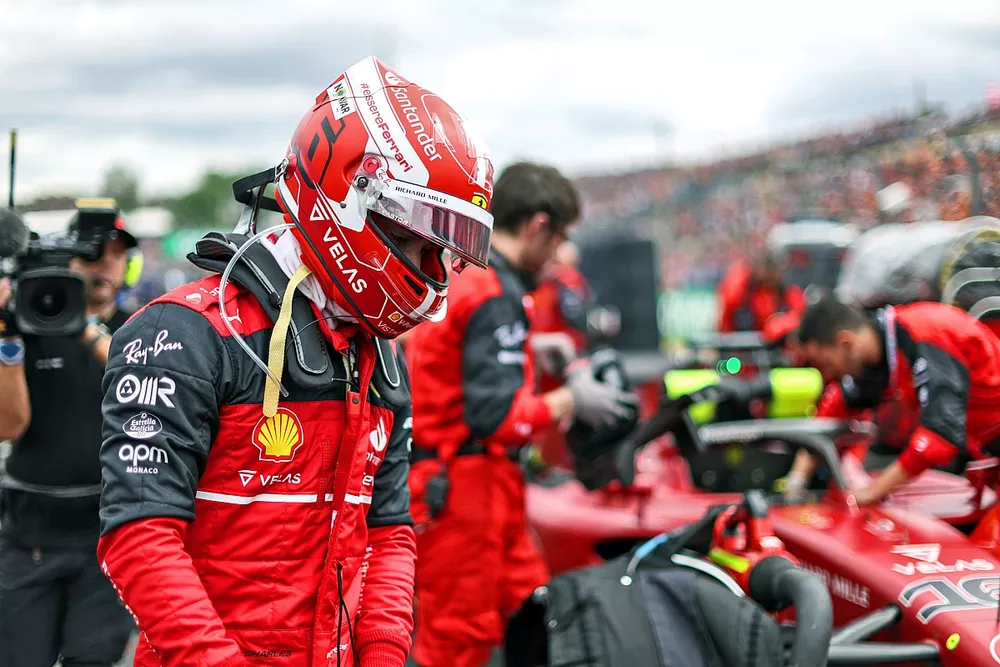
Leclerc started on medium compound tyres at the Hungaroring and spent the opening stint running third, only to jump teammate Carlos Sainz for second place by getting the overcut at the first round of pitstops.
With a five-lap tyre delta, Leclerc managed to catch race leader George Russell and pass him for P1 before opening up a three-second gap at the head of the field.
But when Ferrari brought Leclerc into the pits at the end of lap 39, the team decided to fit hard tyres that struggled to get up to temperature in the cold conditions.
It led to Leclerc quickly being overtaken twice by title rival Max Verstappen, who had started 10th, before losing more and more time as the stint wore on. He was eventually brought in just 15 laps later for a third stop before ultimately finishing sixth.
Ferrari F1 boss Mattia Binotto revealed the team's simulations said that while the hards would be tricky to get up to temperature early on, they were predicted to be the better tyre for the final stint.
"When we fitted the hard, our simulation was that it could have been a difficult couple of laps of warm-up," Binotto explained. "It would have been slower to the medium for 10-11 laps, and then it would have come back and been faster than the end of the stint, and it was a 30-lap stint.
"We were trying to protect position on Max. It would have been too long certainly for the softs. Yes, it would have been difficult at the start of the stint, but it would have come back by the end."
Carlos Sainz, Ferrari F1-75, Charles Leclerc, Ferrari F1-75
Photo by: Mark Sutton / Motorsport Images
Leclerc said after the race that he wanted to hold on to the medium tyres for as long as possible, only to be called it for the hards. He was moved onto softs at his third stop, but could not catch the cars ahead.
The P6 finish means Leclerc now sits 80 points behind Verstappen at the top of the drivers' championship heading into the summer break.
A number of drivers struggled with the hard tyres due to the unusually cool conditions during the race, including Alpine's Fernando Alonso and Esteban Ocon, both of whom lost time during the early part of their stints.
Asked if Ferrari had seen what Alpine's hard tyre struggles and considered not pitting to cover Verstappen, Binotto replied: "Yes, we discussed it, so it's not that [the strategy] is all written in stone.
"During the race and looking at what's going on, we have as well looked at what was happening with the other hard tyres.
"We took all considerations, we discussed what would have been best and that's the choice that we made. It certainly was not the right one today."
Read Also:
- Leclerc says he can't understand Ferrari strategy in Hungarian GP
- Verstappen explains 360º spin during "crazy" Hungary F1 race
- Hamilton "would've been in run for win" in Hungarian GP without qualifying issue
But Binotto stressed the bigger issue for Ferrari on Sunday was the car's lack of pace compared to what it saw on Friday, when Leclerc had set the fastest time and impressed over the long runs.
"It's important to say that we believe that the car was not working as expected," Binotto said. "We didn't have the speed we were hoping for looking back at the Friday, and the pace we had in the race conditions on Friday. So today was certainly different conditions, a lot cooler.
"But overall the speed today was not great enough, and whatever tyres we were using, I don't think we were as good as we were looking for."
Read Also:
- F1 race results: Max Verstappen wins wild Hungarian GP
- 2022 F1 World Championship standings after the Hungarian GP
We want your opinion!
What would you like to see on Motorsport.com?
Take our 5 minute survey.
- The Motorsport.com Team
Read and post comments
Read also :
Share Or Save This Story
Copy link
Share on Viber
Previous article Red Bull planned to start Hungarian GP on hard F1 tyres
Next article Russell "rubbing hands together" with rain forecast in Hungarian GP
Top Comments
There are no comments at the moment. Would you like to write one?
View More & Comment

More from
Luke Smith
1998 Belgian GP: When the Schumachers went to war
Formula 1
Formula 1
1998 Belgian GP: When the Schumachers went to war

The race that transformed perceptions of Red Bull
Formula 1
Formula 1
The race that transformed perceptions of Red Bull

Hamilton in the process of selecting Brad Pitt’s co-star for F1 movie
Formula 1
Formula 1
Hamilton in the process of selecting Brad Pitt’s co-star for F1 movie
Latest news
Max Verstappen slams “unacceptable” bumps at Austin F1 track: “It's out of control”
Formula 1
F1 Formula 1
United States GP
3 h
Max Verstappen slams “unacceptable” bumps at Austin F1 track: “It's out of control”

Kimi Antonelli ready to "finish the job" as first F1 title chance beckons at US GP
Formula 1
F1 Formula 1
United States GP
4 h
Kimi Antonelli ready to "finish the job" as first F1 title chance beckons at US GP

How to watch NASCAR at Talladega II: Weekend schedule, start time, entry list, TV
NASCAR Cup
NAS NASCAR Cup
Talladega II
4 h
How to watch NASCAR at Talladega II: Weekend schedule, start time, entry list, TV
Peterson Racing addresses online abuse after parting ways with Austin Green
NASCAR O'Reilly
NOAP NASCAR O'Reilly
Talladega II
4 h
Peterson Racing addresses online abuse after parting ways with Austin Green
Feature
Discover prime content


Subscribe and access Motorsport.com with your ad-blocker.
From Formula 1 to MotoGP we report straight from the paddock because we love our sport, just like you. In order to keep delivering our expert journalism, our website uses advertising. Still, we want to give you the opportunity to enjoy an ad-free and tracker-free website and to continue using your adblocker.
You have 2 options:
- Become a subscriber.
- Disable your adblocker.
Subscribe now Already subscribed? Sign in here
Already disabled your adblocker?
Reload page
Manage Alerts
Subscribe