Formula 1
FIA says F1 2026 low-drag 'X-mode' will be driver-activated
The FIA has allayed concerns from Formula 1 teams about the activation process of its active aerodynamics package, and expects to use similar parameters to current DRS.

Jake Boxall-Legge
Edited: Jun 9, 2024, 9:51 AM
Copy link
Share on Viber

Key outlines for the 2026 F1 rules were released to the media on Thursday, although it became apparent that multiple F1 teams were concerned about certain aspects of the draft regulations, particularly those governing the application of active aero.
It was initially unclear whether the X-mode activation, where the car's front and rear wings enter a lower-drag state in defined straights, would be driver-controlled or automatically applied during the course of a race.
In a media conference on Saturday, FIA single-seater technical director Jan Monchaux explained that it would be logical to assume the same method of application as is currently used with DRS, where it is applied by the driver through a button on the steering wheel.
"All that is currently still in discussion with the teams. So it's not like we have fully described all the detail of how and when you activate," explained Monchaux.
"The general line we will follow is similar to the DRS. So the DRS, you need to tick the box in terms of distance or lap time distance to the car in front of you at a given point, and then the driver can deploy.
"But it's a driver that pushes a button and deploys the DRS, and also closing it. We think the approach for the X-Mode would be exactly the same.
"Some conditions are being fulfilled, like very low or no lateral acceleration, so effectively exiting the corner. If these conditions are ticked off, the driver will press [the button] and it's not going to be automated.
"Then his DRS and the front wing will open up to go in the low drag. Shortly before arriving on the braking zone, they will deactivate it. And if not, it will make sure it does deactivate."
Active aero F1 2026
Photo by: FIA
Monchaux explained the safety implications will also carry over from the introduction of DRS, and that the FIA will take a "rigorous" approach to ensure that there are minimal risks introduced by their application.
With top speeds expected to rise considerably thanks to the reduced drag produced by the X-mode, it needs to be guaranteed that a driver will not be stuck in that mode when it comes to braking for corners.
Otherwise, this could result in drivers being unable to slow down from 350km/h-plus speeds, and yield high-speed accidents as a consequence.
"The approach on failure analysis the system could be subject to, it will be subject to the same approach that back in the day was done with the DRS," the former Sauber technical director stated.
"And we'll just have the same extremely rigorous approach, making sure that the system, once deployed the first time during the winter test, will be just doing what it's supposed to do and not subject to constant reliability issues or even worse, safety.
"That a few teams might have a few hiccups in the first winter test is to be expected, but I genuinely think the experience gained over the years on the DRS should be perfectly transferable on the front.
"Therefore, the system will not be a huge challenge for the teams in terms of 'can we get it to work' and 'can we get it to work safely, reliably,' because it's going to be almost on every straight line. This we are not too worried about."
Read Also:
Formula 1Are the proposed rules for 2026 putting the DNA of F1 at risk?
Formula 1F1 team bosses to meet amid 2026 rules concern
Formula 1McLaren concerned F1 2026 cars could be too slow in corners, too fast on straights

We want your opinion!
What would you like to see on Motorsport.com?
Take our 5 minute survey.
- The Motorsport.com Team
Read and post comments
Read also :
Share Or Save This Story
Copy link
Share on Viber
Previous article The F1 rule that gave pole to Russell over Verstappen after setting the same time
Next article Alonso: It "hurts" to lose Canada F1 pole chance in one corner
Top Comments
There are no comments at the moment. Would you like to write one?
View More & Comment

More from
Jake Boxall-Legge
Isack Hadjar to make Red Bull return at F1 Azerbaijan GP
Formula 1
Formula 1
Azerbaijan GP
Isack Hadjar to make Red Bull return at F1 Azerbaijan GP

F1 Monaco GP: Kimi Antonelli takes dominant win in non-score for George Russell
Formula 1
Formula 1
Monaco GP
F1 Monaco GP: Kimi Antonelli takes dominant win in non-score for George Russell

Latest news
"Just undriveable" – Isack Hadjar looking for answers after "massive" struggles in Austin practice
Formula 1
F1 Formula 1
United States GP
31 min
"Just undriveable" – Isack Hadjar looking for answers after "massive" struggles in Austin practice
Maverick Vinales: “If I stay at home, I don’t get paid”
MotoGP
MGP MotoGP
Australian GP
1 h
Maverick Vinales: “If I stay at home, I don’t get paid”
The unexpected problem Honda encountered despite its second F1 power unit upgrade
Formula 1
F1 Formula 1
United States GP
1 h
The unexpected problem Honda encountered despite its second F1 power unit upgrade
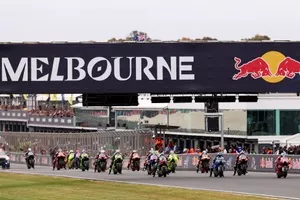
MotoGP Australian GP: Full starting grid as four riders forced out of Phillip Island race
MotoGP
MGP MotoGP
Australian GP
1 h
MotoGP Australian GP: Full starting grid as four riders forced out of Phillip Island race
Feature
Discover prime content




Subscribe and access Motorsport.com with your ad-blocker.
From Formula 1 to MotoGP we report straight from the paddock because we love our sport, just like you. In order to keep delivering our expert journalism, our website uses advertising. Still, we want to give you the opportunity to enjoy an ad-free and tracker-free website and to continue using your adblocker.
You have 2 options:
- Become a subscriber.
- Disable your adblocker.
Subscribe now Already subscribed? Sign in here
Already disabled your adblocker?
Reload page
Manage Alerts
Subscribe