Formula 1 Abu Dhabi GP
FIA to use AI to improve policing of F1 track limits
The FIA has revealed plans to use Artificial Intelligence to better police track limits in Formula 1, with trials of new technology taking place in Abu Dhabi this weekend.

Jonathan Noble
Edited: Nov 24, 2023, 9:05 AM
Copy link
Share on Viber
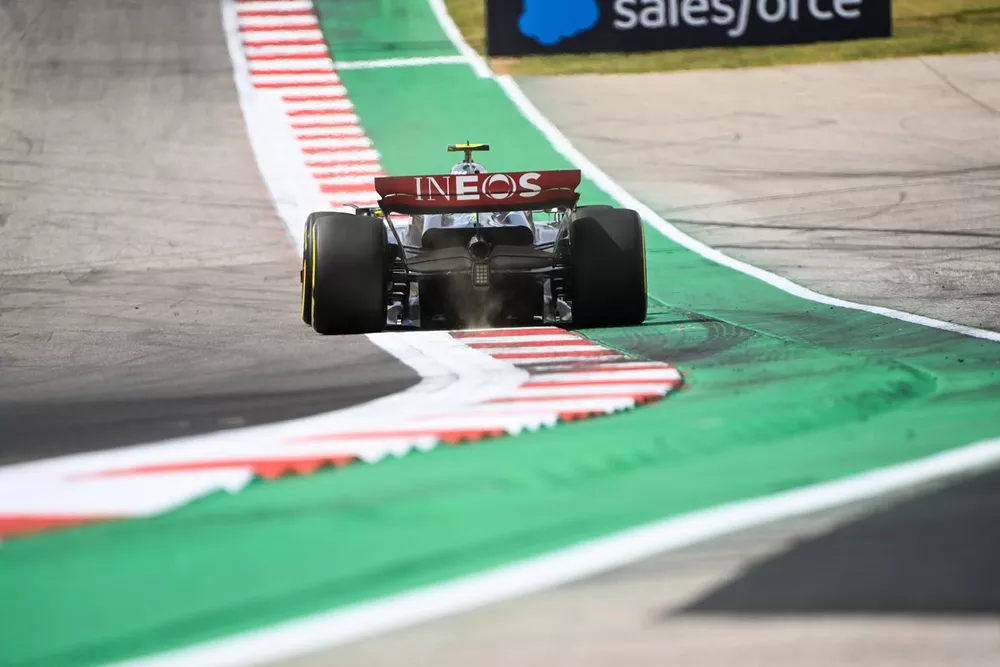
As part of a bid to improve the speed by which track limit checks are processed, the FIA is to introduce what is known as 'Computer Vision', a programme that uses shape analysis.
The idea is that this will be used to judge pixels on a video feed to better judge when cars have breached track limits.
The FIA believes that the technology will allow it to be far more effective in narrowing down the number of incidents that require final checks by a human.
The use of the AI system should mean fewer track-limit incidents have to be processed by the FIA's Remote Operations Centre (ROC), which should result in far less time being taken between a breach being reported and it being ruled on.
Tim Malyon, the head of the ROC, said that the use of AI was more about using the system to dismiss those incidents that did not need a human to judge them.
"At the moment we've 'brute forced' the situation by saying 'we need to make thousands of checks, how do we do that?" he said in an FIA preview.
"Well, we throw people at it, because that's the most accurate solution. What we're looking to do now is introduce a level above ROC, and that's AI software.
"Again, it might sound strange but the methodology with this AI has a lot of parallels with discussions going on in medicine at the moment and the use of Computer Vision, for example, to scan data from cancer screening.
Photo by: Andy Hone / Motorsport Images
Esteban Ocon, Alpine A523, Daniel Ricciardo, AlphaTauri AT04, Fernando Alonso, Aston Martin AMR23, Lance Stroll, Aston Martin AMR23, Zhou Guanyu, Alfa Romeo C43, at the start
"What they've concluded is they don't want to use the Computer Vision to diagnose cancer, what they want to do is to use it to throw out the 80% of cases where there clearly is no cancer in order to give the well-trained people more time to look at the 20%. And that's what we are targeting."
Malyon explained that the ambition was to reduce the current 800 reports that can be anticipated from a grand prix down to 50, which will be much easier for FIA staff to process.
As part of its efforts to introduce the new systems, the FIA is trialling the use of Computer Vision in Abu Dhabi this weekend alongside new systems aimed to provide improved accuracy for car location.
Single-Seater Head of Information Systems Strategy Chris Bentley said that the FIA had brought in a system called Catapult, which uses receivers to provide accurate locations.
"There are examples in NFL where they can identify every player on the pitch, even if they're in a big huddle," he said.
"We can also use that technology on our live feeds. That will be the same as the new tool, and then we will be able to draw the 'lines of interest'. And then the AI would learn as it goes along."
Malyon added: "What we're trying to do for the future is improve all of that technology and deploy new ones.
"Car positioning continues to be developed to improve accuracy. We're also planning to double the size of the ROC in terms of the number of people going from four to eight, next year, and we will double the connection bandwidth between the track and Geneva to facilitate more people working remotely."
Malyon said that one of the key lessons from track limit problems that emerged in Austria this year was that the best resource for checking breaches was not actually using technology to alert the FIA of breaches.
Instead, it was the human eye, which was more effective than data provided by car detection systems or timing loop analysis.
"We basically concluded that the loops were insufficiently accurate, and that by far, our most accurate solution was having a data analyst looking at the video itself," he said.
"In fact, that's an interesting element of the story as currently, through loop positioning, through GPS positioning etc, the human still wins."
Bentley added: "We've turned off loops now for every circuit unless there's a chicane, because it just gets in the way of what we're trying to achieve. And ultimately the rule of thumb is that if it's too close to call, then the benefit of the doubt goes with the driver."
Read Also:
Formula 1How Las Vegas thriller exposed the real enemy of racing in Formula 1
Formula 1F1 to test automatic rain light solution in Abu Dhabi
We want your opinion!
What would you like to see on Motorsport.com?
Take our 5 minute survey.
- The Motorsport.com Team
Read and post comments
Read also :
Share Or Save This Story
Copy link
Share on Viber
Previous article Leclerc: Las Vegas form has not lifted confidence for Abu Dhabi
Next article Wolff, Vasseur handed warning by F1 stewards for bad language at Las Vegas GP
Top Comments
There are no comments at the moment. Would you like to write one?
View More & Comment

More from
Jonathan Noble

Brundle awarded OBE in King’s New Year’s honours
Formula 1
Formula 1
Brundle awarded OBE in King’s New Year’s honours
The new rules dilemma that will define the 2025 F1 season
Formula 1
Formula 1
The new rules dilemma that will define the 2025 F1 season
Verstappen issues Red Bull title warning in push for RB21 progress
Formula 1
Formula 1
Australian GP
Verstappen issues Red Bull title warning in push for RB21 progress
Latest news
Spire, Chris Gabehart reject Joe Gibbs Racing premise on deleted texts
NASCAR Cup
NAS NASCAR Cup
Charlotte II
2 h
Spire, Chris Gabehart reject Joe Gibbs Racing premise on deleted texts
Ricky Stenhouse explains his side of Michael McDowell conflict
NASCAR Cup
NAS NASCAR Cup
Charlotte II
5 h
Ricky Stenhouse explains his side of Michael McDowell conflict
Barnes: Why IndyCar’s updated licensing system fails its own integrity test
IndyCar
Indy IndyCar 7 h
Barnes: Why IndyCar’s updated licensing system fails its own integrity test
Why NASCAR is not penalizing Stenhouse, McDowell for post-race theatrics
NASCAR Cup
NAS NASCAR Cup
Charlotte II
8 h
Why NASCAR is not penalizing Stenhouse, McDowell for post-race theatrics
Feature
Discover prime content


Subscribe and access Motorsport.com with your ad-blocker.
From Formula 1 to MotoGP we report straight from the paddock because we love our sport, just like you. In order to keep delivering our expert journalism, our website uses advertising. Still, we want to give you the opportunity to enjoy an ad-free and tracker-free website and to continue using your adblocker.
You have 2 options:
- Become a subscriber.
- Disable your adblocker.
Subscribe now Already subscribed? Sign in here
Already disabled your adblocker?
Reload page
Manage Alerts
Subscribe