Formula 1 British GP
How Charles Leclerc has changed his steering wheel software for the first time since joining Ferrari
For the first time since joining Ferrari in 2019, Leclerc has overhauled the software of his steering wheel, abandoning the block‑style layout used until last season

Gianluca D'Alessandro
Published: Jul 8, 2026, 2:52 PM
Copy link
Share on Viber
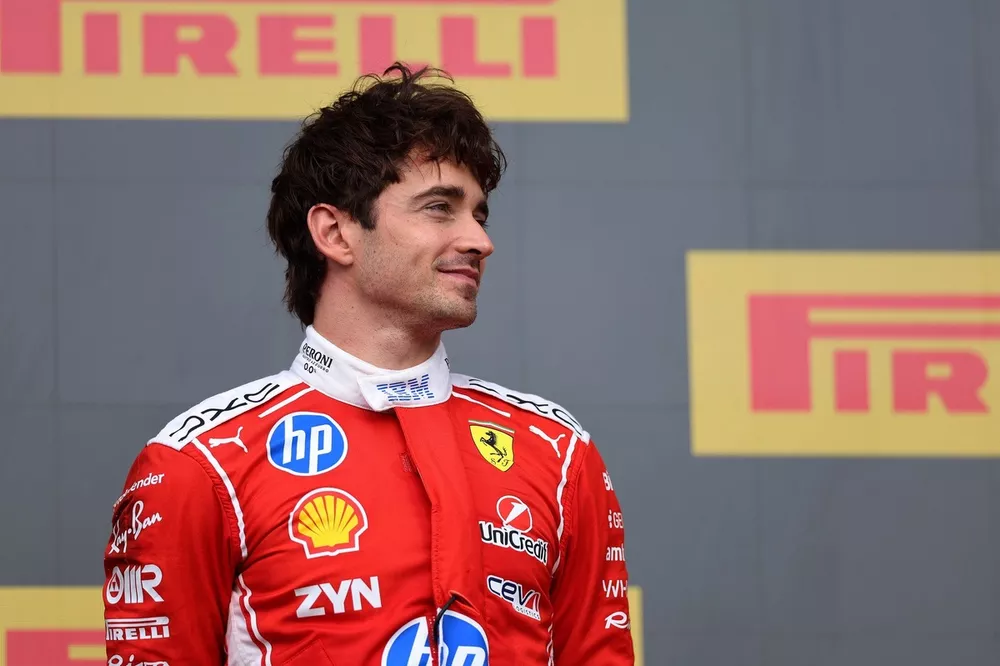
Charles Leclerc, Ferrari
Photo by: Alastair Staley / LAT Images via Getty Images
Last weekend’s British Grand Prix victory was almost a moment of relief for Charles Leclerc, who had been looking for answers to the set-up changes introduced after the sprint in an effort to regain the feeling he had lost with the SF‑26. It is a win that carries a far deeper meaning than his smile on the podium suggests, as his gaze settles on a trophy almost weighted by the difficult weeks now behind him.
This has been the year of a technical revolution, and adapting to the new regulations has been anything but straightforward, even for the drivers themselves. Approaching the mid‑season mark, the new rules continue to impose driving dynamics that feel almost unnatural, such as lifting off before the finish line to manage electrical power, just as Mercedes did at Silverstone.
It has been a season of changes, and when it comes to Leclerc there is one underlying topic that, while flying somewhat under the radar, remains intriguing: his shift in approach to the steering‑wheel software. This marks a significant revolution, because from his first year at Ferrari until the end of last season Leclerc had always kept the exact same configuration, aside from minimal adjustments.
The configuration, even back then, set him clearly apart from Sebastian Vettel and from the driver who preceded him in that seat, Kimi Raikkonen. While the four-time world champion preferred having as much information as possible on the screen in a highly condensed layout, Leclerc had already opted in 2019 for a clean and immediate display, featuring large, easily readable and direct data.
This was a layout the Monegasque maintained until the end of 2025 and one that was also adopted by Carlos Sainz during his years at Maranello, with only minimal tweaks to adjust the arrangement of certain elements according to his preferences. Unlike other teams, Ferrari grants its drivers a certain degree of freedom to find a solution truly tailored to their needs and preferences. Lewis Hamilton has pushed to have a version similar to the one he used for so many years at Mercedes, also requesting changes to the steering wheel itself.
Leclerc's new steering wheel software 2025 vs 2026
Photo by: Motorsport.com
Yet Leclerc’s case is particularly interesting because it represents his first truly substantial modification since becoming a Scuderia driver in 2019. Of course, one might assume this was a necessity dictated by the new regulations, but that is not exactly the case: most teams, aside from minor adjustments, have maintained a very similar layout to that of the previous technical cycle, both in terms of software and the steering wheel itself.
Unsurprisingly, Hamilton has also kept a steering wheel layout very close to the one he used last year with the old hybrid power units, adding only a few elements such as real-time management of the MGU-K. In Leclerc’s case, however, the 2026 revolution seems to have been, above all, an opportunity to rework his software, which is now profoundly different from the past.
A new data layout and the MGU-K indicator
The first major change concerns the layout of the information. While until last year the data was presented in a clear and highly visible manner, it has now been completely reorganised: many parameters, such as speed, engine RPM, completed and remaining laps, or brake balance, have been moved to the left inside small boxes.
This rearrangement has freed up space in the centre for tyre temperatures (shown compared to a reference value) and brake temperatures, which until the end of last season were accessible using buttons in a secondary page, while also prominently displaying the current gear and selected engine mode, adjustable via the central rotary switch on the steering wheel. For 2026, however, there are two other highly intriguing additions.
As Motorsport.com highlighted at the beginning of 2026 when looking at the McLaren’s steering wheel, Ferrari has also introduced a vertical sidebar on the right side of the screen, which clearly shows the driver how the MGU‑K is operating. When the bar extends upwards, the MGU‑K is active, deploying energy to the system. When the bar moves downwards and turns red, such as under braking or at the end of straights during superclipping, the MGU‑K is in harvest mode, recovering energy.
Leclerc softtware MGU-K usage
Photo by: Motorsport.com
The system that indicates to the driver how long he can use the boost (which allows him to attack or defend by briefly increasing the electrical power output) has also been changed. There are now five small red dots that help the driver track how long they can activate it, given that the boost tends to use a big amount of energy in just a few seconds.
There is a specific turbo indicator for race starts
It is fair to say that the race start also played a decisive role in the Silverstone victory. Ferrari’s technical choices and the optimisation of its electronics have made the SF‑26 one of the most effective cars off the line since the Melbourne opener, crucially ensuring consistent performance in a phase where many rivals have struggled.
Without the support of the MGU‑H and with the electric motor restricted from deploying below 50 km/h, spooling the turbo and bringing it into its proper RPM range has become significantly more complex this year. To increase safety and help those manufacturers struggling on this front. But how do drivers know when the turbo is ready and has reached its optimal operational RPM range?
While each team has its own method, Ferrari uses a progressive indicator coded both with a percentage scale up to 100% and a three‑color system (red, white, and green, with green indicating that the turbo is ready). It is a simple feature, but a crucial one nonetheless, ensuring the driver always knows whether the system is in the correct range ahead of the launch, especially given how vital this aspect has become this year.
Leclerc's new steering wheel software for a race start
Photo by: Motorsport.com
We want your opinion!
What would you like to see on Motorsport.com?
Take our 5 minute survey.
- The Motorsport.com Team
Read and post comments
Read also :
Share Or Save This Story
Copy link
Share on Viber
Previous article George Russell explains mindset after tough start to 2026 F1 campaign
Next article Why Red Bull and Max Verstappen struggled at Silverstone – and expect the same at Spa
Top Comments
There are no comments at the moment. Would you like to write one?
View More & Comment
More from
Gianluca D'Alessandro
The Pirelli test row shows why MotoGP riders need a stronger voice
MotoGP
MotoGP
The Pirelli test row shows why MotoGP riders need a stronger voice
Mercedes reveals the "secret code" tactic behind Kimi Antonelli's Madrid-winning VSC call
Formula 1
Formula 1
Spanish GP
Mercedes reveals the "secret code" tactic behind Kimi Antonelli's Madrid-winning VSC call

More from
Charles Leclerc
Why Ferrari failed to deliver on its hype in F1's United States GP qualifying
Formula 1
Formula 1
United States GP
8 h
Why Ferrari failed to deliver on its hype in F1's United States GP qualifying
F1 United States GP: Sunday schedule, weather forecast and how to watch
Formula 1
Formula 1
United States GP
10 h
F1 United States GP: Sunday schedule, weather forecast and how to watch

More from
Ferrari
F1 United States GP: Lewis Hamilton pips Max Verstappen in FP3
Formula 1
Formula 1
United States GP
14 h
F1 United States GP: Lewis Hamilton pips Max Verstappen in FP3
F1 United States GP: Charles Leclerc completes perfect Friday by topping FP2
Formula 1
Formula 1
United States GP
F1 United States GP: Charles Leclerc completes perfect Friday by topping FP2

Latest news
Supercars Gold Coast: Broc Feeney converts Race 2 pole to win after Saturday defeat
Supercars
SUPC Supercars
Gold Coast 500
38 min
Supercars Gold Coast: Broc Feeney converts Race 2 pole to win after Saturday defeat
Marc Marquez: Track conditions were “acceptable” despite Australian GP cancellation
MotoGP
MGP MotoGP
Australian GP
58 min
Marc Marquez: Track conditions were “acceptable” despite Australian GP cancellation
Aprilia unsure whether Australian GP cancellation good or bad for the team
MotoGP
MGP MotoGP
Australian GP
1 h
Aprilia unsure whether Australian GP cancellation good or bad for the team
How the seven NASCAR Cup title contenders perform at Talladega
NASCAR Cup
NAS NASCAR Cup
Talladega II
1 h
How the seven NASCAR Cup title contenders perform at Talladega
Feature
Discover prime content

Subscribe and access Motorsport.com with your ad-blocker.
From Formula 1 to MotoGP we report straight from the paddock because we love our sport, just like you. In order to keep delivering our expert journalism, our website uses advertising. Still, we want to give you the opportunity to enjoy an ad-free and tracker-free website and to continue using your adblocker.
You have 2 options:
- Become a subscriber.
- Disable your adblocker.
Subscribe now Already subscribed? Sign in here
Already disabled your adblocker?
Reload page
Manage Alerts
Subscribe