Feature
Formula 1
Opinion
How F1’s rules got to be so complex
The overly complicated and interminable regulations that govern F1 trammel creativity and confuse fans in equal measure

Pat Symonds
Published: Nov 6, 2026, 9:51 AM
Copy link

Share on Viber
This month I am combining two questions from readers. Steve Butler has asked whether we will ever get to a set of regulations that will enable teams to arrive at different solutions, and Darren Faraway asks what might be the ideal dimensions for a Formula 1 car to enable good racing.
There is no doubt that the current regulations are amazingly prescriptive compared to those of 50 years ago. In the 1970s the regulations governing what was then called, rather archaically, ‘coachwork’ were just a paragraph. Even by 1982, when we were well into ground effect, flexible skirts and trick suspensions, the rules governing the overall shape of the car and the aerodynamic performance were just 496 words.
Article 3 of the 2027 regulations, which governs aerodynamics and therefore the basic shape of the car, runs to 51 pages and 17,711 words. If this were not bad enough, there are three pages that just define the conventions by which the dimensions are established and the fundamental dimensions such as the width, height and wheelbase of the car.
It doesn’t even end there. A further 15 pages define what are termed ‘Regulation Volumes’. These are the volumes defined within the overall dimensions of the car in which, in some cases, you must have bodywork and conversely volumes in which you are not allowed to have bodywork.
This level of detail has two effects. Firstly, it makes it impossible for fans to understand the regulations. Even those of us involved in the sport cannot picture all the shapes involved without having a CAD screen in front of us. Secondly, it gives a level of prescription that leaves very little room for innovation or even the ability to differentiate designs.
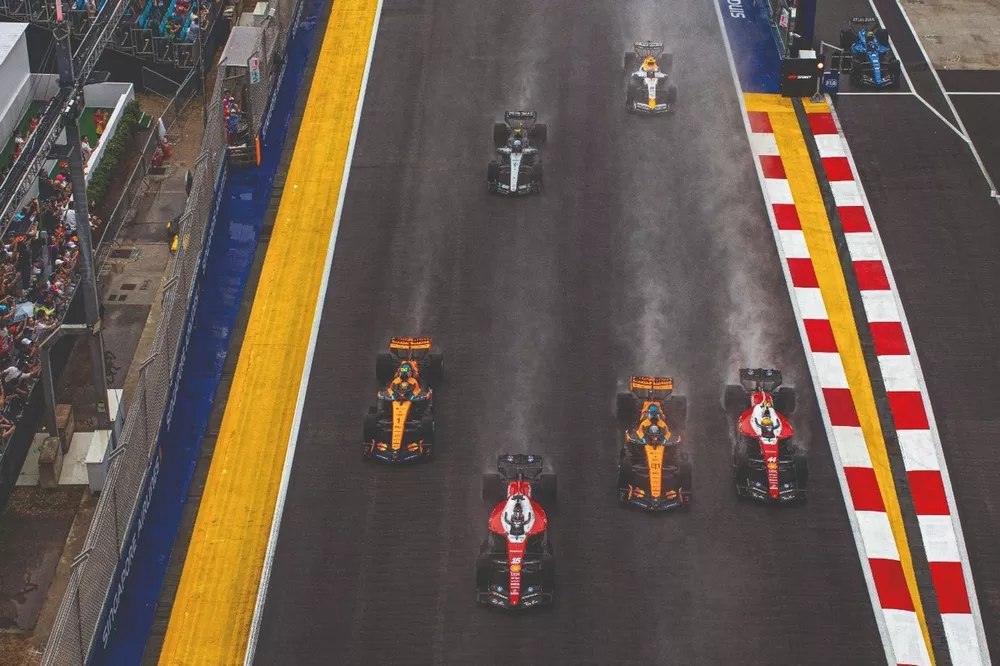
Mr Butler feels that all the cars look similar to the spectator and he is correct. Some years ago, I took a set of photographs of the cars taken at the same spot on the track and turned them into silhouettes. I then asked several people who were involved in the sport to identify the cars. None of them could do so, and some didn’t even recognise the cars they were involved with.
So why are we in this position? I think the answer lies in the way the sport has developed since those times when we saw six-wheel cars, cars with vastly different sidepod shapes and of course different engine configurations. In this time, the 1970s and 1980s, aerodynamic understanding was in its infancy.
The use of wind tunnels started in the mid-1970s as teams realised that the exploitation of ground effect aerodynamics needed a level of understanding rather than an intuitive approach. Even then, the models were very basic compared to the hugely complex wind tunnel models of today.
The last generation of V8 cars got longer as designers strove to reap downforce benefits
Photo by: Sutton Images
Initially just at quarter scale, and later growing to third scale and running on solid nylon tyres with minimal instrumentation, the amount of development was limited. Teams used just two wind tunnels, one at Imperial College and one at Southampton University, so time in the tunnel was limited. No team had even contemplated building their own tunnel.
Under these conditions it was probably reasonable to have pretty open regulations. But as sophistication increased so too did the feeling that regulations needed to increase their complexity to ensure that absolute performance was kept under control for safety reasons, and relative performance was limited to ensure the sport retained some jeopardy rather than one team dominating due to successful innovation.
Year on year this complexity has increased because the philosophy of the FIA these days is to regulate to the nth degree to keep a level playing field. This doesn’t just apply to the bodywork. The engine regulations have grown from just 42 words – of which 32 told you what you could do and 10 what you couldn’t – to a heady 10,642, and that’s before you get to the endless documents about energy management.
The real question is whether this is a good thing. It is hugely frustrating for the engineers but you cannot argue that the racing is not close. Detail design still differentiates the winners from the rest of the field, as it should. I believe we have gone rather too prescriptive with regulations, but I also think this is significantly better than too much freedom destroying close racing.
I believe we have gone rather too prescriptive with regulations, but I also think this is significantly better than too much freedom destroying close racing
As to what is the ideal size for an F1 car, I don’t think there is an exact answer, but I would certainly like to see the wheelbase of the current cars reduced further. Steps in this direction have been made in recent years, and the cars look better for it. A smaller car is a lighter and more nimble car and a short-wheelbase car is also slightly harder to drive, which I believe is a good thing.
I think a width of perhaps just under two metres and a height of around 1m are OK. The wheelbase needs to be defined by minimum packaging for a tall driver, a suitable fuel tank size and the length of the power unit and transmission. The current 3.4m is OK but it would be nice to get it down further.
The last generation of V8 normally aspirated cars with fuel tanks designed for no refuelling were initially around 3.3m but lengthened year on year. This was because designers realised that longer floors produced more efficient downforce. I would hope that with the next generation of V8 cars we could get back to 3.3m while still providing a cockpit long enough for tall drivers.
Packaging will be challenging, but that is exactly what the design of a Formula 1 car should be – challenging.
Want to ask Pat a tech question for a future issue? Let us know on autosport@autosport.com
This article is one of many in the monthly Autosport magazine. For more premium content, take a look at the November 2026 issue and subscribe today.
While ground effect set parameters, the diversity and innovation of the 1981 F1 pack stands out
Photo by: Motorsport Images
We want to hear from you!
Let us know what you would like to see from us in the future.
Take our survey
- The Autosport.com Team
Read and post comments
Read also :
Previous article Permane signs new Racing Bulls F1 deal
Top Comments
There are no comments at the moment. Would you like to write one?
View More & Comment
More from Pat Symonds
How levelling the playing field isn’t antithetical to the principles of F1
Formula 1
F1 Formula 1 19 d
How levelling the playing field isn’t antithetical to the principles of F1
Explaining the complicated art of F1 braking
Formula 1
F1 Formula 1 2 mo
Explaining the complicated art of F1 braking

What an engineer with four decades of F1 experience would choose as the ideal engine rules
Formula 1
F1 Formula 1 2 mo
What an engineer with four decades of F1 experience would choose as the ideal engine rules

How F1 teams prepare for the British GP at Silverstone
Formula 1
F1 Formula 1
British GP
4 mo
How F1 teams prepare for the British GP at Silverstone

Explaining the push and pull factors of Formula 1 suspension
Formula 1
F1 Formula 1 4 mo
Explaining the push and pull factors of Formula 1 suspension
How to simplify the complex subject of F1's electrical rules
Formula 1
F1 Formula 1
Monaco GP
5 mo
How to simplify the complex subject of F1's electrical rules

The big change for F1 2026 that has been largely ignored
Formula 1
F1 Formula 1 6 mo
The big change for F1 2026 that has been largely ignored

How the F1 2026 cars produced some nice surprises amid the noise
Formula 1
F1 Formula 1 7 mo
How the F1 2026 cars produced some nice surprises amid the noise
Latest news
How F1’s rules got to be so complex
Formula 1
F1 Formula 1 41 min
How F1’s rules got to be so complex

Permane signs new Racing Bulls F1 deal
Formula 1
F1 Formula 1
Sao Paulo GP
1 h
Permane signs new Racing Bulls F1 deal

Ingram stays put at Excelr8 in BTCC until end of decade
BTCC
BTCC BTCC 1 h
Ingram stays put at Excelr8 in BTCC until end of decade

Hamilton backs claims Leclerc races him harder than F1 rivals
Formula 1
F1 Formula 1
Sao Paulo GP
15 h
Hamilton backs claims Leclerc races him harder than F1 rivals
Subscribe and access Autosport.com with your ad-blocker.
From Formula 1 to MotoGP we report straight from the paddock because we love our sport, just like you. In order to keep delivering our expert journalism, our website uses advertising. Still, we want to give you the opportunity to enjoy an ad-free and tracker-free website and to continue using your adblocker.
You have 2 options:
- Become a subscriber.
- Disable your adblocker.
Subscribe now Already subscribed? Sign in here
Already disabled your adblocker?
Reload page
Manage Alerts
Subscribe