Analysis
Formula 1
How Ferrari caught up with Mercedes in Bahrain
Ferrari arrived in Bahrain delighted with its victory in the season-opening Australian Grand Prix but knowing that it had plenty of work to do with its SF71H.
Matt Somerfield Giorgio Piola
Edited: Apr 16, 2018, 2:44 PM
Copy link
Share on Viber

Giorgio Piola's F1 technical analysis
Giorgio Piola is the preeminent Formula 1 technical journalist. View our full selection of Giorgio's technical illustrative content
While the car was clearly a potential rival for Mercedes, its pace and some handling uncertainties in the first race left it under no illusions about the extent of work needed.
But changes to the front wing and the bargeboard area combined to help the team deliver a result that surprised Mercedes.
Front wing

Ferrari SF71H and SF70H front wing comparison
Photo by: Giorgio Piola
Even heading to Australia, the team had lingering doubts leftover from pre-season testing and so decided to use some of its free practice time doing back-to-back tests with its new for 2018 front wing design and a wing very similar to the 2017 specification (insets).
The main differentiators were the way the main cascade connected to the r-shaped cascade for support, rather than touching down on the mainplane, the shape of the outer footplate, the mainplane arc and finally the innermost connecting point with the neutral section.

Ferrari SF71H front wing comparison
Photo by: Giorgio Piola
The wing used during the latter part of 2017 (upper right inset) helped improve pitch sensitivity and the generation of the Y250 vortex by arching the leading edge of the mainplane (arrowed).
This year's wing is doing the same job in principle. However, it's powered by the slots in the mainplane (highlighted in yellow).
The doubts Ferrari had about the two differing wing specifications appear to have been put to one side in Bahrain, as the team set about clipping the front wing flaps to suit the downforce levels required for the Sakhir circuit.
The team also improved the rigidity of the second flapped element sprouting from the mainplane (white arrow), as it installed another metal strip.
This meant that as the load builds on the wing, the lower mainplane elements don't rotate as freely as the upper ones, reducing some of the aerodynamic instability that was previously occurring when entering the braking zone.
Sebastian Vettel had talked in Australia about lacking confidence in the front end of the car, and this feeling could have been related to the wing issue.
Bargeboard changes

Ferrari SF71H and Ferrari SF70H bargeboard comparison
Photo by: Giorgio Piola
The region between the front wheels, sidepods and the floor's leading edge is considered the area to offer the most low-hanging fruit for downforce since the change of regulations from 2017.
That is why all of the teams have been focusing their efforts on developing new ideas in order to extract more performance from them.
The SF71H, being an evolution of its predecessor, is similar in many ways but the increase in wheelbase has unlocked further avenues of development in this region of the car.
The bargeboards and their associated aerodynamic paraphernalia have been adjusted to maximise the performance that can be gained.
In the above comparison between the SF71H and the update run from Malaysia onwards on the SF70H last season, we can see how the team has optimised its setup.
The forward element (red arrow) introduced as part of that update has been retained. However its geometry has been altered to suit the new dimensions that are available.
Behind this, the row of mini-winglets (blue arrow) have been stretched out giving them more influence over the airflow that passes around them.
As part of this alteration, the designers have taken a design cue from Mercedes and installed vertical fences upon them too, maximising how the airflow moves around this area in yaw. You'll note the lower scythe shaped elements (black arrow) have also been revised as part of the team's overall revamp.
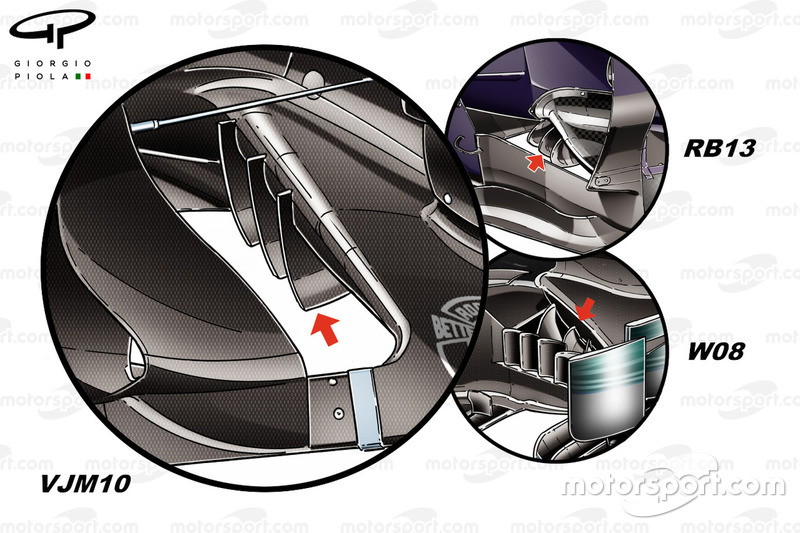
Force India VJM10, Mercedes W08 and Red Bull RB13 floor design, Mexican GP
Photo by: Giorgio Piola
Also noteworthy but not seen in these illustrations is that Ferrari has installed the three strakes on the leading edge of the floor that were first seen on the Mercedes W08 and subsequently run by Red Bull as part of its update in Hungary last season.
As a side note, Force India also tested them in Mexico last season and have since added them to this year's car.
These strakes help to stabilise the turbulent airflow the floor receives, improving flow stability to the diffuser.

Kimi Raikkonen, Ferrari SF71H rear detail
Photo by: Sutton Images
The drivers reportedly had balance and stability issues in Australia, an issue that the team believed was in part due to its new-for-2018 diffuser design.
Whilst a full-blown solution will not be available until China, the team made some minor alterations to the central portion for Bahrain as seen in the below video.
All of this work appears to have made the car better balanced in Bahrain, something that proved key in helping Sebastian Vettel eke out the extra life from his tyres to win the race.
And with it understood that a new floor is scheduled to arrive for this weekend's Chinese Grand Prix, Ferrari could be all set to build on its very strong start to the campaign.
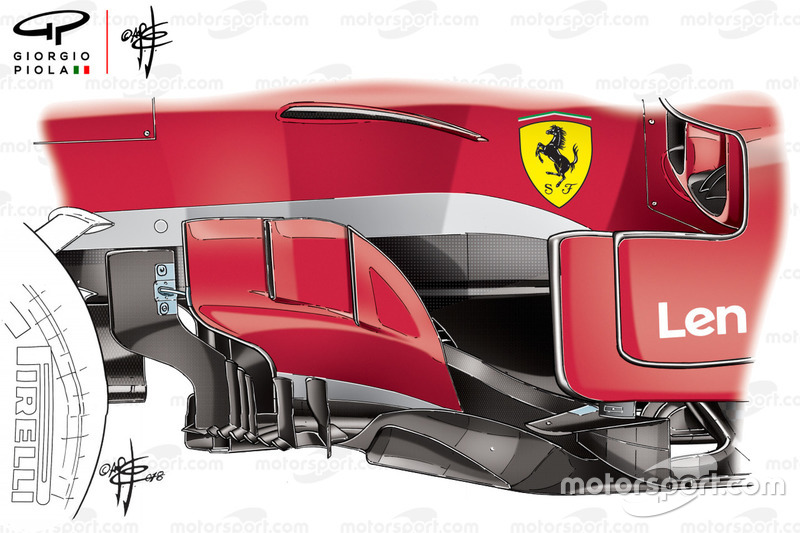
Ferrari SF71H barge board
Photo by: Giorgio Piola
Gary Anderson's verdict on Ferrari's bargeboard
During pre-season testing, the bargeboard area on the Ferrari looked fairly basic when you compared it to the Mercedes, but small developments have been introduced, most recently in Bahrain, increasing the complexity and performance of this very influential area.
The bargeboards basically help everything else aerodynamic to work; the front wing, cooling, underfloor, diffuser and Coke bottle area would all suffer if these components weren't working properly, so it is a huge area of development.
The front area, with the three vertical red vanes and the components below them, combine to help pull airflow out from underneath the raised front of the chassis.
This, in turn, reduces the blockage behind the front wing to improve its performance. The lower area helps prepare the airflow for the leading edge of the underfloor.
This is a very complex area as it works like a small diffuser in its own right, improving the performance of the front of the underfloor in the area just below the Ferrari logo.
The vertical vanes on the outer corners of the sidepods are there to reduce the negative effect the turbulent area behind the front tyre would normally have on the underfloor and undercut sidepods. All this adds up to better underfloor performance.
We want your opinion!
What would you like to see on Motorsport.com?
Take our 5 minute survey.
- The Motorsport.com Team
Read and post comments
Read also :
Share Or Save This Story
Copy link
Share on Viber
Previous article Leclerc: Ericsson making first GPs difficult
Next article FIA worried by "dangerous" flying Haas bodywork
Top Comments
There are no comments at the moment. Would you like to write one?
View More & Comment

More from
Matt Somerfield

Gallery: How F1 tech evolved during the 2024 season
Formula 1
Formula 1
Gallery: How F1 tech evolved during the 2024 season
How McLaren’s rear wing push changed the game in F1
Formula 1
Formula 1
How McLaren’s rear wing push changed the game in F1
How 2026 F1 rules will help avoid identikit designs
Formula 1
Formula 1
How 2026 F1 rules will help avoid identikit designs

More from
Ferrari
Charles Leclerc blames Mexico GP clash on track layout - Fred Vasseur disagrees
Formula 1
Formula 1
Mexican GP
42 min
Charles Leclerc blames Mexico GP clash on track layout - Fred Vasseur disagrees

Lewis Hamilton slams Charles Leclerc for "do or die" attitude after Mexico GP clash
Formula 1
Formula 1
Mexican GP
20 h
Lewis Hamilton slams Charles Leclerc for "do or die" attitude after Mexico GP clash

Latest news
Charles Leclerc blames Mexico GP clash on track layout - Fred Vasseur disagrees
Formula 1
F1 Formula 1
Mexican GP
42 min
Charles Leclerc blames Mexico GP clash on track layout - Fred Vasseur disagrees

Kalle Rovanpera and Ott Tanak set for WRC return as Toyota announces bumper 2027 line-up
WRC
WRC WRC 57 min
Kalle Rovanpera and Ott Tanak set for WRC return as Toyota announces bumper 2027 line-up
Why NASCAR's indecision led to Dodge's decision to return to Cup
NASCAR Cup
NAS NASCAR Cup
Martinsville II
3 h
Why NASCAR's indecision led to Dodge's decision to return to Cup
Dodge announces return to NASCAR Cup Series in 2027
NASCAR Cup
NAS NASCAR Cup 7 h
Dodge announces return to NASCAR Cup Series in 2027
Feature
Discover prime content



Subscribe and access Motorsport.com with your ad-blocker.
From Formula 1 to MotoGP we report straight from the paddock because we love our sport, just like you. In order to keep delivering our expert journalism, our website uses advertising. Still, we want to give you the opportunity to enjoy an ad-free and tracker-free website and to continue using your adblocker.
You have 2 options:
- Become a subscriber.
- Disable your adblocker.
Subscribe now Already subscribed? Sign in here
Already disabled your adblocker?
Reload page
Manage Alerts
Subscribe