Formula 1 Qatar GP
How grooved brake discs are making an F1 return
A great deal of what appear to be new Formula 1 ideas actually revolve around inspiration from the past
Matt Somerfield Giorgio Piola
Published: Nov 28, 2024, 12:12 PM
Copy link
Share on Viber
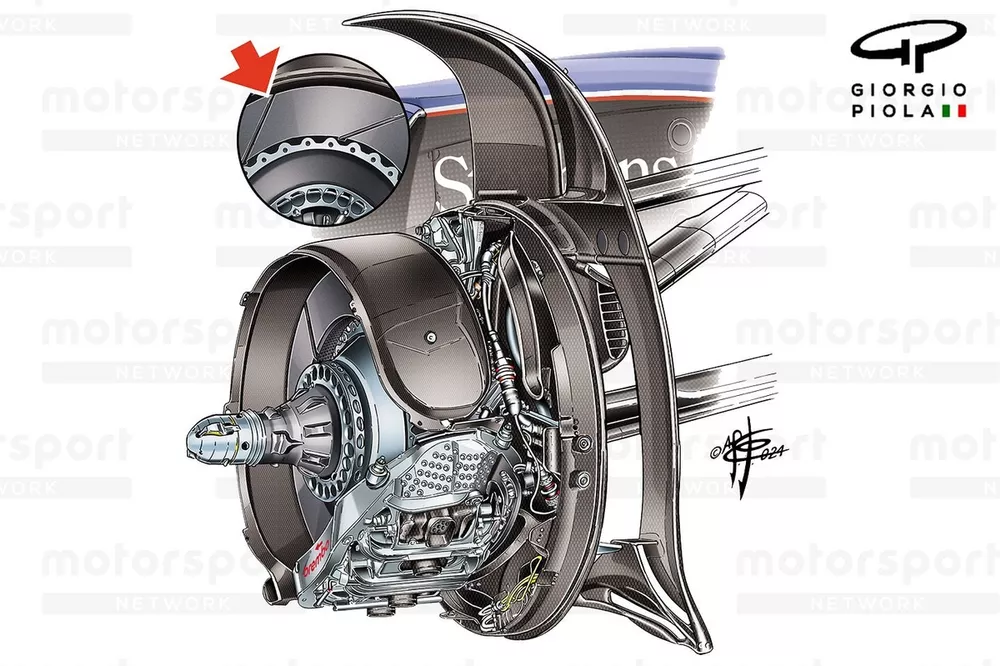
As regulations change and evolve, F1 teams find themselves able to find new ways to reincorporate good concepts that worked previously but suddenly lost their edge for one reason or another.
The latest example of this phenomenon is the reintroduction of grooves on the brake disc rotor, with Carbone Industries trialling them at recent races.
Williams conducted some experiments at the Italian Grand Prix, with Alpine also joining the action in Mexico.
While the hope is always of tweaks like this adding some direct instant performance advantages for this year, it is more likely that the designs are focused on field testing solutions in preparation for 2025.
This early sighter will also allow the teams supplied by the French manufacturer, which is over half the grid, ample time to prepare and optimise the rest of the braking system and brake duct design around tailored new solutions from the brake disc supplier.
The differences that could drive different performances from the grooves both now and in the future include the number of grooves, their length, shape and depth.
F1's switch from 13-inch to 18-inch tyres has resulted in teams having to enlarge the size of the brake drum to match the revised wheel well size.
This requirement has been further ramped up as there were also changes made to prevent the drum and wheels from being used to expel heat and air that could provide an aerodynamic contribution to increasing outwash.
This has resulted in a number of new solutions arising to help move heat and air around the assembly. Both work to provide the necessary assistance to cool components and transfer heat into the tyre via the wheel rim in a way that helps manage tyre temperatures.
The most obvious of these design features is the disc fairing (as seen above on the Red Bull), which has gone through various iterations since the regulations were introduced.
Meanwhile, there's also a considerable variance in the design of each brake drum assembly, with teams creating a layered nest within the assembly to help direct the air and heat before applying the outer brake drum, which must now be sealed to prevent any secondary aerodynamic effects from being employed.
Williams FW21 brake detail, Austrian GP
Photo by: Giorgio Piola
The primary reason for the reintroduction of grooves on the discs though, which is something we last saw when teams used steel discs, is likely to do with increasing the initial bite that's created when the brakes are applied.
This will have a double benefit in terms of changing the approach from the driver, and perhaps making him feel more comfortable, but also how heat is transferred through the assembly.
Should these recent trials have proved successful, and others begin to adopt grooved discs, there's also a significant chance we will see further alterations made to the rest of the brake assembly too.
Not to be outdone, Brembo and the teams supplied by them will have also taken note of these trials and will likely be looking at how it can implement any potential gains from grooved brake discs for 2025 and beyond.
Read Also:
Formula 1Exclusive: Mario Andretti on "personal" factors that meant Michael was not part of Cadillac F1 plan
Formula 1What's left to play for in the final two F1 races in 2024?
We want your opinion!
What would you like to see on Motorsport.com?
Take our 5 minute survey.
- The Motorsport.com Team
Read and post comments
Read also :
Share Or Save This Story
Copy link
Share on Viber
Previous article Fresh FIA upheaval as F2 race director and key steward dismissed
Next article Schumacher to leave Mercedes F1 reserve role at end of 2024
Top Comments
There are no comments at the moment. Would you like to write one?
View More & Comment

More from
Matt Somerfield

Gallery: How F1 tech evolved during the 2024 season
Formula 1
Formula 1
Gallery: How F1 tech evolved during the 2024 season
How McLaren’s rear wing push changed the game in F1
Formula 1
Formula 1
How McLaren’s rear wing push changed the game in F1
How 2026 F1 rules will help avoid identikit designs
Formula 1
Formula 1
How 2026 F1 rules will help avoid identikit designs
Latest news
Manthey acknowledges IMSA to be "tougher than expected" despite two wins
IMSA
IMSA IMSA 1 h
Manthey acknowledges IMSA to be "tougher than expected" despite two wins
How a philosophy shift brought BMW to new heights in 2026
IMSA
IMSA IMSA 1 h
How a philosophy shift brought BMW to new heights in 2026

Fred Vasseur reveals two costly moments that denied Ferrari US GP double podium
Formula 1
F1 Formula 1
United States GP
1 h
Fred Vasseur reveals two costly moments that denied Ferrari US GP double podium

Cleetus McFarland set to compete full-time for 2027 ARCA championship
ARCA
ARCA ARCA 3 h
Cleetus McFarland set to compete full-time for 2027 ARCA championship
Feature
Discover prime content


Subscribe and access Motorsport.com with your ad-blocker.
From Formula 1 to MotoGP we report straight from the paddock because we love our sport, just like you. In order to keep delivering our expert journalism, our website uses advertising. Still, we want to give you the opportunity to enjoy an ad-free and tracker-free website and to continue using your adblocker.
You have 2 options:
- Become a subscriber.
- Disable your adblocker.
Subscribe now Already subscribed? Sign in here
Already disabled your adblocker?
Reload page
Manage Alerts
Subscribe