Formula 1
Lotus Renault Tech Talk With James Allison
Silverstone Circuit
Edited: Jul 4, 2011, 11:36 AM
Copy link
Share on Viber

“We will adapt quickly to the engine management rule changes”
LRGP’s Technical Director looks forward to seeing how the R31 will fare at one of Formula One’s classic races – the British Grand Prix.

Nick Heidfeld, Lotus Renault GP
Photo by: xpb.cc
What can we expect at Silverstone? \
After three races with only slow speed corners it will be interesting to get back on to a circuit with several challenging high and medium speed corners. As has been extensively discussed, the changes to the engine management rules will make it tricky to know exactly how the car will stack up relative to our competitors, but I am hopeful that we will adapt quickly to the challenge. Another possible area of interest is that we may face a situation, like in Barcelona, where it is better to stay in the garage than it is to use any of the Option tyres in qualifying.
What are the challenges of Silverstone?
Silverstone is one of the classic F1 circuits. Compared with the last few Grand Prix races, it offers a very wide range of challenging corners which range from fiercely quick to quite slow and technical. Having such a large difference between the fast and slow places a heavy demand on both the driver and his race engineering team to extract the most from the car. In addition, there is always the capricious British weather to contend with.
How have the changes of the circuit in the last few years made a difference?
Last year’s modification did not really change the essential nature of the track very much; there was a nasty bump in the middle of a fast corner where the old circuit joined the new, but we understand this has been smoothed down somewhat now. Having a new pit complex may change the time lost in the pit lane, which may in turn have a marginal effect on the strategy choices – we will figure all that out in free practice.
How much of a change is it having the race just down the road from the factory?
Once the race weekend gets under way for the race team it makes little difference that the track is in our own back yard – they have their heads down at the circuit. For the guys in the factory it is an opportunity to see the car in action, and it is also much easier to rush a new component to the track at the last minute.
How do the new qualifying engine mapping restrictions affect the team?
The changes caused some bureaucratic headaches for the team but there is little performance effect on the configuration of the car.
The full force of the FIA note relating to engine mapping comes into force at Silverstone - can you tell us more about the new situation?
The headline changes for the Silverstone GP are as follows: when the driver lifts his foot fully off the throttle pedal, then the ECU maps must be set up so that the engine [to all intents and purposes] closes the throttle – previously it was possible to configure the engine maps to leave the throttle open and reduce the engine power by other means. Furthermore, when the driver lifts fully off the throttle, the ECU maps must be configured to cut off the fuel supply to the engine – this is intended to prevent so called “hot blowing” where the energy of the exhaust gas is increased by combustion.
It is not easy to judge the effect of this change on our competitiveness
James Allison
How do you feel this will impact LRGP relative to the other teams?
It is not easy to judge the effect of this change on our competitiveness. The loss for each blown floor car will come from two separate effects – how much downforce will be lost and, in addition, how much will the loss of this downforce upset the balance of the car. All blown floor cars will lose downforce under braking as a result of these new restrictions. Some teams will lose more and some teams less; it is hard to know exactly what relative loss LRGP will suffer.
However, it is possible that we will suffer less on the balance shift side of the equation because our forward exit exhausts produce their effect quite near the middle of the car. This means that as the exhaust blow waxes and wanes, it does not really disturb the aerobalance of the car too much. With a rearward blower, the downforce from the exhaust is all generated at the rear axle. As the new rules reduce the blowing effect on corner entry much more than corner exit, it is possible that the rearward blowers will tend to suffer more nervousness under braking and more understeer on exit as a result of the new restrictions. We will find out at Silverstone!
By: Lotus Renault
We want your opinion!
What would you like to see on Motorsport.com?
Take our 5 minute survey.
- The Motorsport.com Team
Read and post comments
Read also :
Share Or Save This Story
Copy link
Share on Viber
Previous article FOTA Formula One Fans Forum Report
Next article Rosberg Admits Rival Teams' Interest
Top Comments
There are no comments at the moment. Would you like to write one?
View More & Comment

More from
Nick Heidfeld

Which modern Formula 1 driver raced for the most teams?
Formula 1
Formula 1
Which modern Formula 1 driver raced for the most teams?

New all-electric Formula G series to begin in 2024 with radical format
General
General
New all-electric Formula G series to begin in 2024 with radical format
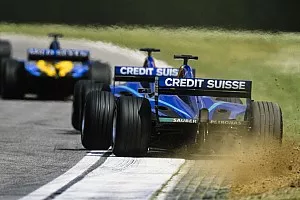
The brief F1 pairing that brought “fun” to Sauber
Formula 1
Formula 1
The brief F1 pairing that brought “fun” to Sauber
Latest news

Zane Smith fined $50,000 by NASCAR for ramming Carson Hocevar after Phoenix Cup race
NASCAR Cup
NAS NASCAR Cup
Phoenix II
3 h
Zane Smith fined $50,000 by NASCAR for ramming Carson Hocevar after Phoenix Cup race
FIA expects F1 races in Qatar and Abu Dhabi to continue as planned
Formula 1
F1 Formula 1
United States GP
7 h
FIA expects F1 races in Qatar and Abu Dhabi to continue as planned
TDS Racing doubles down on IMSA program with two-car LMP2 return
IMSA
IMSA IMSA 7 h
TDS Racing doubles down on IMSA program with two-car LMP2 return
Why Isack Hadjar doesn’t like F1 sprints anymore
Formula 1
F1 Formula 1
Singapore GP
8 h
Why Isack Hadjar doesn’t like F1 sprints anymore
Feature
Discover prime content


Subscribe and access Motorsport.com with your ad-blocker.
From Formula 1 to MotoGP we report straight from the paddock because we love our sport, just like you. In order to keep delivering our expert journalism, our website uses advertising. Still, we want to give you the opportunity to enjoy an ad-free and tracker-free website and to continue using your adblocker.
You have 2 options:
- Become a subscriber.
- Disable your adblocker.
Subscribe now Already subscribed? Sign in here
Already disabled your adblocker?
Reload page
Manage Alerts
Subscribe