Analysis
Formula 1 Italian GP
How low can you go? Skinny Monza F1 wings explained
Monza holds a special place on the calendar, owing to the unique challenge that it poses to engineers and drivers alike. While higher top speeds are achieved elsewhere, its unique layout prompts many designers to create specific rear wing designs for this one race each year.
Matthew Somerfield
Published: Sep 7, 2020, 5:11 PM
Copy link
Share on Viber

Giorgio Piola's F1 technical analysis
Giorgio Piola is the preeminent Formula 1 technical journalist. View our full selection of Giorgio's technical illustrative content
Join us as we take a look at the various solutions used by each team to help reduce downforce and drag for the unique challenges of the Italian GP.
Mercedes AMG W11 rear wing comparison
Photo by: Motorsport Images
Mercedes carried a fair amount of rear wing when compared with some rivals but, as we can see from this comparison it’s much less than we’ve seen it use at any point throughout the season so far, with the wing featuring a conventional shape and no Gurney flap on the upper flap's trailing edge. In Austria it used a single pillar arrangement, a sizable top flap complete with a deep Gurney flap on the trailing edge.
For the Hungarian GP it went for a full downforce rear wing and included a double element T-Wing to supplement it. The rear wing featured a twin mounting pillar configuration, which was favoured in order to reduce the wing's tendency to be pulled around by the associated loads. A deeper mainplane and top flap also accompanied them, along with the retention of the deep Gurney flap. But, note how it also expanded the central V in the upper flap to try and offset some of the additional drag that would be created.
Read Also:
Another slightly revised layout appeared for the races at Silverstone, which was loosely based around the same design as the one seen in Austria. To reduce drag and improve their top speed on the ex-airfield’s longer straights, Mercedes removed the Gurney flap from the trailing edge of the upper flap. It was a return to a high downforce configuration for the Spanish GP but, rather than the double element T-wing, it favoured a single element version.
Then to Belgium and the challenges of Spa-Francorchamps, where all of the teams have to balance their desire to reduce drag over the need for downforce in sector two. Once again the team opted for a setup similar to the one seen at Silverstone but ditched the Gurney flap on the trailing edge of the upper flap as it looked to strip off some downforce whilst compromising balance a little.
Red Bull Racing RB16 rear view
Photo by: Motorsport Images
Red Bull continued to strip back downforce for the Italian GP in an effort to boost straightline speed. Both rear wing designs featured a gentle spoon shaping to the mainplane, albeit with the Monza spec pegged at a shallower angle.
Red Bull Racing RB16 side view
Photo by: Motorsport Images
As you can see from both comparative images the chord on the wing used in Monza (right) is significantly shorter than the one used at Spa, with the flap effectively having the trailing edge lopped off all the way past the point where the central V groove previously existed. This also resulted in a change to the position of DRS adjuster, whilst you’ll also note the central mounting pillars are also different to reduce their aerodynamic impact.
Let's take a look at the other cars on the grid, and how they all compared.
Click on the arrows on the images to scroll through them…
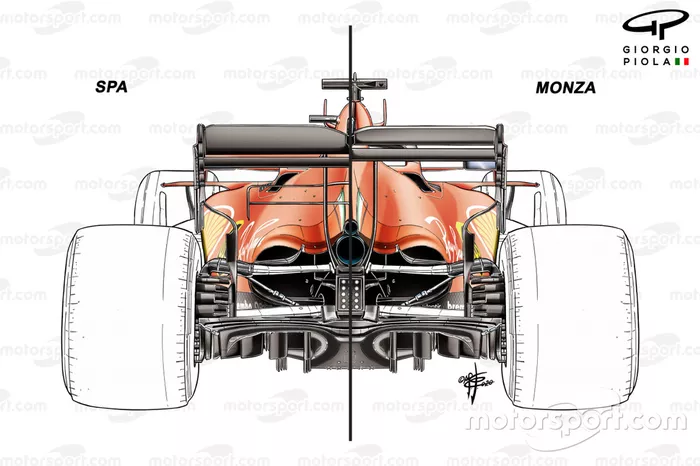
Ferrari tested the Monza specification rear wing early-on during the Spa weekend. As shown in this comparison it is much lower downforce than the one that the team actually used by the team in Belgium. The T-Wing was also disposed of.
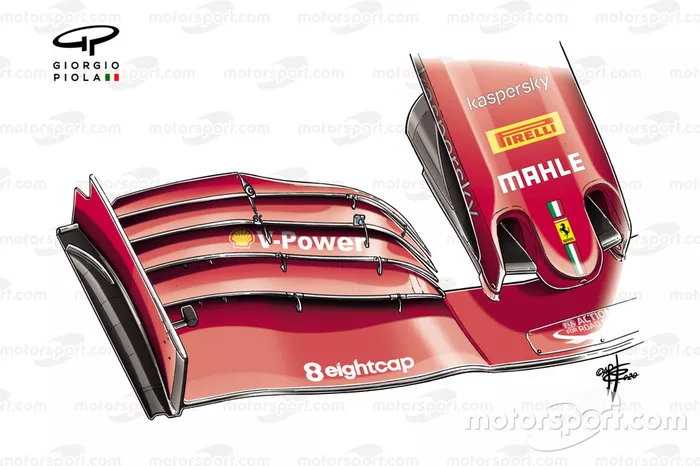
In order to take some load off the front end and balance out efforts at the rear of the car, the Scuderia also made changes to the front wing, cutting down the trailing edge of the innermost portion of the upper flap.
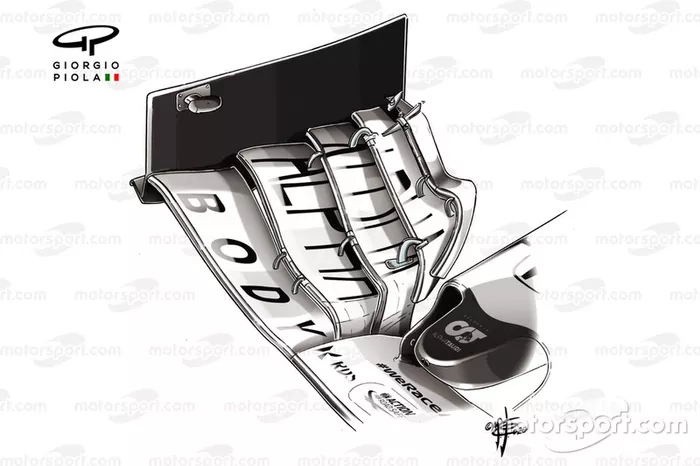
AlphaTauri didn’t have a one-off Monza special package, as it already used the extremely low dowforce package at the Belgian GP. This included changes at the front and rear of the car, with the team sporting perhaps one of the most aggressive front wing solutions on the grid, as it sliced a significant portion off the front wing’s upper flap. It’s a decision that’s echoed up and down the field as teams know it provides a cost-effective solution and if necessary can be trimmed further on site.
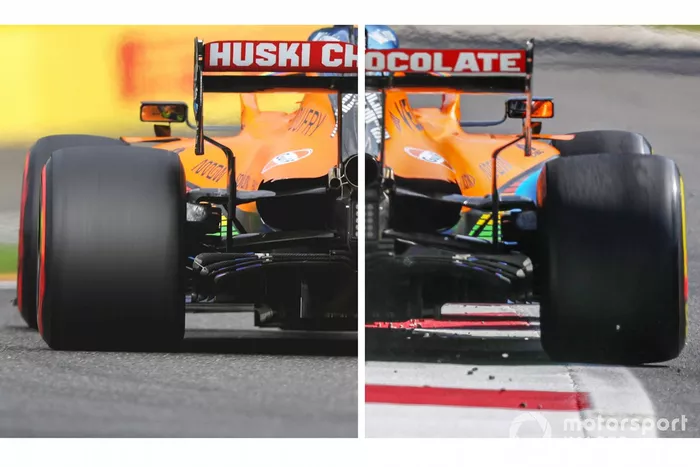
McLaren, having already opted for a more conventional low-downforce offering at the Belgian GP, took things a stage further for the Italian GP by reducing the overall size of its wing to reduce downforce and drag.
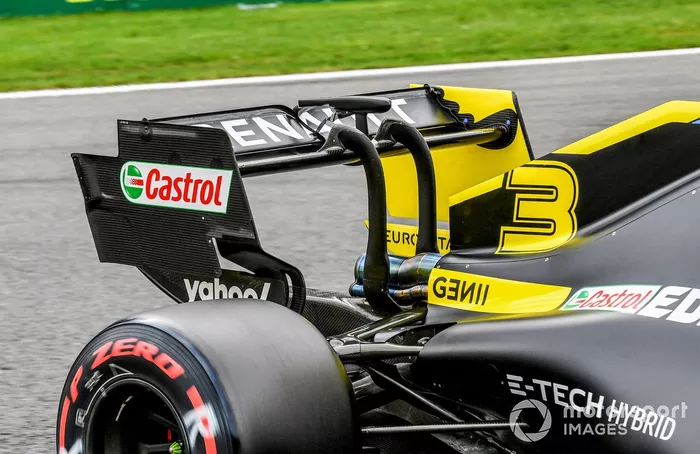
Renault had already trimmed its car out to a downforce level akin to what you’d expect for Monza in Belgium last week. As such, it ran a very similar arrangement this week, meaning the straightline boost it appeared to have against some of their rivals last week was inevitably quashed.
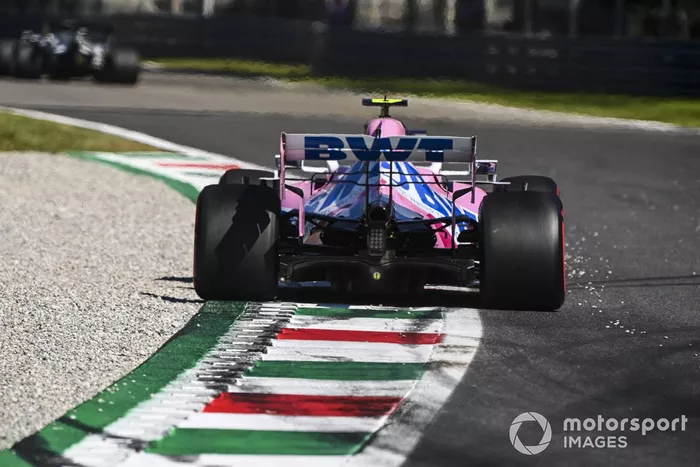
Racing Point opted for a similar rear wing arrangement in Italy as used at Spa, putting more downforce at its disposal than competitors which it is able to offset with the Mercedes power unit. This gives extra stability in the low speed corners and increases the lifespan of the tyres. It’s also worth noting that both drivers opted to use the T-Wing at the Italian GP, whereas in Belgium, where you’d expect them to use it, they did not.

Alfa Romeo briefly trialled its Monza specification rear wing at the Belgian GP. The wing itself is particularly low downforce for the team and saw Raikkonen rocket to the top of the speed traps at several points during the weekend, even though the team is struggling with a lack of straightline speed owing to the Ferrari power unit. The unique feature of this rear wing are the mounting pillars, which have had the curved element at the top unceremoniously hacked off.

As a comparison here’s the rear wing raced by Alfa Romeo in Belgium, with a spoon-shaped mainplane used in order to try and retain downforce in the central portion of the wing, while reducing drag at the outer section.
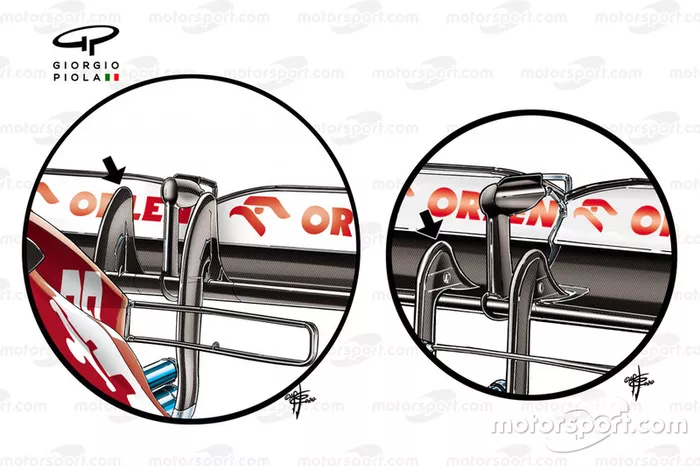
Here’s a comparison of the two styles of mounting pillars that have been used by Alfa Romeo up until now, with the ones used in Italy a variation on the taller ones on the left.
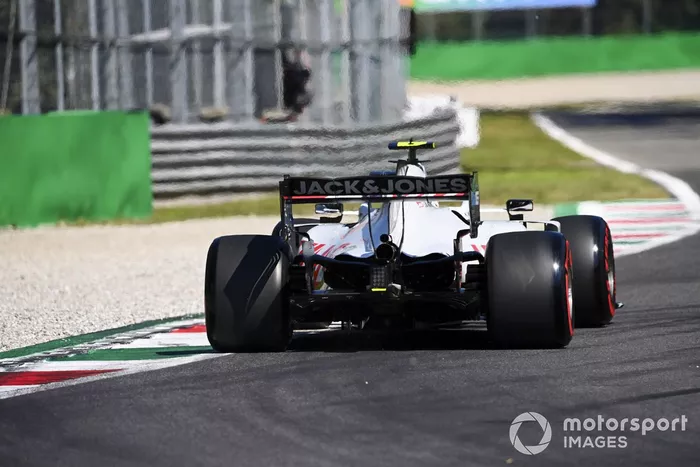
Haas has, for a number of years, used a distinctive bow-tie shaped trailing edge on the upper flap of its rear wing design for the Belgian and Italian Grands Prix. This seems to work contrary to the rest of the grid in many respects, as while others are keen to lessen the tip vortex by reducing the flaps height at the outer corner, it does this further inboard at the juncture with the slot gap separators.
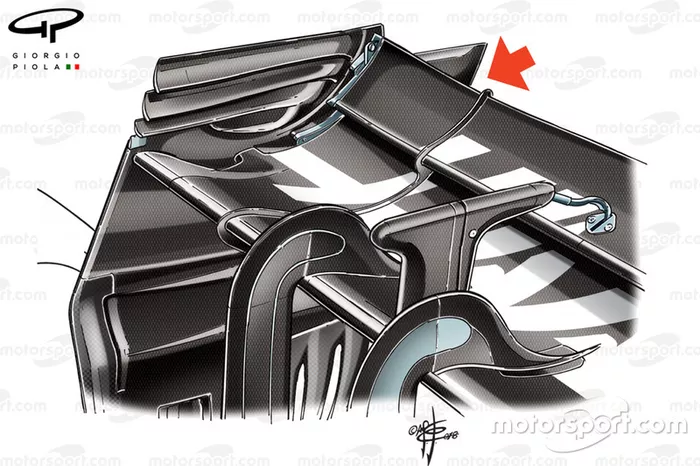
It’s a design that the team has used for the last three years, with this illustration of the wing used on the 2018 challenger pointing out where the trailing edge of the upper flap descends toward the slot gap separator.
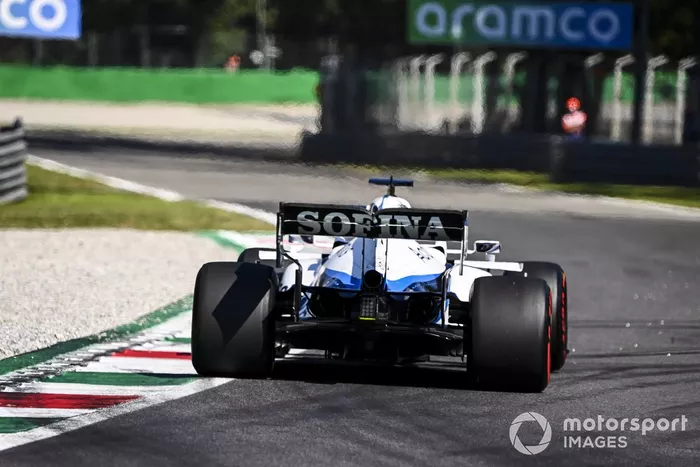
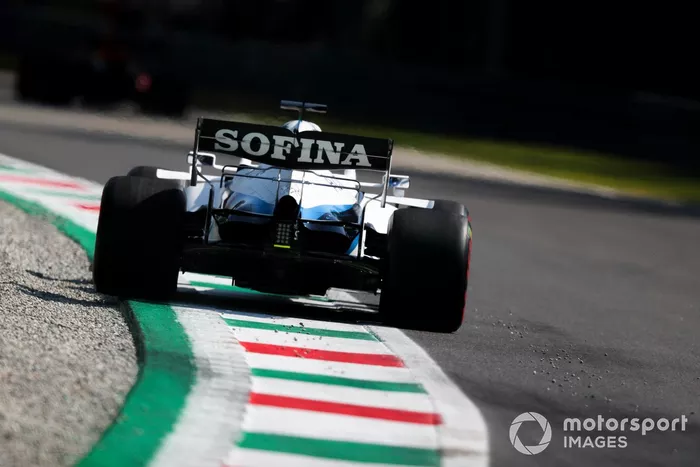
Williams had an alarmingly large rear wing on the FW43 at the Italian GP. While the Mercedes power unit can help to offset some of the drag penalty that ensues, it’s clear that it opted not to spend time and resource on a one-off wing design that would have little to no benefit elsewhere on the calendar.
Taking over from George Russell in FP1, Roy Nissany also ran the FW43 in even higher downforce trim, utilising the spoon-shaped rear wing and double T-Wing combo.
13
We want your opinion!
What would you like to see on Motorsport.com?
Take our 5 minute survey.
- The Motorsport.com Team
Read and post comments
Read also :
Share Or Save This Story
Copy link
Share on Viber
Previous article Hamilton explains why he missed pre-race kneeling at Monza
Next article Gasly feels "ready" for Red Bull F1 team return
Top Comments
There are no comments at the moment. Would you like to write one?
View More & Comment
More from
Matthew Somerfield

Haas reveals its major F1 United States Grand Prix update
Formula 1
Formula 1
United States GP
Haas reveals its major F1 United States Grand Prix update
British GP: F1 technical images from the pitlane explained
Formula 1
Formula 1
British GP
British GP: F1 technical images from the pitlane explained

Australian GP: F1 technical images from the pitlane explained
Formula 1
Formula 1
Australian GP
Australian GP: F1 technical images from the pitlane explained
Latest news

George Russell: F1 2026 season a test of "character and resilience"
Formula 1
F1 Formula 1
United States GP
7 min
George Russell: F1 2026 season a test of "character and resilience"
Marc Marquez: ‘Jorge Martin rides on instinct; he just attacks, and that’s his strength’
MotoGP
MGP MotoGP
Australian GP
1 h
Marc Marquez: ‘Jorge Martin rides on instinct; he just attacks, and that’s his strength’
Lamborghini Super Trofeo | North America, Race 2: Bamber dominates to take the win
Lamborghini Super Trofeo
LBST Lamborghini Super Trofeo
World Finals - Monza 2026
1 h
Lamborghini Super Trofeo | North America, Race 2: Bamber dominates to take the win

Belgian firm to take over Renault/Alpine engine facility in Viry
WEC
WEC WEC 1 h
Belgian firm to take over Renault/Alpine engine facility in Viry
Feature
Discover prime content




Subscribe and access Motorsport.com with your ad-blocker.
From Formula 1 to MotoGP we report straight from the paddock because we love our sport, just like you. In order to keep delivering our expert journalism, our website uses advertising. Still, we want to give you the opportunity to enjoy an ad-free and tracker-free website and to continue using your adblocker.
You have 2 options:
- Become a subscriber.
- Disable your adblocker.
Subscribe now Already subscribed? Sign in here
Already disabled your adblocker?
Reload page
Manage Alerts
Subscribe