Breaking news
Formula 1
Racing Point says F1 stewards verdict "bewildering"
Racing Point Formula 1 chief Otmar Szafnauer says the FIA stewards' ruling over the design of its brake ducts is "bewildering", but is happy that the car is legal.

Luke Smith
Edited: Aug 7, 2020, 1:10 PM
Copy link
Share on Viber
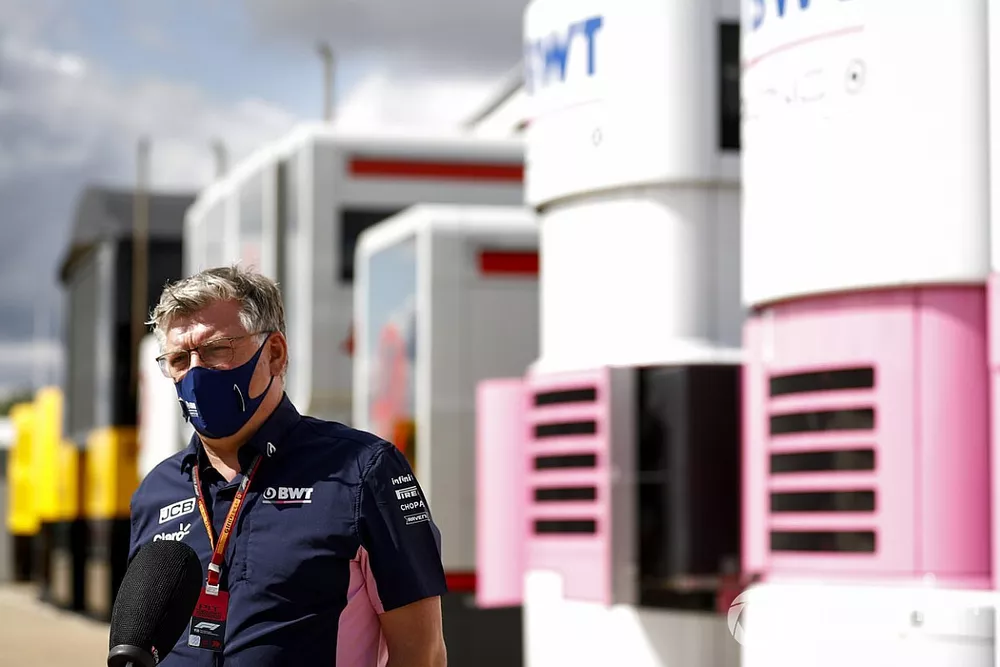
Following multiple protests from Renault, the FIA stewards announced on Friday that Racing Point had breached the sporting regulations in the design of the brake ducts for its RP20 car.
Racing Point has been docked 15 points in the constructors' championship and handed a €400,000 fine, but is allowed to continue using the brake ducts for the remainder of the year.
Szafnauer was pleased the team could continue to use the part, but did not feel it had been made clear in the sporting regulations that its design process was outlawed.
"The good news from the judgement was that the car is completely legal from a technical perspective, so we can continue to run the brake ducts," Szafnauer said on Sky Sports F1.
"It's just a matter of process which is in the sporting regulations. We read the sporting regulations, there is nothing specific in there which says we couldn't do what we did.
"Other teams have done exactly the same, probably even more than what we did in a way. It's a bit bewildering. However, we now have to decide whether our punishment is one that we should appeal.
"But like I said, the good news is we can continue to run this car as it is here, and thereafter, and it's legal."
Read Also:
The FIA did not accept Racing Point's argument that it had designed the brake ducts for the RP20 car from scratch, deeming Mercedes had been the principal designer of the part.
Brake ducts were non-listed parts last year, which could be supplied to customers, but are no longer classified in the same way.
Szafnauer said that brake ducts were the only part that had undergone such a change for the 2020 season in a move that Racing Point actually helped facilitate.
"There's only one part of the car that went from a non-listed part to a listed part, which is brake ducts," Szafnauer explained.
"I was there in the strategy group meeting when we voted for this. I supported this, going from a non-listed part to a listed part. Some teams didn't want this to happen, others did. I think we were the swing vote.
"I supported Cyril [Abiteboul, Renault F1 team principal] wholeheartedly on this.
"We started this process well before the brake ducts were even contemplated moving from non-listed to listed.
"So it pains me and surprises me that the process has now been deemed not within the regulations when the regulations aren't clear."
Rival team bosses in paddock have said the case is crucial to defining future F1 models and the amount of sharing that happens between teams.
Szafnauer felt that any concerns over this would be allayed by the new regulations set to come into force for 2022, when a radical overhaul of the design of the cars is planned.
"I think all that kind of stuff should be addressed by the new rules in 2022," Szafnauer said. "There are different categories of parts there, and it's to address just that.
"It becomes even more clear in 2022, the regulations have been pushed out a year because of the virus situation that we find ourselves in.
"This kind of issue will completely disappear."
We want your opinion!
What would you like to see on Motorsport.com?
Take our 5 minute survey.
- The Motorsport.com Team
Read and post comments
Read also :
Share Or Save This Story
Copy link
Share on Viber
Previous article Full F1 stewards conclusion on Racing Point protest
Next article Vettel opens up on car ride with Racing Point boss
Top Comments
There are no comments at the moment. Would you like to write one?
View More & Comment

More from
Luke Smith

1998 Belgian GP: When the Schumachers went to war
Formula 1
Formula 1
1998 Belgian GP: When the Schumachers went to war

The race that transformed perceptions of Red Bull
Formula 1
Formula 1
The race that transformed perceptions of Red Bull

Hamilton in the process of selecting Brad Pitt’s co-star for F1 movie
Formula 1
Formula 1
Hamilton in the process of selecting Brad Pitt’s co-star for F1 movie

More from
Racing Point
Aston Martin: Vettel can help bring out the best in Stroll
Formula 1
Formula 1
Aston Martin: Vettel can help bring out the best in Stroll
Stroll: 2020 results answered own questions over F1 capability
Formula 1
Formula 1
Stroll: 2020 results answered own questions over F1 capability
Aston Martin set for February F1 livery and car launch
Formula 1
Formula 1
Aston Martin set for February F1 livery and car launch
Latest news
MotoGP announces new start time for Australian GP after weather delays
MotoGP
MGP MotoGP
Australian GP
30 min
MotoGP announces new start time for Australian GP after weather delays
2026 MotoGP Australian Grand Prix – How to watch, session times & more
MotoGP
MGP MotoGP
Indonesian GP
1 h
2026 MotoGP Australian Grand Prix – How to watch, session times & more
There will be even less drag in Cup cars at Talladega on Sunday
NASCAR Cup
NAS NASCAR Cup
Talladega II
2 h
There will be even less drag in Cup cars at Talladega on Sunday
Kimi Antonelli delivers Austin surprise pole in tricky Mercedes: "Finally we're seeing the results"
Formula 1
F1 Formula 1
United States GP
3 h
Kimi Antonelli delivers Austin surprise pole in tricky Mercedes: "Finally we're seeing the results"
Feature
Discover prime content



Subscribe and access Motorsport.com with your ad-blocker.
From Formula 1 to MotoGP we report straight from the paddock because we love our sport, just like you. In order to keep delivering our expert journalism, our website uses advertising. Still, we want to give you the opportunity to enjoy an ad-free and tracker-free website and to continue using your adblocker.
You have 2 options:
- Become a subscriber.
- Disable your adblocker.
Subscribe now Already subscribed? Sign in here
Already disabled your adblocker?
Reload page
Manage Alerts
Subscribe