Preview
Formula 1
Renault preview to the Spanish Grand Prix
The first corner comes at the end of the 1km pit straight on which speeds will peak at well over 300kph...
Edited: May 7, 2013, 7:16 PM
Copy link
Share on Viber

Rémi Taffin, Renault Sport F1 Head of Track Operations: The 4.655km long Circuit de Catalunya is a medium downforce, medium engine demand track used extensively in testing as it has a very good ‘average’ of characteristics of other circuits on the calendar.
In fact it is currently used in part for our engine sign off process. There are a variety of low and medium speed corners that push the RS27 on the lower rev ranges, particularly in sector three, but 55% of the track is also taken at full throttle.

Remi Taffin, race engineer Renault F1 Team
Photo by: XPB Images
The longest period of full throttle is of course the pit straight. This length gives the opportunity for a fully charged KERS to be deployed twice as the KERS energy counter resets on the start/finish line.
While a double KERS release in the race is useful to overtake, it puts a lot of stress on the KERS cooling system. We don’t think it will be a major problem for us as cooling efficiency is a key element in our package, but it does need to be carefully monitored. Setting up the right top gear in these conditions is then quite a big challenge!
The undulating nature of the track also puts the engine internals under pressure so every element of the engine gets a full workout here. The first corner is quite representative of this as the driver accelerates as the track goes uphill.
In addition to monitoring the fluid systems, we also need to deliver a smooth torque curve to give controlled power to counter the high g.
Going into the European season we are very motivated. The Bahrain result was a good fillip – not only did it keep the record of a Renault-powered car finishing on the podium every race this year, it was the first triple podium for Renault engines since Bahrain 2012 and the 50th win for the RS27 V8 unit.
More importantly however is the fact we are delivering consistency across our teams. We now need to keep this rhythm and momentum going.
Barcelona: three corners in detail
Turn 1 to 3: The first corner comes at the end of the 1km pit straight on which speeds will peak at well over 300kph. The car and engine are therefore subject to heavy braking loads as the driver scrubs off 50% of that speed to take the first corner at approximately 140kph.
Halfway through Turn 1, drivers start to accelerate into Turn 2 and Turn 3 (also known as Renault) but as the circuit starts to climb a car will have a tendency towards ‘snappy’ oversteer. Having a delay in engine response or an overshoot in torque delivery will only confirm this trend, thus increasing tyre wear as the car tries to slide to one side and subject the tyres to lateral g-force.
Turn 10: Once through Turn 9 the track begins to descend into Turn 10. The braking zone for this corner is the hardest one of the track, as the cars arrive at 300kph and take the turn at just over 70kph. To give the right stability engineers work very hard on the overrun settings, trying to give neutral engine braking when the driver is off the throttle.
In parallel engineers will try to make the downward gear shifts as smooth as possible so the torque gradient change is ironed out and not too aggressive. Giving smooth downshifts and the right level of overrun will result in a better balance, thus helping to control wheel lock and minimize tyre wear.
By the end of the corner the driver is down in first gear but needs to accelerate back up the hill. This sends huge loads through the tyres so pedal maps are often designed with just this corner in mind.
Turn 14 to 16: The chicane on this track is very slow and needs, again, the right amount of engine torque, not only at the entry of the corner but in the midpoint of the chicane.
In fact the driver will just blip the throttle between the entry and the exit of the chicane as he changes direction.
Even if he is only on the power for a millisecond balancing the car on this knife edge is critical to keep the car balanced, minimize wheelspin and ultimately gain lap time.
Once the cars exit this chicane traction is very important as the speed will be carried through turn 16, with the driver ultimately going flat out using KERS onto the pit straight.
Renault Sport F1
We want your opinion!
What would you like to see on Motorsport.com?
Take our 5 minute survey.
- The Motorsport.com Team
Read and post comments
Read also :
Share Or Save This Story
Copy link
Share on Viber
Previous article New P Zero hard compound and extra tyres for free practice in Barcelona
Next article Lauda plays down Vettel-to-Mercedes reports
Top Comments
There are no comments at the moment. Would you like to write one?
View More & Comment

More from
Renault F1 Team

Top 10 F1 cars of the 1980s
Formula 1
Top 10 F1 cars of the 1980s
Does Daniel Ricciardo regret leaving Red Bull for Renault?
Formula 1
Formula 1
United States GP
Does Daniel Ricciardo regret leaving Red Bull for Renault?
On this day: Fernando Alonso wins the world title, Michael Schumacher retires from F1
Formula 1
Formula 1
Brazilian GP
On this day: Fernando Alonso wins the world title, Michael Schumacher retires from F1
Latest news
MotoGP Portuguese GP: Full starting grid
MotoGP
MGP MotoGP
Portuguese GP
50 min
MotoGP Portuguese GP: Full starting grid
Oscar Piastri questions "strange" pace deficit to other Mercedes-powered cars in Las Vegas
Formula 1
F1 Formula 1
Las Vegas GP
1 h
Oscar Piastri questions "strange" pace deficit to other Mercedes-powered cars in Las Vegas
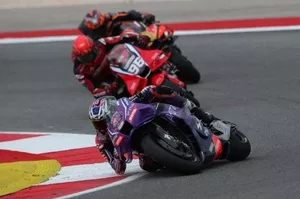
Jack Miller furious over MotoGP sprint race schedule change: “We don’t race in the rain anymore”
MotoGP
MGP MotoGP
Portuguese GP
1 h
Jack Miller furious over MotoGP sprint race schedule change: “We don’t race in the rain anymore”

Diogo Moreira admits he is “lucky” after frightening Portimao MotoGP highside
MotoGP
MGP MotoGP
Portuguese GP
2 h
Diogo Moreira admits he is “lucky” after frightening Portimao MotoGP highside
Feature
Discover prime content

Subscribe and access Motorsport.com with your ad-blocker.
From Formula 1 to MotoGP we report straight from the paddock because we love our sport, just like you. In order to keep delivering our expert journalism, our website uses advertising. Still, we want to give you the opportunity to enjoy an ad-free and tracker-free website and to continue using your adblocker.
You have 2 options:
- Become a subscriber.
- Disable your adblocker.
Subscribe now Already subscribed? Sign in here
Already disabled your adblocker?
Reload page
Manage Alerts
Subscribe