Analysis
Formula 1
Tech analysis: Could hollow spokes be F1's latest trick?
A spotlight has been shone on tyre pressures in recent weeks, with a number of teams suspicious that some outfits have found clever - albeit legal - ways to get around the limits laid down by the FIA.

Matt Somerfield
Edited: May 27, 2016, 7:25 PM
Copy link
Share on Viber
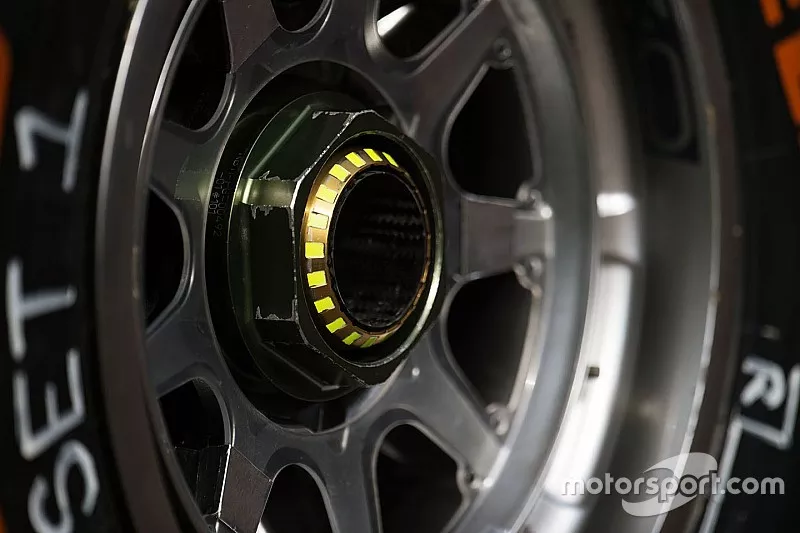
They believe ways have been found to lower the pressures after Pirelli and the FIA have taken their measurements on the grid, improving performance throughout the race.
Pressure and temperature are intrinsically linked, meaning the harder you work the tyre, (like at a race start) the more the pressure ramps up.
With the limits set well above what teams would like to run at, if someone is able to lower them by just 2psi it could deliver a decent performance advantage – especially if those unable to do it experience raising pressures because of the heat cycle a tyre goes through.
Spa legacy
Before the Italian Grand Prix last season, the pressures given out by Pirelli were recommendations.
However, the issues faced by a handful of drivers in the preceding round at Spa was enough for Pirelli and the FIA to begin enforcing a start pressure.

Mercedes brake warmers
Photo by: Giorgio Piola
Mercedes reacted immediately, knowing just how closely the temperatures on the grid correlate to the pressures taken.
In the first instance it used a brake drum cosy (above) to manipulate the heat held within the brakes on the grid, which in-turn radiates into the wheel rim and tyre when fitted to the car.
That would help temporarily to raise the heat of the air - and therefore the pressure - when the tyre is fitted.

Mercedes AMG F1 Team W07 rear detail
Photo by: Giorgio Piola
For 2016 this process has been refined and a more substantial cover serves this purpose, not only at the rear but at the front of the car now too. This priming of the tyres maximises the performance of the tyres at the start of the race, whilst helping to improve their performance over a race stint.
McLaren letter
McLaren was unsure about whether some teams had gone as far as some trick technology - so wrote to the FIA to ask for clarification about a double chambered rim.
The response was that such a design was illegal - and in replying the FIA effectively outlawed any team from running such a device.
The FIA rejected all of McLaren's design interpretations citing article 12.8.3 of the technical regulations which states:
"A complete wheel must contain a single fixed internal gas volume. No valves, bleeds or permeable membranes are permitted other than to inflate or deflate the tyre whilst the car is stationary"
While no one suggests teams are cheating, Pirelli and the FIA have ramped up their investigations to better understand what teams are up to.
Live tyre pressure data is being collected in Monaco this weekend and going into 2017 the FIA is considering proper live monitoring so a minimum 'running' pressure can be imposed.
Clever rims
So far no team has been identified as using a design that can emulate what McLaren has asserted.
However, a detailed look at rim designs has revealed that Ferrari and Mercedes may be using a clever way to replicate the advantages of a double chamber but within the limits of the rules.
Mercedes is supplied rims by Advanti, whilst Ferrari use O.Z, the former a subsidiary of the latter.
Both Red Bull and Renault are supplied by O.Z too but neither run this solution.

Rim, view 3
Photo by: Matthew Somerfield
My illustration of the Mercedes wheel rim above shows how hollow spokes are designed to intersect with the wheel rim itself, thus creating an enlarged but still fixed, internal gas volume.
In motion, the internal gas volume is likely to change, which in turn has an effect on the pressures, temperatures, spring rate and shape of the tyre.

Rim, view 1
Photo by: Matthew Somerfield
As the tyre rotates the air/nitrogen mixture held within accelerates too, although not at the same rpm as the wheel/tyre initially.
But as inertia builds it should be sufficient enough that the gas within the tyre chamber moves too rapidly to allow the gas to flow properly between it and the hollow spokes, choking flow.
This would effectively change the internal gas volume and in-turn reduce the internal pressure of the tyre chamber.

Rim, view 2
Photo by: Matthew Somerfield
It doesn't stop there though, as the hollow spokes and rims are subject to differing temperature ranges and so the system as a whole may work as a sort of heat pump in transient conditions.
This would change the shape and the bulk temperature of the tyre - having a marked effect on performance, whilst also reducing degradation and perhaps most importantly allow setups that other teams without this wheel rim configuration cannot achieve.
Reducing the tyres pressure changes its shape, allowing a broader contact patch, which, if used with the correct set-up, should improve the performance of the car, be it from suspension setup or ride height.
Furthermore, it can have larger aerodynamic ramifications, as the deformation of the tyre has an impact on how airflow is squirted into key areas, such as the front of the floor and diffuser.
Stabilising the tyre's deformation, especially in transient conditions, offers a more consistent aerodynamic platform from which to build from and can offer more consistent downforce.
Not a new trick...

The car of Sergio Perez, Sauber F1 Team after his crash
Photo by: XPB Images
As always, it's interesting when we realise that this trick is not new, as O.Z has employed a similar design on other cars that have been kind on their tyres, such as, Sauber's C30 in 2011.

Sebastian Vettel, Ferrari SF15-T heads to the pit late in the race with a puncture
Photo by: XPB Images
Mercedes and Ferrari have been running their hollow rims for some time with images of the puncture sustained by Lewis Hamilton in Spa 2014 revealing as much, whilst this image of Sebastian Vettel's tyre failure at last years Belgian GP shows that Ferrari's rims pre-date Pirelli's pre race checks from Monza too.
So whilst not new, it does highlight how the mandated pressures are having an effect on the teams and that this solution, perhaps not seen to be a silver bullet when those pressures weren't mandated, may have played further into Mercedes and Ferrari's hands since.
Too little, too late?
All is not lost at this stage. Unlike the baked in advantage that Ferrari had from their wheel design in 2010, the wheel is no longer subject to the same kind of homologation process, so rivals could opt to go down this route if they choose.
However, this won't be a quick replacement process with lead time for design, manufacture and testing a significant thorn in the side of all the teams that want to push through development.
So with Pirelli ramping up tyre pressures to compensate for those that are better equipped to bring them down, it will be fascinating to see if others copy this idea.
We want your opinion!
What would you like to see on Motorsport.com?
Take our 5 minute survey.
- The Motorsport.com Team
Read and post comments
Read also :
Share Or Save This Story
Copy link
Share on Viber
Previous article Mercedes yet to get the best from new ultrasoft - Lowe
Next article F1 agrees on Halo over Aeroscreen for 2017
Top Comments
There are no comments at the moment. Would you like to write one?
View More & Comment

More from
Matt Somerfield

Gallery: How F1 tech evolved during the 2024 season
Formula 1
Formula 1
Gallery: How F1 tech evolved during the 2024 season
How McLaren’s rear wing push changed the game in F1
Formula 1
Formula 1
How McLaren’s rear wing push changed the game in F1
How 2026 F1 rules will help avoid identikit designs
Formula 1
Formula 1
How 2026 F1 rules will help avoid identikit designs
Latest news

"Two steps forward, one step back" – Oscar Piastri explains the route out of McLaren's car woes
Formula 1
F1 Formula 1
Mexican GP
1 h
"Two steps forward, one step back" – Oscar Piastri explains the route out of McLaren's car woes

Denny Hamlin proud of season despite another likely missed title
NASCAR Cup
NAS NASCAR Cup
Martinsville II
2 h
Denny Hamlin proud of season despite another likely missed title
Max Verstappen jokes about Daniel Ricciardo's Le Mans ambition: "He's a smart man picking me!"
Formula 1
F1 Formula 1
Mexican GP
2 h
Max Verstappen jokes about Daniel Ricciardo's Le Mans ambition: "He's a smart man picking me!"
Alex Albon dismisses Fernando Alonso criticism: 'F1 has no more pay drivers'
Formula 1
F1 Formula 1
Mexican GP
2 h
Alex Albon dismisses Fernando Alonso criticism: 'F1 has no more pay drivers'
Feature
Discover prime content


Subscribe and access Motorsport.com with your ad-blocker.
From Formula 1 to MotoGP we report straight from the paddock because we love our sport, just like you. In order to keep delivering our expert journalism, our website uses advertising. Still, we want to give you the opportunity to enjoy an ad-free and tracker-free website and to continue using your adblocker.
You have 2 options:
- Become a subscriber.
- Disable your adblocker.
Subscribe now Already subscribed? Sign in here
Already disabled your adblocker?
Reload page
Manage Alerts
Subscribe