Analysis
Formula 1
Tech analysis: Dissecting the Toro Rosso STR12
Toro Rosso has a reputation for creating neat solutions, many of which made their way onto other challengers up and down the grid in the last few seasons - making the STR12 launch a must-see as we enter a new regulation set.
Matt Somerfield Giorgio Piola
Edited: Feb 27, 2017, 12:25 PM
Copy link
Share on Viber

Giorgio Piola's F1 technical analysis
Giorgio Piola is the preeminent Formula 1 technical journalist. View our full selection of Giorgio's technical illustrative content

Scuderia Toro Rosso STR12 detail
Photo by: Giorgio Piola
The front wing shares more than a passing resemblance to the one used last season, although it's clearly revised to cater for the dimensional and geometric changes made by the FIA for 2017.
However, where it does differ is the use of slots in the upper two flaps, taking cues from a design used by McLaren last season. The blown axle has been retained, Toro Rosso looking to continue to use the relationship that already existed between the flow structures generated by it and the front wing.

Toro Rosso STR11 front wing, German GP
Photo by: Giorgio Piola
The team has also ditched its thumb-style nose for 2017, trading it for a narrower nose solution, much like the one Mercedes has opted to run for the last two seasons. The nose sits as far back over the neutral section as is possible with extremely short pillars employed to connect the two.

Toro Rosso STR12 nose detail
Photo by: Basile Davoine
While the FIA has tightened the reins on stalks to mount the camera housings on, it seems Toro Rosso is thinking outside the box and has simply moved them outboard to improve where they sit in an aerodynamic sense.
The team is also utilising an 'S' duct once more but the outlet is more pronounced on this years challenger, with their pitot tube array lengthened to match.
The turning vanes presented on the the STR12 are similar to the ones used last season but feature a much larger footplate and only two slots in their surface.

Scuderia Toro Rosso STR12 detail
Photo by: Giorgio Piola
The front brake duct is a carryover from last season but this image is all about the suspension, which, like on the Mercedes, sees the upper wishbone mounted higher than is ordinarily done at the outboard pivot.
The team has designed an elegant horn which extrudes from the upright above the wheel rim, not only changing the suspension kinematics but also changing how the airflow moves down the car.

Daniil Kvyat, Carlos Sainz Jr., Scuderia Toro Rosso STR12
Photo by: XPB Images
The bargeboards shown at the launch are a simple single-piece affair meeting with the extended floor axehead and will likely get revised as the project matures. The airflow conditioners are made up of two surfaces, placed one in front of the other in order to protect the airflow rushing around the sidepods from the wake generated by the front tyre.
The sidepods are much narrower than last season, which is probably due to the team's switch to the up-to-date Renault power unit this year, whereas last year it ran a year old Ferrari power unit.
The extremely narrow inlet is complimented by a bugled surface in the lower forward area of the sidepod which will undoubtedly assist in both cooling and positioning airflow around the sidepod's undercut.
Above the sidepod is a relatively simple slat mounted on a single vortex generator in order to improve flow over the upper surface.

The Toro Rosso STR12 rear detail
Photo by: Scuderia Toro Rosso
The sidepods feature a distinctive curvature in the middle section, which slopes down toward the floor before rising again toward the cooling outlet at the rear of the car.
The large airbox used in 2016 is retained as the team looks to centralise some of the radiators and electronics rather than have them spread out through the sidepods.
The engine cover is complemented by the shark fin, which is ever-present for the 2017 pack, providing aerodynamic stability for the lower rear wing. given its position relative to the airbox and the instability that can create, especially in yaw.

Toro Rosso STR12 floor detail
Photo by: Red Bull Content Pool
The area ahead of the rear tyre features the same style vertical floor strake that was introduced last season, with a slot placed centrally.
Meanwhile, the team is thinking outside the box at the outer section too with the floor slightly curved upward and supplemented by a detached scroll, a design usually reserved for the front of the floor.
The rear suspension shares some commonality with last year's design with the lower wishbone conjoined again, creating a much larger aerodynamic surface with which to control the airflow.
The upper wishone is connected to the upright in the conventional manner this year, though with last year's taller mounting discarded, which has also had an impact on the positioning of the pull rod.

Daniil Kvyat, Toro Rosso STR12
Photo by: Benjamin Vinel
The rear wing features many of the design cues from the car's predecessors, starting with a support pillar that intersects with the exhaust, improving the rear wing's rigidity while having an aerodynamic effect on the plume being expelled by the exhaust.
The pillar connects with the shark fin at its base as it travels up to meet with the DRS actuator pod, much like it did last season.
The endplates feature the open-ended style louvres pioneered by the team last season and subsequently copied by most the grid and two leading edge tyre wake slots, another carryover from last year's design.
Two gradient slots are also present in order to energise the outer sections of the unerside of the wing, which also features a gentle spoon shape to trade downforce and drag.
The STR12 is only the second challenger to be shown with a Y150/Monkey Seat winglet and, like Ferrari's, it sits further back down the crash structure than would have been the case in the past, as it looks to work more effectively with the upwash airflow structures and the now leaned-back rear wing.
We want your opinion!
What would you like to see on Motorsport.com?
Take our 5 minute survey.
- The Motorsport.com Team
Read and post comments
Read also :
Share Or Save This Story
Copy link
Share on Viber
Previous article Williams, Haas add T-wings to their F1 cars
Next article Barcelona F1 test: Vettel on top as Red Bull, McLaren hit trouble
Top Comments
There are no comments at the moment. Would you like to write one?
View More & Comment

More from
Matt Somerfield

Gallery: How F1 tech evolved during the 2024 season
Formula 1
Formula 1
Gallery: How F1 tech evolved during the 2024 season
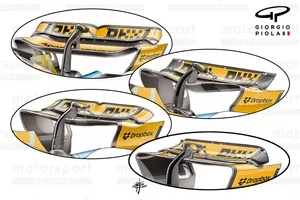
How McLaren’s rear wing push changed the game in F1
Formula 1
Formula 1
How McLaren’s rear wing push changed the game in F1
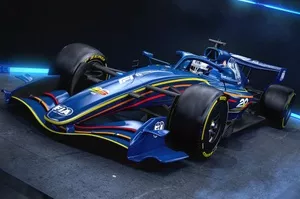
How 2026 F1 rules will help avoid identikit designs
Formula 1
Formula 1
How 2026 F1 rules will help avoid identikit designs

More from
Racing Bulls

Alan Permane signs new Racing Bulls F1 deal
Formula 1
Formula 1
Sao Paulo GP
14 h
Alan Permane signs new Racing Bulls F1 deal
Liam Lawson’s remarkable form is giving Red Bull a headache for 2027
Formula 1
Formula 1
Mexican GP
Liam Lawson’s remarkable form is giving Red Bull a headache for 2027

Latest news
Chase Briscoe leads NASCAR Cup Homestead practice; Larson brushes wall and Reddick wrecks
NASCAR Cup
NAS NASCAR Cup
Homestead-Miami
34 min
Chase Briscoe leads NASCAR Cup Homestead practice; Larson brushes wall and Reddick wrecks
Hamlin and Bell left with what could have been in NASCAR Chase
NASCAR Cup
NAS NASCAR Cup
Homestead-Miami
37 min
Hamlin and Bell left with what could have been in NASCAR Chase
Why Max Verstappen ended F1 practice early in Brazil – Red Bull explains
Formula 1
F1 Formula 1
Sao Paulo GP
1 h
Why Max Verstappen ended F1 practice early in Brazil – Red Bull explains
F1 Brazil GP: Saturday schedule, weather forecast and how to watch
Formula 1
F1 Formula 1
Sao Paulo GP
2 h
F1 Brazil GP: Saturday schedule, weather forecast and how to watch
Feature
Discover prime content
How F1’s rules got to be so complex
Formula 1
By Pat Symonds
How F1’s rules got to be so complex


Subscribe and access Motorsport.com with your ad-blocker.
From Formula 1 to MotoGP we report straight from the paddock because we love our sport, just like you. In order to keep delivering our expert journalism, our website uses advertising. Still, we want to give you the opportunity to enjoy an ad-free and tracker-free website and to continue using your adblocker.
You have 2 options:
- Become a subscriber.
- Disable your adblocker.
Subscribe now Already subscribed? Sign in here
Already disabled your adblocker?
Reload page
Manage Alerts
Subscribe