Analysis
Formula 1 German GP
Tech analysis: Ferrari's chequered bid to seek downforce answers
Ferrari admitted its car has not progress aerodynamically since the Spanish Grand Prix. Giorgio Piola and Matt Somerfield look at the Italian squad's latest attempts to generate more downforce.
Giorgio Piola Matt Somerfield
Edited: Aug 2, 2016, 1:26 PM
Copy link
Share on Viber
Giorgio Piola's F1 technical analysis
Giorgio Piola is the preeminent Formula 1 technical journalist. View our full selection of Giorgio's technical illustrative content
Ferrari
Introduced at the Hungarian GP, the 2D animation above shows a different view of the winglet we showed you at the last GP.
The winglet extends forward above the floor and is used to pinch the airflow, improving diffuser performance in the outside channel. It also works with the winglet stack above which the team started using in 2015 to assist the outer portion of the diffuser.
This area of the car is extremely sensitive given its proximity to the rear tyre, which deforms under load and can have a dramatic impact on performance.
The SF16-H is perhaps the busiest on the grid in this area of the car, as the designers try to engineer flow structures that improve performance and reduce sensitivity.
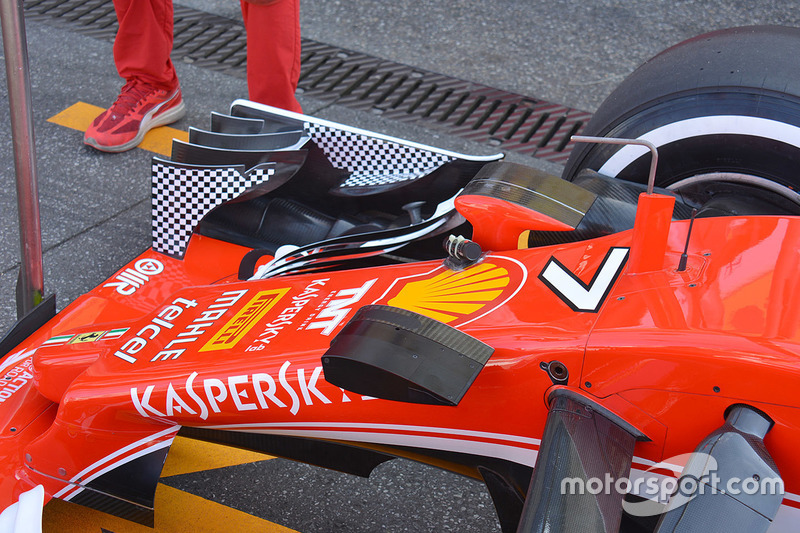
Ferrari SF16-H front nose detail
Photo by: Giorgio Piola
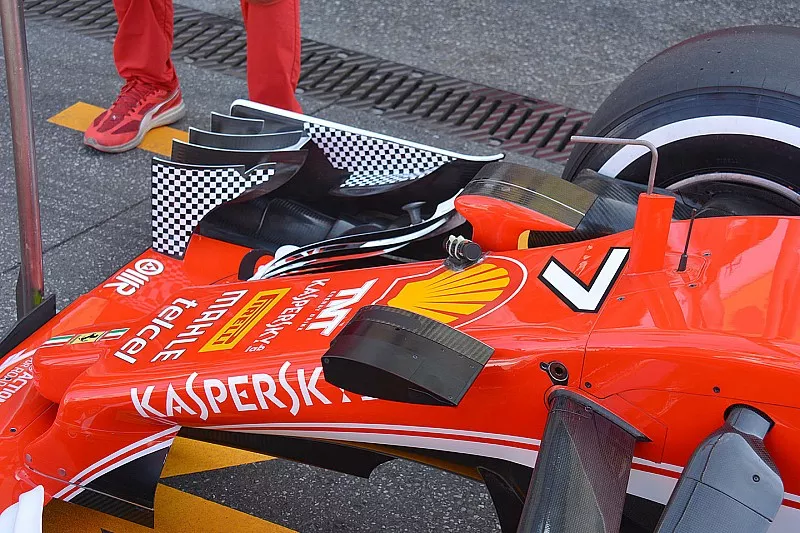
Ferrari conducted tests during free practice to ascertain how much their front wing is flexing whilst out on track.
Chequerboard stickers were affixed to the endplate, canard and 'r' cascade and will be used as a reference as the engineers study the footage from hi-speed camera, which was mounted on the SF16-H's nose.
No part of the car is infinitely rigid, but with load and deflection tests conducted by the FIA on certain parts, such as the front wing, it is important that the teams understand how to reach these limits for the static tests - but also circumnavigate them while on track to gain a competitive advantage over their rivals.
It's part of a constant chase for the engineers as they make gains and the FIA adjust the tests, but certainly isn't something that can be ignored, as others will be pushing the limits.
Mercedes
Development from Mercedes has been relentless so far this season, something that shows in the pure pace difference between them and the chasing pack.
Given this exhaustive development curve it is hardly surprising that the team had little to offer in terms of new parts for the race before the summer break, however, what did come to light was their use of a new brake disc over the last two races.

Mercedes W07 brake disc, German GP
Photo by: Giorgio Piola
The disc features a concave surface in the rim rather then the flat edge we are used to seeing used by F1 teams.
Rather than being a design pushed through by the manufacturer it is our understanding that the team requested that development be focused in this direction in order to assist both aero- and thermodynamically.
The shape change clearly has an impact on the drilling positions which dissipate heat from the disc, but it's fair to say there will also be a weight advantage too. Aside from the obvious shape change, the colouration of the disc also points at a change in the material being used.
Clearly it is still a carbon composite, but there may well be a ratio change in the materials being blended in order to reduce weight or increase thermal efficiency.
Sauber
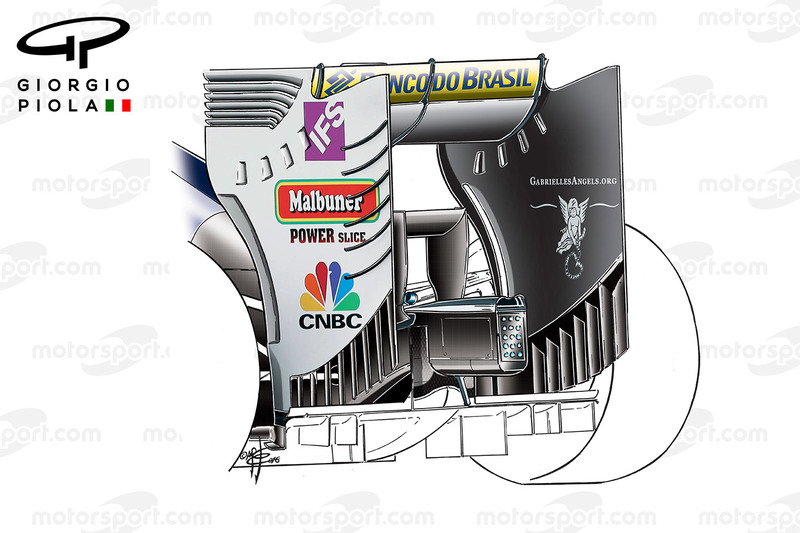
Sauber C35 rear wing, Hungarian GP
Photo by: Giorgio Piola
Having trialled their new rear wing design at both Silverstone and Hungary, the team finally applied it for the race in Germany, with both drivers sporting the new wing and monkey seat.
The new wing features several new distinguishing features, all of which we have seen other teams use with varying results.
The wing is now supported by a single centre mounting pillar, which should improve the performance of the mainplane, given the blockage caused by the twin pillars on the underside of the mainplane.
Like the old Y-shaped pillar, it intersects with the exhaust not only to improve rigidity but also to improve power unit performance.
The endplates feature gradient slots, like we've seen Ferrari, Red Bull and McLaren all use in the past or continue to use now. These allow airflow to move from outside the endplate in, injecting airflow to the underside of the mainplane and top flap, something that is more important in yaw.
The louvres follow a design trend started by Toro Rosso at the start of the season, with the leading edges displaced in order to change how the pressure moves from one side to another, which changes how the vortex at the flap and endplate juncture forms, with the intent of improving downforce and reducing drag.
The monkey seat is fairly conventional and can be found mounted either side of the crash structure, rather than on the rear wing support pillars as its predecessor was. It features two flaps with which to assist in the upwash of airflow and connect the diffuser and rear wing airflow structures.
We want your opinion!
What would you like to see on Motorsport.com?
Take our 5 minute survey.
- The Motorsport.com Team
Read and post comments
Read also :
Share Or Save This Story
Copy link
Share on Viber
Previous article Williams insists it won't wait too long for Button
Next article Hamilton “nowhere near” engine limit in German GP
Top Comments
There are no comments at the moment. Would you like to write one?
View More & Comment
More from
Giorgio Piola
The fascinating story behind McLaren's most iconic F1 car
Formula 1
Formula 1
The fascinating story behind McLaren's most iconic F1 car
Emilia Romagna GP: F1 technical images from Imola's pitlane
Formula 1
Formula 1
Emilia Romagna GP
Emilia Romagna GP: F1 technical images from Imola's pitlane
The F1 downforce choices that proved key at the Saudi GP
Formula 1
Formula 1
Saudi Arabian GP
The F1 downforce choices that proved key at the Saudi GP
More from
Ferrari
Max Verstappen on Ferrari clashes: "I would never sign two number-one drivers"
Formula 1
Formula 1
Sao Paulo GP
Max Verstappen on Ferrari clashes: "I would never sign two number-one drivers"
Latest news

Carson Hocevar and Cleetus McFarland win LeMullets 2026 in epic finish
General
Misc General 1 h
Carson Hocevar and Cleetus McFarland win LeMullets 2026 in epic finish
TV ratings released for NASCAR Cup season finale
NASCAR Cup
NAS NASCAR Cup
Homestead-Miami
7 h
TV ratings released for NASCAR Cup season finale
Chase Elliott's car chief leaves Hendrick for NASCAR Truck crew chief role
NASCAR Truck
NSTR NASCAR Truck
Homestead
8 h
Chase Elliott's car chief leaves Hendrick for NASCAR Truck crew chief role
Feature
Discover prime content
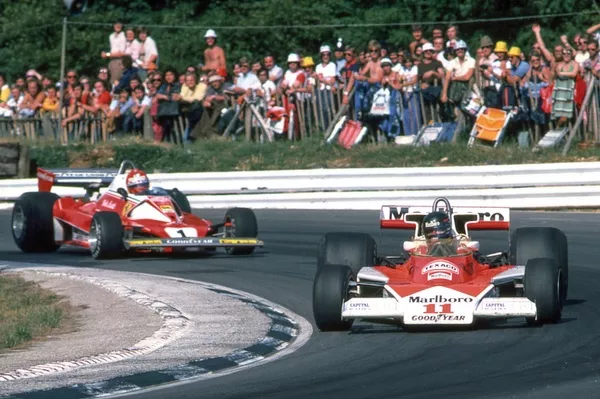
Top 10 F1 cars of the 1970s
Formula 1
By Kevin Turner
Top 10 F1 cars of the 1970s

Subscribe and access Motorsport.com with your ad-blocker.
From Formula 1 to MotoGP we report straight from the paddock because we love our sport, just like you. In order to keep delivering our expert journalism, our website uses advertising. Still, we want to give you the opportunity to enjoy an ad-free and tracker-free website and to continue using your adblocker.
You have 2 options:
- Become a subscriber.
- Disable your adblocker.
Subscribe now Already subscribed? Sign in here
Already disabled your adblocker?
Reload page
Manage Alerts
Subscribe