Analysis
Formula 1 Brazilian GP
Tech analysis: Ferrari with a tough balancing act
Ferrari has found itself in a quandary in the latter part of 2016, with Red Bull surpassing it in the constructors' championship, regulation changes looming for 2017 and pressure from Sergio Marchionne for long-term success.
Giorgio Piola Matt Somerfield
Edited: Nov 16, 2016, 4:23 PM
Copy link
Share on Viber

Giorgio Piola's F1 technical analysis
Giorgio Piola is the preeminent Formula 1 technical journalist. View our full selection of Giorgio's technical illustrative content
The loss of James Allison mid-way through this campaign has been a bitter pill to swallow too, with a technical director's DNA ingrained in the way a team operates for a significant time.
On top of this, the team, left with very few options to directly replace Allison, has opted for a more horizontal management structure for the foreseeable future, which will undoubtedly take time to work in the way we see other teams maximise it.
The struggles it has faced in these last few GPs has been a war between understanding the fundamental flaws of the SF16-H, improving its qualifying and race pace and making sense of any conceptual ideas during practice sessions that can be applied to next season.
It's a difficult balancing act and requires both sides of the garage to make sacrifices to their programmes to achieve their overall goal.
As such, much has been made about the improvement of Raikkonen in comparison to Vettel in the latter part of the year but, where the German has seemingly sacrificed more of his GP preparation to help understand next year's car it has often left him under prepared for the current challenge.
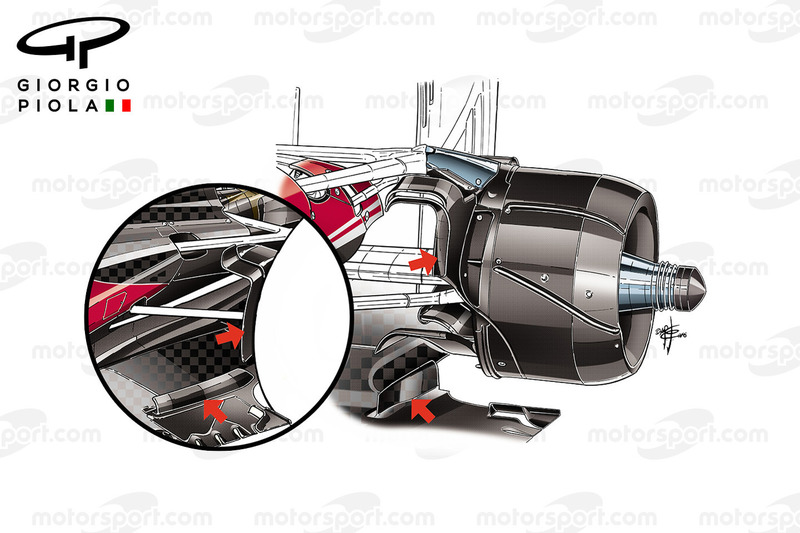
Ferrari SF16-H rear brake ducts comparison, Brazilian GP
Photo by: Giorgio Piola
This push and pull in current and 2017 development has meant that the team has not only looked at new components but also made comparisons with older ones. In Brazil much of this focus was placed on rear brake cooling and aerodynamic stability.
The brake ducts' vertical fence that was revised way back in China featured a much smaller fence, exposing the lower horizontal fin to its own less interrupted airflow and allowing it a clearer pathway out the rear of the brake duct fin cluster.
However, the reduction in the fence's height also means that the inlet receives less cooled air, leading to an aero vs cooling compromise.
The wider tyres and various aerodynamic changes that surround them for 2017 are clearly a concern to the Scuderia, as some of this test work is clearly focused on getting a handle on it early.
However, the evaluation of these different brake duct configurations is also the result of another change made slightly ahead of this to the SF16-H's floor.
The vertical strake mounted just ahead and inboard of the front tyre (arrowed) creates a very specific vortex that works with, but not limited to, the slots in the floors periphery and the lower brake duct fin, in order to reduce the effect of 'tyre squirt'.
This phenomenon that if left untreated is destructive to the diffusers performance is something that Ferrari is keen to manage.
As both short and long versions of the vertical brake duct fence were used in combination with the outgoing curved strake it made perfect sense for all of their options to be explored.
We want your opinion!
What would you like to see on Motorsport.com?
Take our 5 minute survey.
- The Motorsport.com Team
Read and post comments
Read also :
Share Or Save This Story
Copy link
Share on Viber
Previous article Raikkonen: F1's wet tyres were better a decade ago
Next article Obituary: Dr Aki Hintsa, 1958-2016
Top Comments
There are no comments at the moment. Would you like to write one?
View More & Comment
More from
Giorgio Piola

The fascinating story behind McLaren's most iconic F1 car
Formula 1
Formula 1
The fascinating story behind McLaren's most iconic F1 car

Emilia Romagna GP: F1 technical images from Imola's pitlane
Formula 1
Formula 1
Emilia Romagna GP
Emilia Romagna GP: F1 technical images from Imola's pitlane
The F1 downforce choices that proved key at the Saudi GP
Formula 1
Formula 1
Saudi Arabian GP
The F1 downforce choices that proved key at the Saudi GP
More from
Ferrari

The six drivers doing double duty in Portimao GTWCE and Barcelona WEC this weekend
WEC
WEC
Barcelona
The six drivers doing double duty in Portimao GTWCE and Barcelona WEC this weekend
Fred Vasseur "not sure" if Red Bull is currently F1's best team
Formula 1
Formula 1
Singapore GP
Fred Vasseur "not sure" if Red Bull is currently F1's best team
Latest news

Max Verstappen on GTWC Europe debut: “We’re here to win”
GT World Challenge Europe Endurance
WCEE GT World Challenge Europe Endurance 8 h
Max Verstappen on GTWC Europe debut: “We’re here to win”

How to watch NASCAR at Phoenix II: Weekend schedule, start time, entry list, TV
NASCAR Cup
NAS NASCAR Cup
Phoenix II
8 h
How to watch NASCAR at Phoenix II: Weekend schedule, start time, entry list, TV

Ryan Ellis signs multi-year NASCAR O'Reilly deal with Alpha Prime Racing
NASCAR O'Reilly
NOAP NASCAR O'Reilly
Phoenix II
8 h
Ryan Ellis signs multi-year NASCAR O'Reilly deal with Alpha Prime Racing

Ayao Komatsu: Rafael Camara chosen for F1 2027 seat on speed, not Ferrari links
Formula 1
F1 Formula 1
Singapore GP
14 h
Ayao Komatsu: Rafael Camara chosen for F1 2027 seat on speed, not Ferrari links
Feature
Discover prime content



Subscribe and access Motorsport.com with your ad-blocker.
From Formula 1 to MotoGP we report straight from the paddock because we love our sport, just like you. In order to keep delivering our expert journalism, our website uses advertising. Still, we want to give you the opportunity to enjoy an ad-free and tracker-free website and to continue using your adblocker.
You have 2 options:
- Become a subscriber.
- Disable your adblocker.
Subscribe now Already subscribed? Sign in here
Already disabled your adblocker?
Reload page
Manage Alerts
Subscribe