Analysis
Formula 1
Tech analysis: Is Mercedes doing enough to stay ahead in 2017?
Admitting one's weaknesses is a first step in addressing them and with a significant shift in performance expected from many teams in 2017 it seems Mercedes is keen to iron out its own.
Giorgio Piola Matt Somerfield
Edited: Nov 18, 2016, 1:04 PM
Copy link
Share on Viber
Giorgio Piola's F1 technical analysis
Giorgio Piola is the preeminent Formula 1 technical journalist. View our full selection of Giorgio's technical illustrative content
Over the last three seasons, Mercedes has taken the bar and raised it well out of reach - and while others have made gains throughout, none have been able to mount a sustainable challenge.
Many of the great runs of dominance in Formula 1’s history have come to an end either through regulatory change not suiting the reigning champions, another challenger amassing a superior technical arsenal or the breaking up of a team's technical personnel.
The proof will be in the pudding when it comes to the way Mercedes has interpreted next year’s regulations, when weighed against the rest of the field, but what cannot be denied is that its infrastructure and the way the team wields its technical prowess is matched by few.
The movement of staff ahead of a regulation change can also be a gamechanger as even with the firewall of gardening leave imposed on engineers, it is inevitable that information is bled from one operation to another.
Mercedes has done well to hold onto most of its staff ahead of 2017 and whilst those that have moved might be able to provide insight, the same can be said for anyone that Mercedes has been able to acquire.
Shifting development from one car to another is also a key factor in boosting performance under a new set of regulations but with a significant staff pool, perhaps the largest on the grid, Mercedes should be able to cope better than most with multiple car programmes.
It is the harmonious relationship between chassis and powertrain departments that has shone through as one of the most significant aspects of its success since 2014 and no wonder, given how intertwined the two now are.
If anyone should have benefitted from this school of thinking, it should have been Ferrari but the Prancing Horse's problems have been exacerbated by its inability to fixate on how you trade performance off one with the other.
Meanwhile, a fractious relationship between Red Bull and Renault is now on the mend and recent investment from both sides may see them challenge Mercedes next season.
The threat of increased competition puts Mercedes in a position where it knows it has to not only get its car right but improve on areas of weakness that have been exposed in the past. As such, the manufacturer has set up separate technical working groups that research and develop methods in which to eradicate or improve these issues.
One of these has been focused on improving Mercedes' brake performance, which is of particular interest next season because the overall minimum weight of the car is increasing by 20 kgs and there will be more rotational mass to deal with given the increase in width of the tyres.
The regulations have some scope to deal with these problems with the maximum width of the brake disc increased from 28mm to 32mm. However, this simply adds more rotational mass into the equation, something that the teams may be looking at ways of reducing.
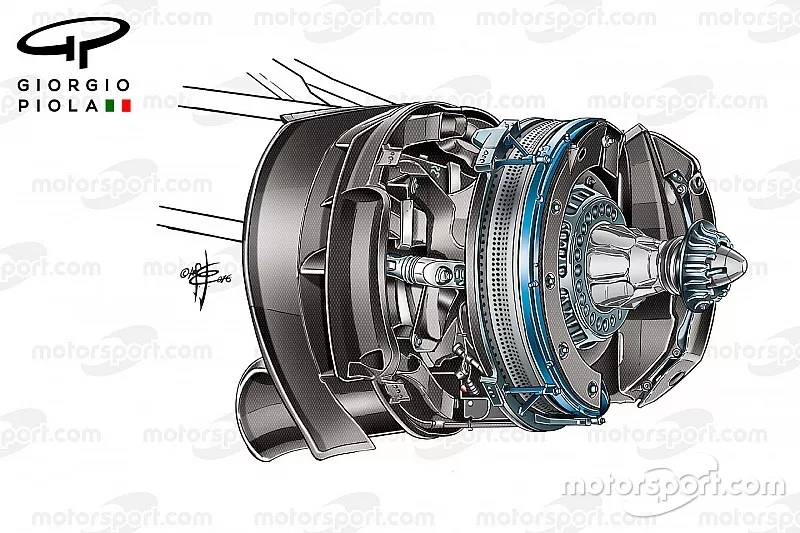
That brings us along to a solution that Mercedes has tested at Monza, Austin and in Mexico and is something that we haven’t seen packaged in this particular way before.

Mercedes W06 hydraulic parts, front suspension
Photo by: Giorgio Piola
We must also bear in mind the covert nature in which this arrangement has been tested in a real-world environment, as although we have uncovered what Mercedes has been up to, it's also been testing its developmental open-ended front wing, perhaps with a view of drawing attention away from the brake solution, just as the team did last year when it tested a new hydraulic suspension element in combination with an ‘S’ duct.

Mercedes W07 front brake disc, captioned, Mexican GP
Photo by: Giorgio Piola
Mounted in extremely close proximity to the brake disc we find a pair of shims [1] of a similar, if not the same, material to the brake disc. Each of these shims are around 6-8mm in width and have holes drilled in them in the same way a brake disc does to release heat.
Unlike the brake disc, these shims are static and only take up residence at the front half of the brake assembly, with the caliper mounted at the rear.

Mercedes W07 front brakes comparison, Brazilian GP
Photo by: Giorgio Piola
In order to mount the outer shim alongside the brake disc, the team has been forced to create a new concentric housing, as made obvious when we compare the regular specification [Race] with the new one [Test] above.
Metal truss work is used to bridge the gap between each housing [upper image, 2] so as to be less intrusive to the surrounding airflow. The shims are also fed cool air through the housings by new ductwork installed within the assembly.
The outer housing is fed by an offshoot from the crossover pipe, which itself is enlarged as it ordinarily feeds just the caliper with cool air. Meanwhile, the inner shim housing is fed by new pipework that traverses the front face of the assembly.
Whilst the objective of this new concept is to improve the operation of the brakes, it will come with several fringe benefits, too. The proximity of the rotating brake disc to the shims will undoubtedly lead to a rapid heat cycle, activating the brake material and improving brake feel for the driver much quicker than is ordinarily possible.
"Once at the correct operating temperature, the shared living space means that it will be much more difficult to overheat the disc and lose performance, as heat is transferred between the surfaces. Heat loss will also take more time as each surface retains its own energy, widening the operating window.
We know only too well how much the teams focus their effort on using heat generated by the brakes in order to bring the tyres in and manage them over a stint. With the tyre width increasing in 2017, widening the band that the brake disc occupies should result in a better thermal relationship with the wheel rim and, in turn, the tyre.
Mercedes will also be considering the impact of weight too, as whilst the shims are clearly adding some, it’s a negligible penalty when we consider it may allow the team to run a narrower brake disc than the maximum 32mm that will be allowed, reducing the rotational mass of the disc.
If seen to be a gamechanger by the other teams, the use of the concept is going to be divisive, perhaps even to the point where clarification will be sought, as sometimes it’s easier to get something outlawed rather than spend time and money developing your own version.
For now we must play the waiting game and see if this solution makes its way onto the W08. If it does, it’ll be interesting to see who follows in Mercedes' footsteps.
We want your opinion!
What would you like to see on Motorsport.com?
Take our 5 minute survey.
- The Motorsport.com Team
Read and post comments
Read also :
Share Or Save This Story
Copy link
Share on Viber
Previous article Rosberg gap leaves Hamilton in "awkward position" for Abu Dhabi
Next article Pirelli has "room for improvement" with 2017 wet tyres - Horner
Top Comments
There are no comments at the moment. Would you like to write one?
View More & Comment
More from
Giorgio Piola
The fascinating story behind McLaren's most iconic F1 car
Formula 1
Formula 1
The fascinating story behind McLaren's most iconic F1 car

Emilia Romagna GP: F1 technical images from Imola's pitlane
Formula 1
Formula 1
Emilia Romagna GP
Emilia Romagna GP: F1 technical images from Imola's pitlane
The F1 downforce choices that proved key at the Saudi GP
Formula 1
Formula 1
Saudi Arabian GP
The F1 downforce choices that proved key at the Saudi GP

More from
Mercedes
Kimi Antonelli and George Russell set for Mercedes talks over Las Vegas GP qualifying woes
Formula 1
Formula 1
Las Vegas GP
5 min
Kimi Antonelli and George Russell set for Mercedes talks over Las Vegas GP qualifying woes

Max Verstappen responds to George Russell after Vegas clash
Formula 1
Formula 1
Las Vegas GP
4 h
Max Verstappen responds to George Russell after Vegas clash

Latest news
Kimi Antonelli and George Russell set for Mercedes talks over Las Vegas GP qualifying woes
Formula 1
F1 Formula 1
Las Vegas GP
5 min
Kimi Antonelli and George Russell set for Mercedes talks over Las Vegas GP qualifying woes
Max Verstappen shares theory on Ferrari's lack of top speed in F1 2026
Formula 1
F1 Formula 1
Las Vegas GP
36 min
Max Verstappen shares theory on Ferrari's lack of top speed in F1 2026
Fernando Alonso: Honda lacks so much power that rivals take extra margin behind us
Formula 1
F1 Formula 1
Las Vegas GP
1 h
Fernando Alonso: Honda lacks so much power that rivals take extra margin behind us
Feature
Discover prime content

Subscribe and access Motorsport.com with your ad-blocker.
From Formula 1 to MotoGP we report straight from the paddock because we love our sport, just like you. In order to keep delivering our expert journalism, our website uses advertising. Still, we want to give you the opportunity to enjoy an ad-free and tracker-free website and to continue using your adblocker.
You have 2 options:
- Become a subscriber.
- Disable your adblocker.
Subscribe now Already subscribed? Sign in here
Already disabled your adblocker?
Reload page
Manage Alerts
Subscribe