Analysis
Formula 1
Tech analysis: McLaren's plan to increase rear downforce
Having failed to use its new rear wing in China due to a lack of free practice time, McLaren fit it on Fernando Alonso's MCL32 in Bahrain.
Matt Somerfield Giorgio Piola
Edited: Apr 22, 2017, 11:10 AM
Copy link
Share on Viber
Giorgio Piola's F1 technical analysis
Giorgio Piola is the preeminent Formula 1 technical journalist. View our full selection of Giorgio's technical illustrative content
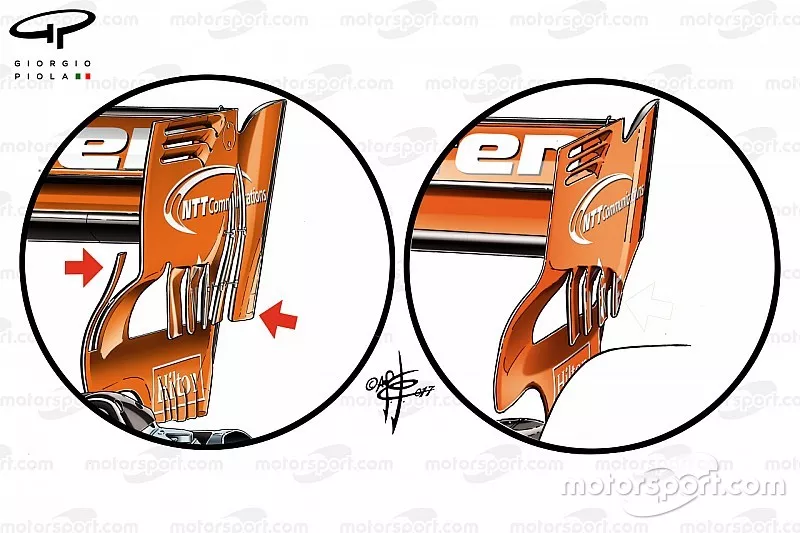
The rear wing builds on the concept already put forward by the team since the start of the season, making use of the box area within the regulations that asks for a curvature to the endplate, allowing a narrower section above the floor but a wider wing at the top.
This box area, while requiring the curvature, also leaves open the possibility for strakes like the ones exclusively used by McLaren, something it has exploited even further with this update.
Four strakes previously hung adrift from the endplate's main surface with the trailing element reforming a connection to the main assembly (right hand illustration).
The revised endplate (left hand illustration) now features an additional pair of much longer slots (right arrow), in a similar fashion to the wing that had a solo outing at the Austrian GP during free practice last season (below), while a small metal stay is used to maintain their integrity.
Meanwhile, a leading edge slat, detached from the upper edge of the endplate has also been added (left arrow).

McLaren MP4-31 rear wing (trialed but not raced)
Photo by: Giorgio Piola
It seems that McLaren is pursuing a way to extract more downforce from the rear wing by artificially increasing its aspect ratio, as airflow is introduced into the outer portion of the wing that would ordinarily be blocked by the endplate - thus changing the shape and vorticity of the wing tip vortices too.

McLaren MCL32 T wing and rear endplate details
Photo by: Giorgio Piola
This is further improved by the introduction of the T-wing (above), which also has an impact on the tip vortices, as it creates a new airflow structure ahead of the main wing.
While these changes should improve the downforce being generated by the rear wing, it's worth noting that the team will also make geometrical changes to the wing elements in order that the drag being created is balanced.
Testing times

Oliver Turvey, McLaren MCL32
Photo by: LAT Images
The uphill struggle that McLaren faces due to Honda's inadequacies is well-documented, but that isn't stopping the Woking-based outfit from attempting to make gains through better understanding of its aerodynamic package and Pirelli's tyres.
The MCL32 was fitted with numerous kiel and pitot tube arrays at the post-race test in Bahrain.
This is done in order to measure both the impact of their aerodynamic surfaces and monitor how the deformation of the tyres changes the various aerodynamic structures being generated.

Stoffel Vandoorne, McLaren MCL32
Photo by: Sutton Motorsport Images / sutton-images.com
The team also mounted another sensor in the diffuser, which monitors the rear tyres deformation under load. This is likely an infra-red camera, as that will help the team to establish how temperature within the tyre changes the tyre's behaviour - including changes to the construction and the impact that has on the compound.
We want your opinion!
What would you like to see on Motorsport.com?
Take our 5 minute survey.
- The Motorsport.com Team
Read and post comments
Read also :
Share Or Save This Story
Copy link
Share on Viber
Previous article Haas doesn't expect gap to top F1 teams to close in 2017
Next article Renault confident it knows how to fix race pace problem
Top Comments
There are no comments at the moment. Would you like to write one?
View More & Comment

More from
Matt Somerfield

Gallery: How F1 tech evolved during the 2024 season
Formula 1
Formula 1
Gallery: How F1 tech evolved during the 2024 season
How McLaren’s rear wing push changed the game in F1
Formula 1
Formula 1
How McLaren’s rear wing push changed the game in F1
How 2026 F1 rules will help avoid identikit designs
Formula 1
Formula 1
How 2026 F1 rules will help avoid identikit designs

More from
McLaren
How the F1 2026 regulations neutered Oscar Piastri's "real strength"
Formula 1
Formula 1
Las Vegas GP
16 h
How the F1 2026 regulations neutered Oscar Piastri's "real strength"

What Flavio Briatore takes from McLaren after Fernando Alonso "disaster"
Formula 1
Formula 1
Las Vegas GP
17 h
What Flavio Briatore takes from McLaren after Fernando Alonso "disaster"

Top 10 F1 cars of the 1980s
Formula 1
Top 10 F1 cars of the 1980s
Latest news

LIVE: F1 Las Vegas GP updates - Qualifying
Formula 1
F1 Formula 1
Las Vegas GP
49 min
LIVE: F1 Las Vegas GP updates - Qualifying
F1 Las Vegas GP: George Russell tops final practice after Max Verstappen collision
Formula 1
F1 Formula 1
Las Vegas GP
2 h
F1 Las Vegas GP: George Russell tops final practice after Max Verstappen collision
LIVE: F1 Las Vegas GP updates - George Russell leads final practice
Formula 1
F1 Formula 1
Las Vegas GP
4 h
LIVE: F1 Las Vegas GP updates - George Russell leads final practice
NASCAR set to incrementally increase horsepower as part of 2027 Cup rules
NASCAR Cup
NAS NASCAR Cup 7 h
NASCAR set to incrementally increase horsepower as part of 2027 Cup rules
Feature
Discover prime content

Top 10 F1 cars of the 1980s
Formula 1
By Kevin Turner
Top 10 F1 cars of the 1980s
Subscribe and access Motorsport.com with your ad-blocker.
From Formula 1 to MotoGP we report straight from the paddock because we love our sport, just like you. In order to keep delivering our expert journalism, our website uses advertising. Still, we want to give you the opportunity to enjoy an ad-free and tracker-free website and to continue using your adblocker.
You have 2 options:
- Become a subscriber.
- Disable your adblocker.
Subscribe now Already subscribed? Sign in here
Already disabled your adblocker?
Reload page
Manage Alerts
Subscribe