Analysis
Formula 1 Barcelona February testing
Analysis: Top F1 teams' tech secrets on show in Barcelona
Formula 1 teams can pick and choose what they want to show off during their car launches, but actual track action offers no such luxury. Matt Somerfield and Giorgio Piola look at the tech solutions that broke cover in Barcelona.
Matt Somerfield Giorgio Piola
Edited: Mar 4, 2018, 1:26 PM
Copy link
Share on Viber

Giorgio Piola's F1 technical analysis
Giorgio Piola is the preeminent Formula 1 technical journalist. View our full selection of Giorgio's technical illustrative content
Formula 1 car launches offer us an insight into the core shape and design intention of each team, but they very rarely tell us the full story of what teams have planned for the season ahead.
In fact, it looks like a few outfits deliberately played around in doctoring some of their launch images to put the media – and rival teams – off the scent of their most innovative solutions.
But at some point teams have to run these key parts on the cars – and testing at Barcelona this week duly revealed many of these interesting design ideas.
Here we take a look at some of the details behind the main challengers.
Mercedes
Mercedes took its time to evaluate the W09 during the first few days of the test.
But, having lost almost an entire day of testing to the weather on Wednesday, it decided to roll out a new front and rear wing, plus a new nose cape on the final day in an attempt to get a baseline ahead of next year’s running.

Mercedes F1 W09 detail front wing
Photo by: Mark Sutton
The front wing is an evolution of its predecessor and features a revised endplate and inner canard arrangement.
The endplate and canard have been conjoined, creating a much wider flap that completely changes the behaviour of the airflow that travels up, over and around the front tyre. This helps shape the wake created by it and lessens the aerodynamic damage it has downstream.

Mercedes F1 W09 cape
Photo by: Mark Sutton
The cape, which the team introduced in Spain last season and subsequently tweaked in Malaysia, was also modified with a much larger curved leading edge.

Mercedes GP W09 rear
Photo by: Giorgio Piola
At the rear of the car, the team installed a lower T-wing at the start of the test (red arrow), exploiting the small area left in the regulations that permits such appendages.

Valtteri Bottas, Mercedes AMG F1 W09
Photo by: Stefano Arcari
The lower-downforce, reduced-drag ‘spoon’-style rear wing used for the first few days was cast aside on Thursday as the team evaluated a new, higher downforce, rear wing which features a more conventional mainplane. This is supplemented by an extrusion in the central section.
The extrusion is roughly the same width as the simple single element winglet hung from the mounting pylon below, and likely works in harmony with it in order to extract the most performance from each other as well as the exhaust plume below.
Ferrari

Ferrari SF71H sidepods
Photo by: Giorgio Piola
The SF71H features some really nice features that set it apart from much of the field.
Its wing mirrors are not only a very original and innovative design, but also show just how prepared the team is to fly close to the sun when it comes to interpreting the regulations.
The open face of the mirror exposes a guide vane that's connected to the rear of the mirror glass.
This not only allows the airflow another pathway, but gives it a purpose - reducing the turbulence created, and feeding the upper sidepod inlet while improving flow over the entire surface of the sidepod downstream.
Other teams will now almost certainly be looking on with interest and evaluating the design of the mirrors, to see if any benefits can be found by adopting such as a design themselves.
While Ferrari is the only team with such a sidepod inlet that can be helped with this design, the concept could be used by others to help reduce airflow resistance in this area of the car.

Ferrari SF71H diffuser
Photo by: Giorgio Piola
Another interesting novelty, this time at the rear of the SF71H, is the crash structure enclosure (white arrow), which creates a sort of tunnel either side of it in the coke bottle region.
It’s unclear at this stage whether these outlets, which terminate inline with the upper cooling outlets, are an expansion of the cooling requirement of the SF71H or whether they have further aerodynamic ramifications.

Ferrari SF70H rear floor detail
Photo by: Sutton Images
When not installed, the enclosure reveals that the floor features a concave shape, following the external boat tail shaping and allows access to the starter motor (white arrow, below).

Ferrari SF70H floor-starter hole
Photo by: Mark Sutton
It’s likely the designers have found that airflow migrating around the sidepod into the coke bottle region was adversely affected by the sudden transition into this floor well and have sought a way to improve performance.
Red Bull

Red Bull RB13, front wing comparison
Photo by: Giorgio Piola
During day four of the test, Red Bull opted to regress to its earlier specification wing from 2017 (inset), before returning to a specification in line with what it finished last season with.
As you can see, the two wings have different characteristics, with a wider outboard section to work the airflow across the front of the tyre’s face (yellow highlight). There is also a different endplate canard (circled) and, most importantly, a very different flap orientation.
The newer configuration’s tips curl over in a more conventional fashion (blue arrows), whilst the lowest flap (red arrow) meets the connecting point with the neutral section.
The latter of these changes has an impact on the ferocity and shape of the Y250 vortex that’s shed from this region, and marked a distinct change in philosophy at the tail end of the season, making it an interesting decision to do back-to-back tests and correlation work with the two configurations.

Max Verstappen, Red Bull Racing RB14
Photo by: Sutton Images
Not for the first time, the team has run without an aerodynamic surface during testing in order to put mileage on the board. Think back to 2015 when it ran the Camo Bull without a front wing (after Daniil Kvyat’s off) as it didn’t have a spare, until one was shipped out.
The team ran the RB14 without the sidepod deflectors extensively throughout the opening few days of the test, amid suggestions that the succession of panels held by supports at either end may not be strong enough.

Red Bull Racing RB14 deflector support
Photo by: Mark Sutton
A revised deflector could be found on the RB14 during the last day of the test, which featured an additional support spar (white arrow).
We want your opinion!
What would you like to see on Motorsport.com?
Take our 5 minute survey.
- The Motorsport.com Team
Read and post comments
Read also :
Share Or Save This Story
Copy link
Share on Viber
Previous article "Ugly, awkward" halo could cause Eau Rouge problem - Magnussen
Next article Opinion: What might retirement look like for Lewis Hamilton?
Top Comments
There are no comments at the moment. Would you like to write one?
View More & Comment

More from
Matt Somerfield

Gallery: How F1 tech evolved during the 2024 season
Formula 1
Formula 1
Gallery: How F1 tech evolved during the 2024 season
How McLaren’s rear wing push changed the game in F1
Formula 1
Formula 1
How McLaren’s rear wing push changed the game in F1
How 2026 F1 rules will help avoid identikit designs
Formula 1
Formula 1
How 2026 F1 rules will help avoid identikit designs

More from
Ferrari
‘I’ll try to win, somehow’ – Can Lewis Hamilton and Max Verstappen fight back for F1 Brazilian GP victory?
Formula 1
Formula 1
Sao Paulo GP
3 h
‘I’ll try to win, somehow’ – Can Lewis Hamilton and Max Verstappen fight back for F1 Brazilian GP victory?
F1 Brazilian GP: Sunday schedule, weather forecast and how to watch
Formula 1
Formula 1
Sao Paulo GP
18 h
F1 Brazilian GP: Sunday schedule, weather forecast and how to watch
Latest news
LIVE: F1 Brazilian GP - Kimi Antonelli survives pre-race off
Formula 1
F1 Formula 1
Sao Paulo GP
23 min
LIVE: F1 Brazilian GP - Kimi Antonelli survives pre-race off
WEC Monza: Cadillac wins chaotic finale, #8 Toyota seals drivers’ title
WEC
WEC WEC
Monza
31 min
WEC Monza: Cadillac wins chaotic finale, #8 Toyota seals drivers’ title
Justin Allgaier is a Hall of Fame asset, nearing a Hall of Fame resume
NASCAR O'Reilly
NOAP NASCAR O'Reilly
Homestead-Miami
46 min
Justin Allgaier is a Hall of Fame asset, nearing a Hall of Fame resume
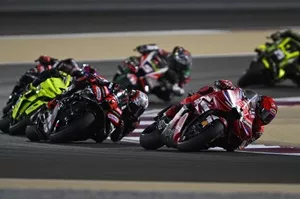
LIVE: MotoGP Qatar GP: Commentary and updates
MotoGP
MGP MotoGP
Qatar GP
1 h
LIVE: MotoGP Qatar GP: Commentary and updates
Feature
Discover prime content
How F1’s rules got to be so complex
Formula 1
By Pat Symonds
How F1’s rules got to be so complex

Subscribe and access Motorsport.com with your ad-blocker.
From Formula 1 to MotoGP we report straight from the paddock because we love our sport, just like you. In order to keep delivering our expert journalism, our website uses advertising. Still, we want to give you the opportunity to enjoy an ad-free and tracker-free website and to continue using your adblocker.
You have 2 options:
- Become a subscriber.
- Disable your adblocker.
Subscribe now Already subscribed? Sign in here
Already disabled your adblocker?
Reload page
Manage Alerts
Subscribe