Analysis
Formula 1
Tech analysis: The clever solutions that divide the F1 grid
Pre-season testing has offered a glimpse of the general direction F1 teams are heading in with their designs this year. Here were take a look at some of the most interesting design features seen so far.
Matt Somerfield Giorgio Piola
Edited: Mar 21, 2017, 1:28 PM
Copy link
Share on Viber
Giorgio Piola's F1 technical analysis
Giorgio Piola is the preeminent Formula 1 technical journalist. View our full selection of Giorgio's technical illustrative content

Red Bull Racing RB 13 comparison
Photo by: Giorgio Piola
The Red Bull RB13's nose has drawn attention due to the inlet that can be found right at the tip of the thumb section.
It was initially proposed that the team was using the inlet for driver cooling like its 2014 nose did (inset), given inlets this far forward should only fulfill this purpose.

Force India VJM08B nose cone, captioned
Photo by: Giorgio Piola
However, the team has found a workaround, taking advantage of the cross-sectional rules that have previously allowed Force India's 'Cobra' nose solution (above).
And just like with Force India's solution, the idea is to make it as if the bodywork doesn't exist, at least from an aerodynamic perspective, with the airflow taken in by the inlet(s) immediately ejected out of the rear face, simulating a higher nose.
This is all achieved with vertical fins that are carefully placed within the nose tips thumb, in order that if a slice be taken through, the side of the nose a hole could never be made.
It was also assumed that the inlet may also be connected to the team's 'S' duct solution, which returns after a sabbatical.
However, two NACA-style inlets can be found just behind the front wing mounting pillars which are used to feed the 'S' duct in a similar way to how Toro Rosso and Mercedes fed theirs last year.

Mercedes W08 front suspension
Photo by: Giorgio Piola
Mercedes has taken what was originally thought to be a unique approach to its front suspension layout, with its outboard wishbone pivot mounted above the upright on a horn-shaped appendage (red arrow), although we subsequently found out that Toro Rosso had the same idea when it launched the STR12 a few days later.
We've seen teams do similar things at the rear of the car for a number of years, as they look to trade off the mechanical capability of the suspension with potential aerodynamic gains - and this is done for much the same purpose too.

Toro Rosso STR12 front suspension, captioned
Photo by: Giorgio Piola
Moving the upper wishbone upwards allows the lower one to be placed slightly higher too, changing the entire suspension geometry but also allowing the airflow worked by the wing a different path to follow as it heads toward the sidepods.
Mercedes has also made a change to its front brake duct fence for 2017, as you'll note a slot just ahead of the small brake cooling inlet.

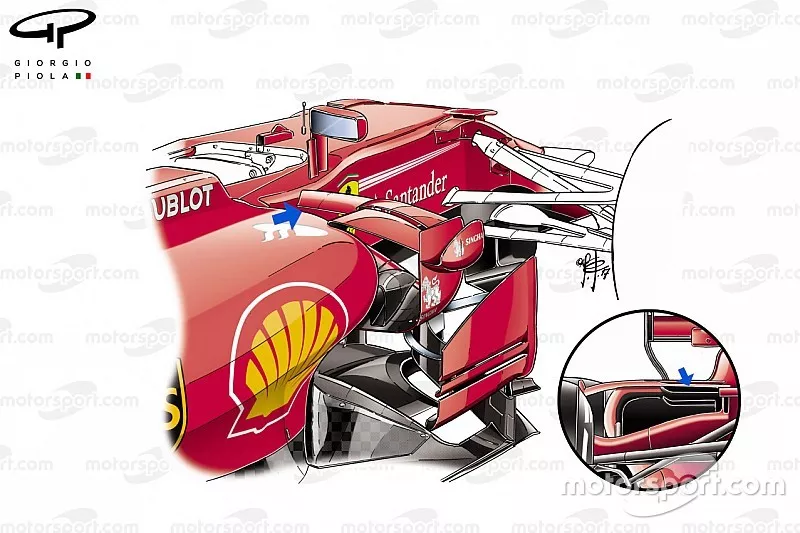
Ferrari SF70H turning vanes, detailed
Photo by: Giorgio Piola
Ferrari's sidepod layout is one of the most interesting on the grid, as the team has looked to set its inlet back, keeping the opening straight, rather than be angled as the regulations intended.
To overcome this angular requirement the team has obfuscated the sidepod with a cluster of winglets which encourage the air to flow into and around the sidepod in a more desirable manner.
The team has also incorporated a secondary inlet (blue arrow) which sits above the main inlet and collects and distributes airflow inside the sidepod to improve cooling and efficiency.

Williams FW40 double planes
Photo by: Giorgio Piola
Whenever wholesale changes are made to the regulations, there are some unintended consequences: the T-wings are one such frailty in the wording of the current regulations, with changes made to October's release of the regulations that inadvertently opened up the space for these 50mm chord winglets.
Mercedes, Ferrari, Haas and Williams have adopted T-wings so far, although the latter opted for two winglets (arrowed).
These winglets, although very short in chord, will create their own downforce but will also realign the upwash and aerodynamic connection between the diffuser and rear wing to improve downforce and reduce drag.
It's also worth noting that Williams has a gurney-style trim straddling their engine cover (arrowed), as the team looks to make larger gains from the side force generated by the shark fin.
We want your opinion!
What would you like to see on Motorsport.com?
Take our 5 minute survey.
- The Motorsport.com Team
Read and post comments
Read also :
Share Or Save This Story
Copy link
Share on Viber
Previous article Force India admits third place already out of reach
Next article Season preview: Will Mercedes finally be toppled in F1's new era?
Top Comments
There are no comments at the moment. Would you like to write one?
View More & Comment

More from
Matt Somerfield

Gallery: How F1 tech evolved during the 2024 season
Formula 1
Formula 1
Gallery: How F1 tech evolved during the 2024 season
How McLaren’s rear wing push changed the game in F1
Formula 1
Formula 1
How McLaren’s rear wing push changed the game in F1
How 2026 F1 rules will help avoid identikit designs
Formula 1
Formula 1
How 2026 F1 rules will help avoid identikit designs
Latest news

IndyCar veteran Sting Ray Robb secures United Autosports Asian Le Mans seat
IndyCar
Indy IndyCar 2 h
IndyCar veteran Sting Ray Robb secures United Autosports Asian Le Mans seat
Five things to look out for at the F1 Mexico GP
Formula 1
F1 Formula 1
Mexican GP
4 h
Five things to look out for at the F1 Mexico GP
Every time NASCAR took a win away due yellow line violations
NASCAR Cup
NAS NASCAR Cup
Talladega II
5 h
Every time NASCAR took a win away due yellow line violations
Max Verstappen sits out for Red Bull in Mexico GP FP1
Formula 1
F1 Formula 1
United States GP
5 h
Max Verstappen sits out for Red Bull in Mexico GP FP1
Feature
Discover prime content



Subscribe and access Motorsport.com with your ad-blocker.
From Formula 1 to MotoGP we report straight from the paddock because we love our sport, just like you. In order to keep delivering our expert journalism, our website uses advertising. Still, we want to give you the opportunity to enjoy an ad-free and tracker-free website and to continue using your adblocker.
You have 2 options:
- Become a subscriber.
- Disable your adblocker.
Subscribe now Already subscribed? Sign in here
Already disabled your adblocker?
Reload page
Manage Alerts
Subscribe