Analysis
Formula 1 Singapore GP
Tech analysis: The Singapore updates that didn't make the race
Several aerodynamic updates were introduced by F1 teams in Singapore, but very few made it into the race, as Giorgio Piola and Matt Somerfield explain.
Giorgio Piola Matt Somerfield
Edited: Sep 21, 2016, 5:00 PM
Copy link
Share on Viber
Giorgio Piola's F1 technical analysis
Giorgio Piola is the preeminent Formula 1 technical journalist. View our full selection of Giorgio's technical illustrative content
McLaren

McLaren MP4-31, rear wing
Photo by: Giorgio Piola
McLaren arrived in Singapore with another new rear wing solution, emulating the design cues already seen at Toro Rosso at the start of the season and since copied by Mercedes and Sauber.
The focus of its attention is the louvres placed in the front upper section of the endplate in order to displace the vortex being generated at the wing's tip - thus improving efficiency.
Like those that went before it, McLaren had opted to try out a design which sees the louvres extended right to the endplate's leading edge, increasing their impact on the airflow.
Not satisfied with a copy and paste approach though, the Woking-based squad increased the slots so that they terminated just ahead of the juncture with the flapped section too.
This should have enabled it to run the flaps at a steeper angle of attack to improve downforce, without the fear of a substantial increase in drag. However, the trial on Fernando Alonso's car was short-lived and the team reverted to the previous specification.
There is no word yet as to whether this was simply a test for an upcoming race or another failed attempt to improve performance, with an all new rear wing introduced in Austria that has yet to see the light of day again since.
Ferrari

Ferrari SF16-H serrated front wing
Photo by: Giorgio Piola
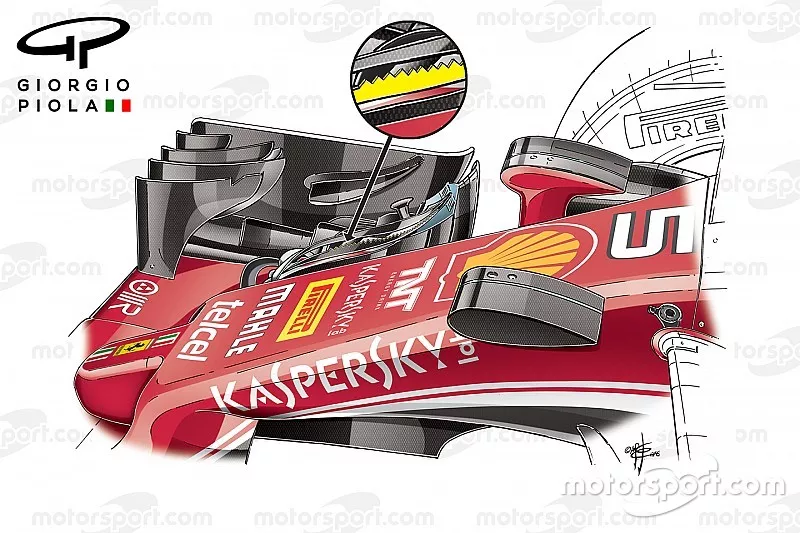
Ferrari is still focusing some of its effort on improving the SF16-H as it chases Red Bull for second position in the constructors' championship. In Singapore it tested a new front wing, which featured a serrated strip on the trailing edge of the penultimate flap (highlighted in yellow, also see inset).
It's not a new feature, with Mercedes having run such a solution on its front wing since Japan last year, whilst Red Bull trialled similar in China this season.
The intent of the serrations is to help keep flow attached to the underside of the flaps so that they can be run at a steeper angle of attack without fear of flow separation, improving downforce.
Williams
Williams FW38 serrated front wing
Photo by: Giorgio Piola
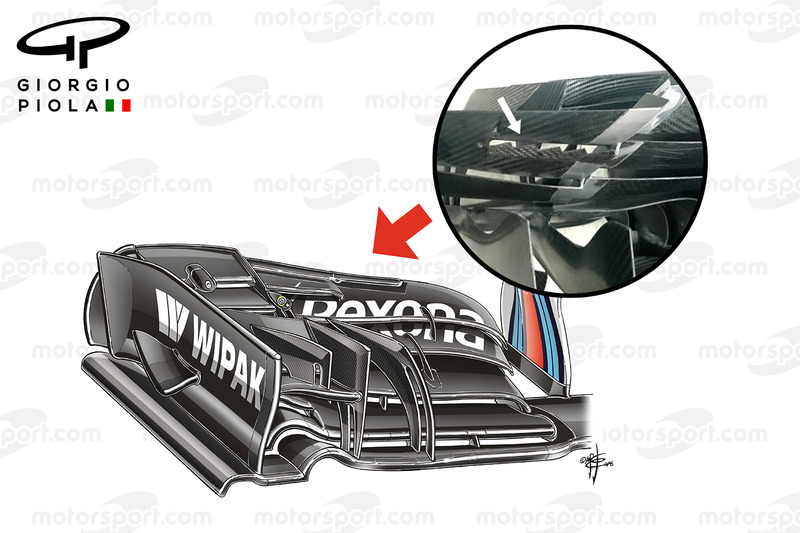
Ferrari wasn't the only ones to arrive in Singapore with a serrated front wing though, with Williams also giving the aerodynamic tweak a chance.
Where Williams' solution differs from the others though, is that their serrations are only placed behind the slot in the upper flap, improving the efficiency of a much smaller section of the wing.
Haas

Haas F1 Team VF-16, front wing detail
Photo by: Giorgio Piola
Haas as another team to introduce an update only for it to be left in the spares pile come qualifying and the race.
The American team's new front wing featured several new elements as it looks to improve performance going into the last few races. They're all concepts we've seen on other cars before but ones that should yield extra performance nonetheless.
The mainplane has now been fully divided into two parts, with the slot extended out toward the central neutral section (highlighted in yellow).
To maintain performance from the slot, several slot gap separators have been added (highlighted in light blue). These maintain the height of the slot in order to limit the aerodynamic damage debris collecting in the slot could have.
The upper flap also profited from some attention, with a smaller slot introduced to improve circulation (highlighted in green)
The 'r' shaped cascade that usually lines up alongside the main cascade was exchanged for a 'c' shaped vane hung from the main cascade (highlighted in red).
It serves the same purpose of moving airflow across and around the front face of the tyre but limits the impact of having a structure joined to the mainplane can have.
Lastly, canards were placed on either side of the endplate (inner, highlighted in purple and outer see inset) in order to change how airflow is washed up and around the front tyre.
Manor

Manor Racing MRT05, detail front wing
Photo by: Giorgio Piola
With so many teams trialling but not running their updates it was left to Manor to show the rest the way. The team had a new front wing and bargeboards for Singapore, as it looked to increase downforce for the street circuit.
The front wing's endplate was completely revised, with the trailing edge curved out from top-to-bottom to help shape how the air is extracted. The new endplate also featured a pinch as it met with the inboard cascade, following a very similar design ethos to Red Bull.
This pinched section runs longitudinally down the endplate's length to meet with a new 'L' shaped canard that creates a pressure gradient in order to help pull airflow out around the endplate. The outer footplate was also revised, featuring a squared profile rather than the previously favoured curved profile.
Meanwhile, the cascade also saw some geometrical adjustments with the bottom profile curved to meet the pinch in the endplate, whilst the flaps above were also revised.
In the centre of the cascade were two new vertical fins which again are very similar to the ones used by Red Bull and help to distribute the pressure across the surface of the cascades flaps.
Manor Racing MRT05 sidepods detail
Photo by: Giorgio Piola
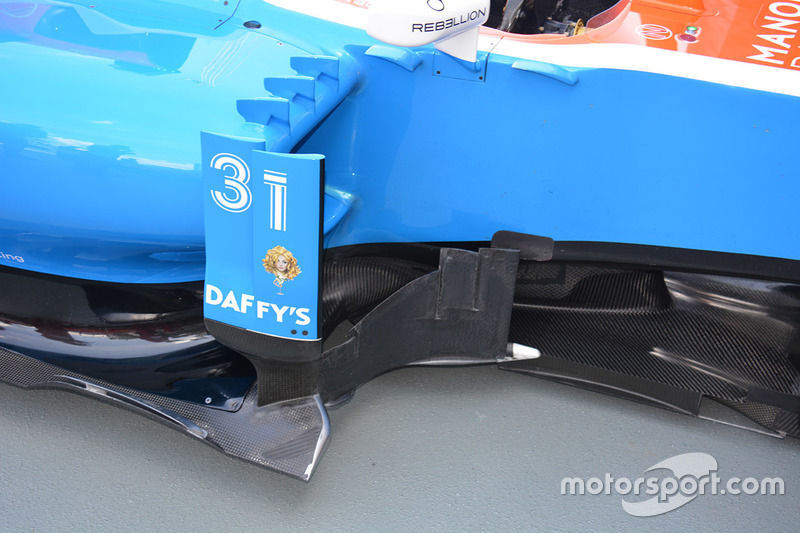
The team also revised its bargeboards, with the slots added a few races ago extended much further down their length in order to improve how the pressure is distributed between the surfaces.
We want your opinion!
What would you like to see on Motorsport.com?
Take our 5 minute survey.
- The Motorsport.com Team
Read and post comments
Read also :
Share Or Save This Story
Copy link
Share on Viber
Previous article Formula 1 begins Ultra High Definition trials
Next article Inside Line F1 Podcast: Pokemon to lure fans in F1?
Top Comments
There are no comments at the moment. Would you like to write one?
View More & Comment
More from
Giorgio Piola
The fascinating story behind McLaren's most iconic F1 car
Formula 1
Formula 1
The fascinating story behind McLaren's most iconic F1 car
Emilia Romagna GP: F1 technical images from Imola's pitlane
Formula 1
Formula 1
Emilia Romagna GP
Emilia Romagna GP: F1 technical images from Imola's pitlane
The F1 downforce choices that proved key at the Saudi GP
Formula 1
Formula 1
Saudi Arabian GP
The F1 downforce choices that proved key at the Saudi GP

More from
McLaren
Five things to look out for at F1’s Qatar GP
Formula 1
Formula 1
Qatar GP
Five things to look out for at F1’s Qatar GP
Zak Brown rules out McLaren engine programme for F1 2030
Formula 1
Formula 1
Las Vegas GP
Zak Brown rules out McLaren engine programme for F1 2030

Top 10 F1 cars of the 1980s
Formula 1
Top 10 F1 cars of the 1980s
Latest news

Marc Marquez announces immediate retirement from MotoGP in bombshell announcement
MotoGP
MGP MotoGP
Valencia GP
2 min
Marc Marquez announces immediate retirement from MotoGP in bombshell announcement
How Nico Rosberg beat Lewis Hamilton – and his demons – to clinch F1 world title
Formula 1
F1 Formula 1
Abu Dhabi GP
14 min
How Nico Rosberg beat Lewis Hamilton – and his demons – to clinch F1 world title
Supercars Adelaide: Brodie Kostecki boosts title hopes as rivals hit trouble in Race 1
Supercars
SUPC Supercars
Adelaide 500
34 min
Supercars Adelaide: Brodie Kostecki boosts title hopes as rivals hit trouble in Race 1
2026 MotoGP Valencia Grand Prix – How to watch, session times & more
MotoGP
MGP MotoGP
Valencia GP
3 h
2026 MotoGP Valencia Grand Prix – How to watch, session times & more
Feature
Discover prime content


Top 10 F1 cars of the 1990s
Formula 1
By Kevin Turner
Top 10 F1 cars of the 1990s

Subscribe and access Motorsport.com with your ad-blocker.
From Formula 1 to MotoGP we report straight from the paddock because we love our sport, just like you. In order to keep delivering our expert journalism, our website uses advertising. Still, we want to give you the opportunity to enjoy an ad-free and tracker-free website and to continue using your adblocker.
You have 2 options:
- Become a subscriber.
- Disable your adblocker.
Subscribe now Already subscribed? Sign in here
Already disabled your adblocker?
Reload page
Manage Alerts
Subscribe