Analysis
Formula 1
Tech analysis: Why serrated wings have made an F1 return
The old saying goes that you cannot teach an old dog new tricks. But in Formula 1, teams often use those old tricks to make improvements, as Giorgio Piola and Matt Somerfield explain.
Edited: Mar 8, 2016, 2:10 PM
Copy link
Share on Viber

Giorgio Piola's F1 technical analysis
Giorgio Piola is the preeminent Formula 1 technical journalist. View our full selection of Giorgio's technical illustrative content
Recently we have seen a trend among teams to use serrated trailing edges on their flaps.
It is not a new idea but it is interesting they have returned again to current designs as teams seek ways to find gains within the constraints of very tightly-worded regulations.
McLaren idea

McLaren MP4/29 rear wing vortex
Photo by: Giorgio Piola
Let us start our journey in 2014, at Hockenheim, where McLaren arrived with a new rear wing, inspired by both nature and designs that had gone before.
The trailing edge of the mainplane and leading edge of the upper flap had knuckle shapes carved out, something marine biologists would recognise as tubercles - small nodules found on the dorsal fins of humpback whales.
Research into these tubercles suggests that they improve manoeuvrability, allowing a steeper angle of attack before separation occurs, improving performance through modification of the boundary layer.
At the same time, the span of the surface appears improved, reducing the tip vortex strength and reducing drag.
This was clearly something that McLaren felt at that point in its development cycle was worth exploiting, and could remedy some of its inefficiencies.
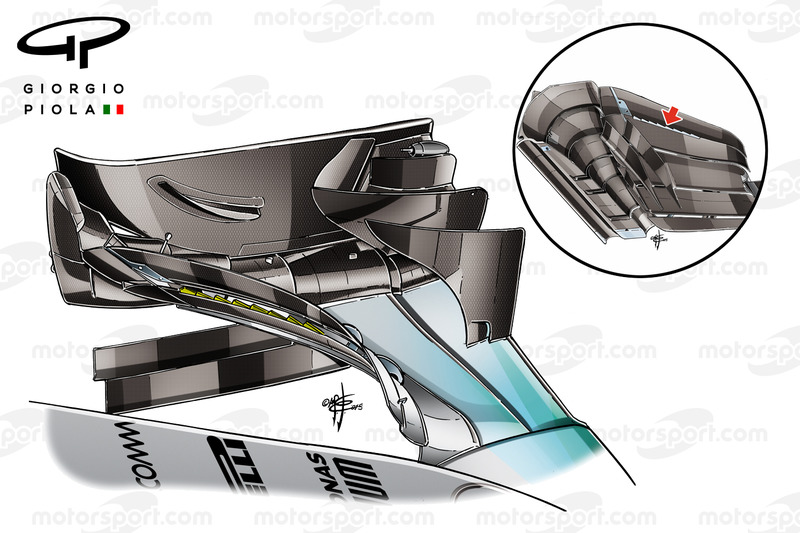
Mercedes W06 front wing Sochi & front wing bottom view
Photo by: Giorgio Piola
In 2015, Mercedes re-purposed this idea – using it on its front wing instead. It placed a serrated strip on the trailing edge of the penultimate flap.
This not only gave a direct improvement to the flap it was attached to, but also boosted the airflow that shifts the separation point on the upper flap too - improving performance.

Mercedes AMG F1 W06 rear wing
Photo by: Giorgio Piola
In the latter stages of 2015, Mercedes also looked into the viability of using serrations on the rear wing, something it investigated again during this year's pre-season tests.
As our exclusive photographs show, it used a serrated 'trip strip' (above), mounted at differing heights on the flaps, to ascertain what type of performance it would get in the real world.
It was likely doing this before making a mainplane with the desired serrations.

Mercedes W07 serrated main flap rear wing
Photo by: Giorgio Piola
On the last day of testing, a new rear wing mainplane and top flap arrived, matched to the new endplates that had been tested earlier in the week.

Mercedes W07 serrated main flap rear wing (yellow inserts)
Photo by: Giorgio Piola
This new mainplane flap is a physical representation of the tests that had already been conducted by the team
As you can see, midway from either side of the centreline slot gap separator is an adjoining serration (highlighted in yellow), which is not an anomaly but done in order to meet the regulations and allow the team to design the serrations so that they traverse the wing in opposing directions between the outer slot gap separator and the centreline one .

Ferrari SF16-H serrated gurney flap rear wing
Photo by: Giorgio Piola
Not to be outdone by the current champions, Ferrari also turned its attention to serrated flaps, with a short-lived test on their rear wing gurney flap on the first day of the second test.
The gurney design is not the first time we have seen such devices used in Formula 1 though, with Williams in 2004 and Renault in 2005 using serrated trailing edge devices in an attempt to improve the overall efficiency of their wings (below).

Williams FW26 rear wing Monza & Renault R26 rear wing Budapest
Photo by: Giorgio Piola
There still seems plenty of life left in some old ideas.
We want your opinion!
What would you like to see on Motorsport.com?
Take our 5 minute survey.
- The Motorsport.com Team
Read and post comments
Read also :
Share Or Save This Story
Copy link
Share on Viber
Previous article Analysis: How drivers are missing the chance to shape F1's future
Next article Alonso: McLaren needs more performance after "huge step" in reliability
Top Comments
There are no comments at the moment. Would you like to write one?
View More & Comment

More from
Ferrari
Lewis Hamilton: Ferrari’s top-speed deficit was “brutal” at F1 Las Vegas GP
Formula 1
Formula 1
Las Vegas GP
Lewis Hamilton: Ferrari’s top-speed deficit was “brutal” at F1 Las Vegas GP

Why Ferrari believes written rules won't help manage Charles Leclerc and Lewis Hamilton
Formula 1
Formula 1
Las Vegas GP
Why Ferrari believes written rules won't help manage Charles Leclerc and Lewis Hamilton

Top 10 F1 cars of the 1980s
Formula 1
Top 10 F1 cars of the 1980s
Latest news

Joe Gibbs Racing constructs timeline of Chris Gabehart's alleged theft
NASCAR Cup
NAS NASCAR Cup 5 h
Joe Gibbs Racing constructs timeline of Chris Gabehart's alleged theft

IndyCar adds Kansas Speedway to 2027 schedule in joint NASCAR weekend
IndyCar
Indy IndyCar 9 h
IndyCar adds Kansas Speedway to 2027 schedule in joint NASCAR weekend

Decision time looms for Colton Herta after 2027 Cadillac F1 snub
Formula 1
F1 Formula 1
Las Vegas GP
10 h
Decision time looms for Colton Herta after 2027 Cadillac F1 snub

Kalle Rovanpera: New 2027 WRC cars will see "everybody start from zero"
WRC
WRC WRC 11 h
Kalle Rovanpera: New 2027 WRC cars will see "everybody start from zero"
Feature
Discover prime content




Subscribe and access Motorsport.com with your ad-blocker.
From Formula 1 to MotoGP we report straight from the paddock because we love our sport, just like you. In order to keep delivering our expert journalism, our website uses advertising. Still, we want to give you the opportunity to enjoy an ad-free and tracker-free website and to continue using your adblocker.
You have 2 options:
- Become a subscriber.
- Disable your adblocker.
Subscribe now Already subscribed? Sign in here
Already disabled your adblocker?
Reload page
Manage Alerts
Subscribe