Top List
Formula 1
Tech gallery: How the Force India VJM10 evolved throughout 2017
A selection of the best technical images of Force India’s 2017 challenger, the VJM10, courtesy of Giorgio Piola, Sutton Images and LAT images

Matt Somerfield
Edited: Mar 19, 2018, 7:33 PM
Copy link
Share on Viber

Giorgio Piola's F1 technical analysis
Giorgio Piola is the preeminent Formula 1 technical journalist. View our full selection of Giorgio's technical illustrative content

Close-up of the front wheel rim and blown axle.

Rear view of the steering wheel shows the shape and detail employed on the clutch paddles.
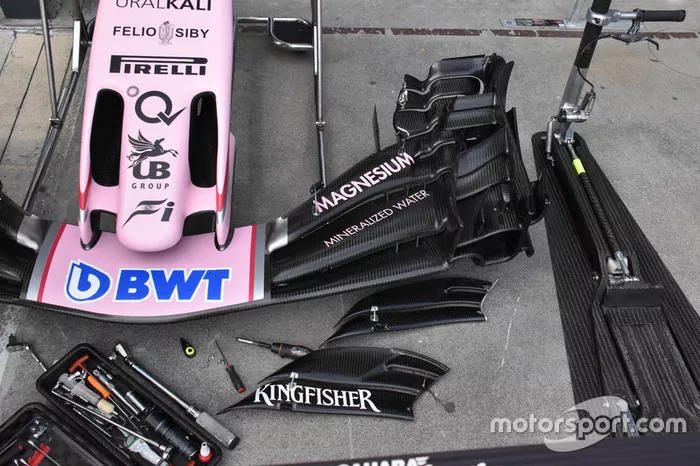
The front wing under construction with different upper flap options available.

The team made revisions to the area ahead and around the sidepods, the sidepod airflow conditioner also had an extra support added (red arrow).
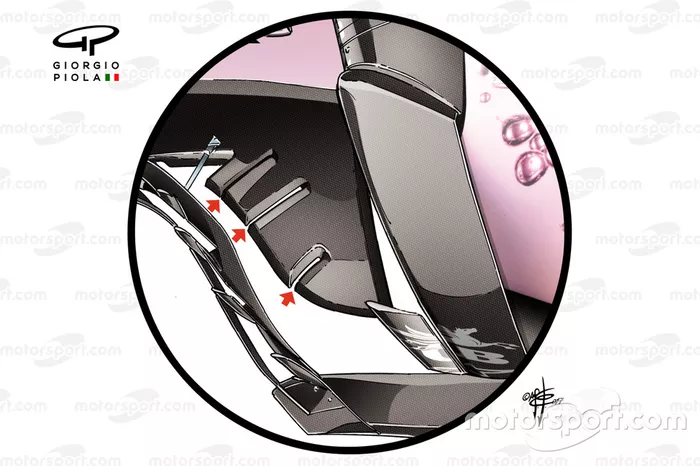
The floor extension behind the bargeboards was modified to include these slots (arrows), changing the flow pattern around them.
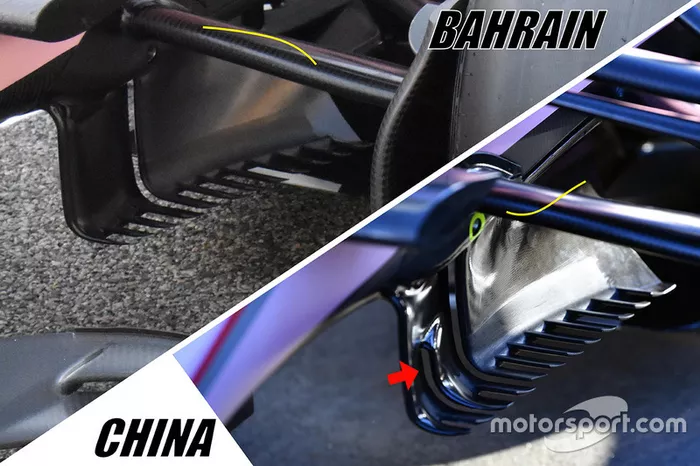
A comparison of the turning vanes used in China and Bahrain shows the removal of the long slot in the forwardmost element. The yellow line highlights the change in shape to the rearward one.

Changes made to the bargeboards and airflow conditioners with the launch car inset for comparison. More slots were introduced to the main bargeboard (red arrows), the pre-bargeboard was extended (white arrow) and the airflow conditioners connection to the sidepod was reduced in width (yellow arrow).
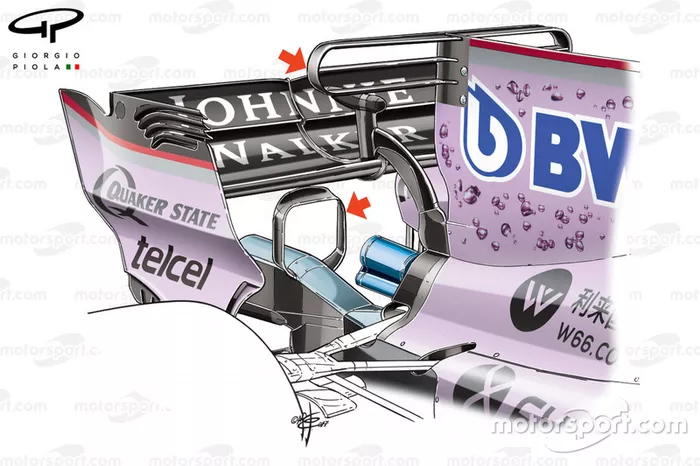
The team added a triple element T-wing and monkey seat to help balance the car in Monaco.

Changes made to the bargeboards, with the corner shape of each section optimised (white arrow) and the pre-bargeboard extended (red arrow).
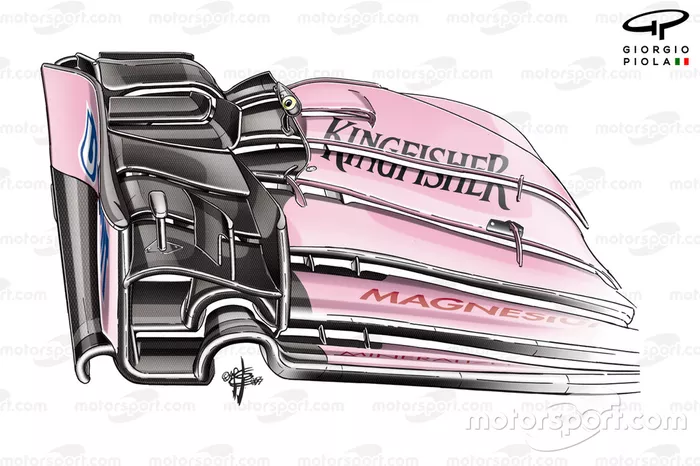
Force India ran without the endplate canards in Azerbaijan and Canada.
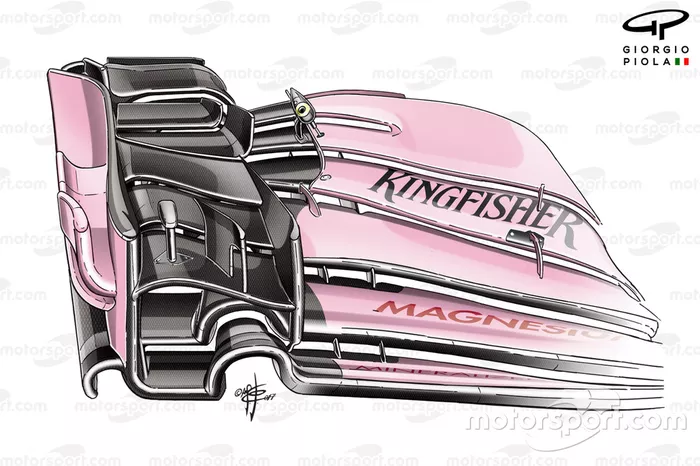
The wing complete with canards for comparison.
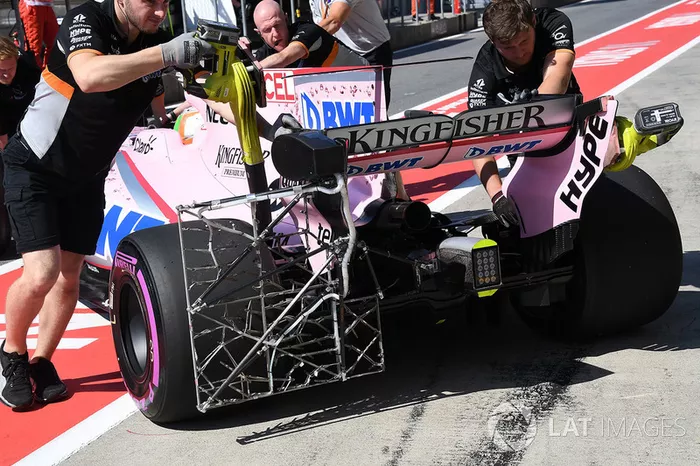
A kiel probe array is mounted behind the car during practice to gather data.
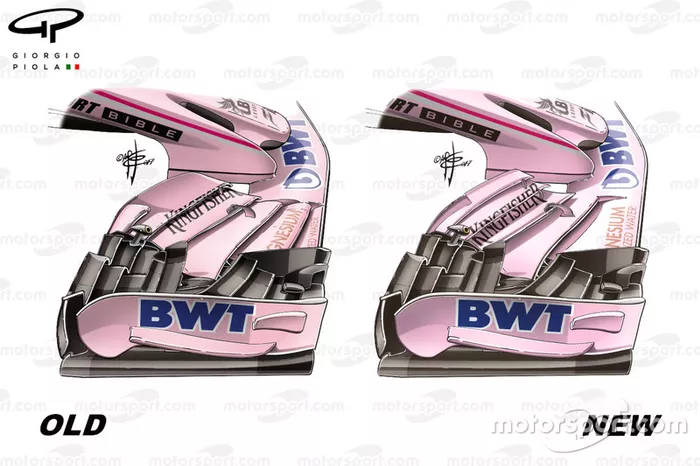
Side view of the changes made by Force India to its front wing, including an additional slot in the mainplane and increase in the number of upper flaps from two to three.

The swept cockpit canards added to the VJM10 at the Austrian GP (blue arrows).
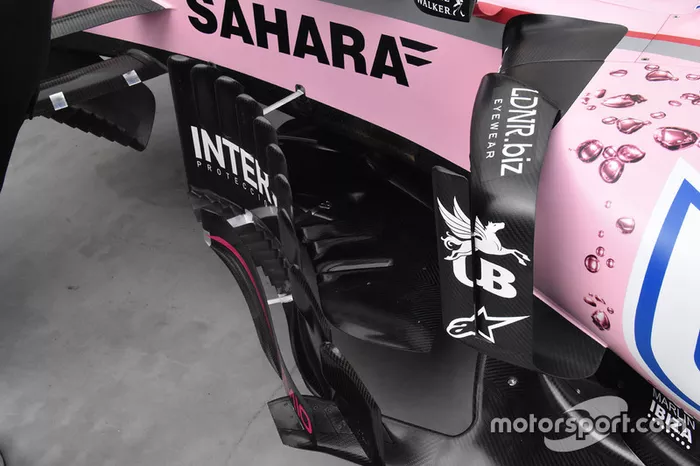
Side view of the bargeboard area. Note the continuation of the mini-winglets between the pre-bargeboard and main bargeboard.

A look at the VJM10’s front suspension, including the large third or ‘heave’ element mounted horizontally between the rockers.

A look at the VJM10’s front brake assembly while the car is being prepared shows the various routes airflow must navigate to both cool the brakes and improve aero.
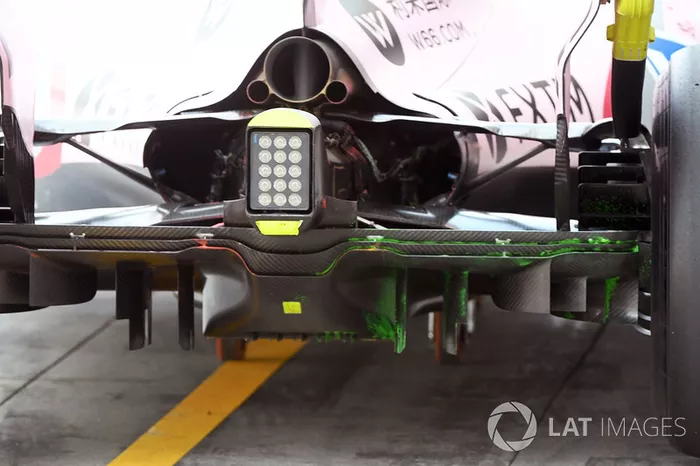
Close-up of the VJM10’s diffuser with flo-viz applied.

Close-up of the VJM10’s main exhaust and wastegate exhausts, which have been conjoined.
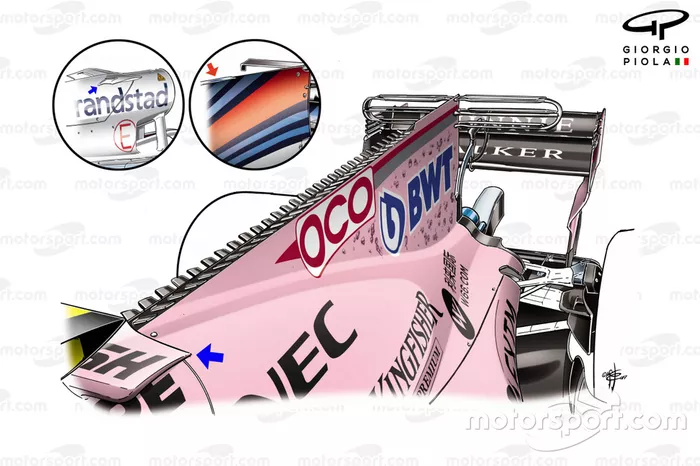
The ‘Stegosaurus’ added by the team in Singapore is a row of multiple winglets on either side of the engine cover's spine, which create a series of smaller vortices that entwine to create a larger vortex and improve the performance of the shark fin. Also noted is the wider airbox winglet (blue arrow) which is similar to a design employed by Williams (inset).
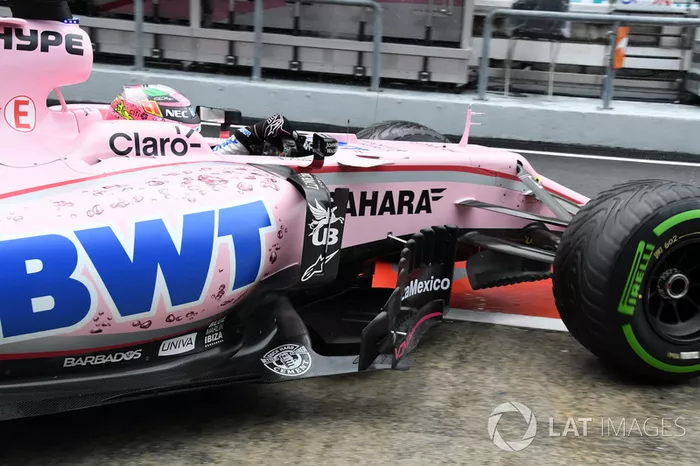
A nice view of the mid section of the chassis shows how the serrated sections of the turning vanes and bargeboards have a different aspect.
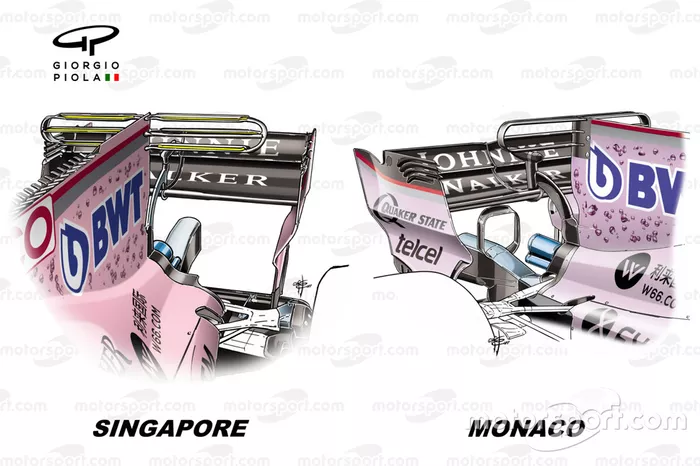
Comparison of the two T-wing designs used in Singapore and Monaco, with the extra slots added for Singapore highlighted in yellow.

A great ¾ view of the sidepod and the area ahead of it which features complex structures such as the bargeboards.
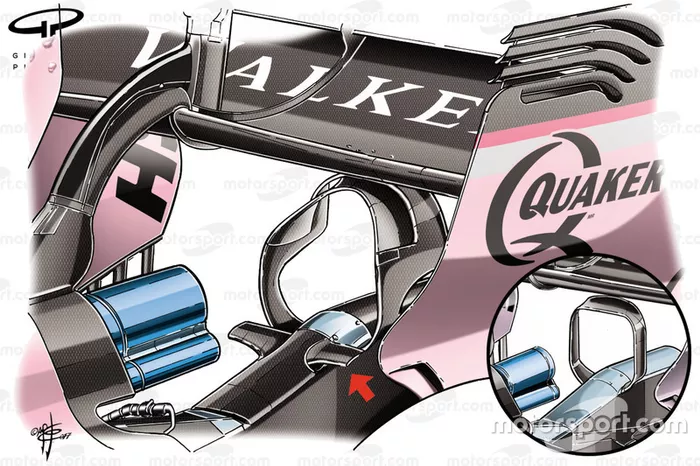
The two element monkey seat introduced in Japan, with additional crash structure winglets too (red arrow). The more simplistic monkey seat can be seen in the inset for comparison.
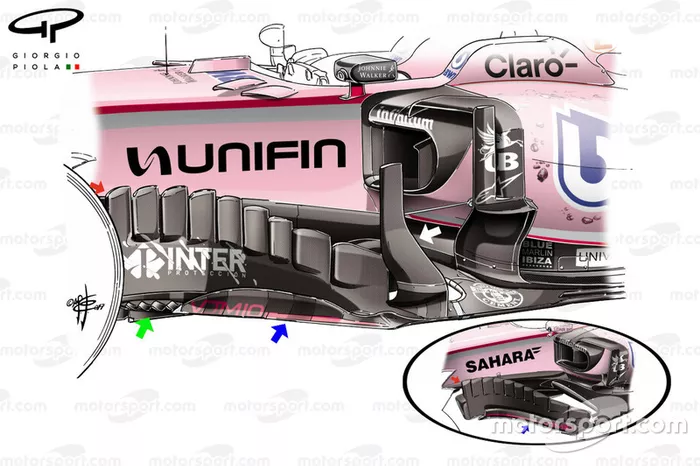
The team optimised the bargeboard area of the car further in Mexico, changing the shape of each serration in its upper surface (red arrow), revising the shape of the pre-bargebaord (blue arrow), adding a row of mini-winglets (green arrow) and increasing the height of the last section of the main bargeboard to form a deflector (white arrow).
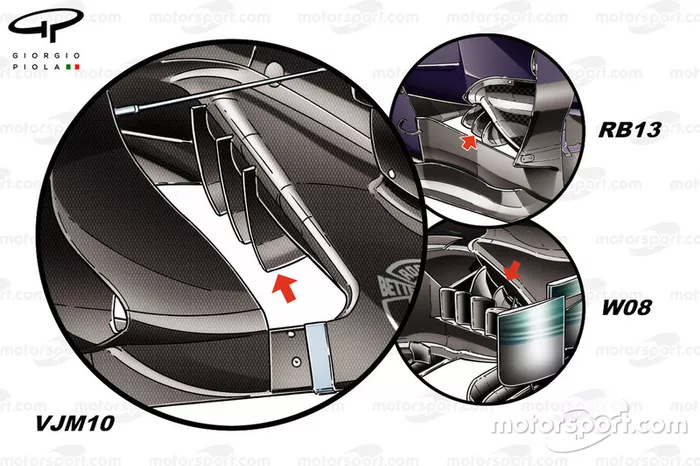
The team tested, but did not race, a solution already seen on the Mercedes W08 and Red Bull RB13, three strakes placed on the leading edge of the upturned floor - breaking up turbulence and creating their own set of vortices.

A close up of the VJM10’s front wing from behind showing just how aggressive the compartmentalisation of the wing is in order to create the outwash tunnel.

A close-up of the front wing endplate shows the detail of the two endplate canards deployed by the team.

A close-up of the triple element T-wing, which has slots in the leading edge of each element in order to improve efficiency. Note the small swan neck-style supports in the centre of each slot to bridge the gap and stop it closing as pressure builds.

The two-element turning vanes have multiple serrations in their footplate to trip the airflow, creating smaller vortices that roll up and combine to create a larger vortex.
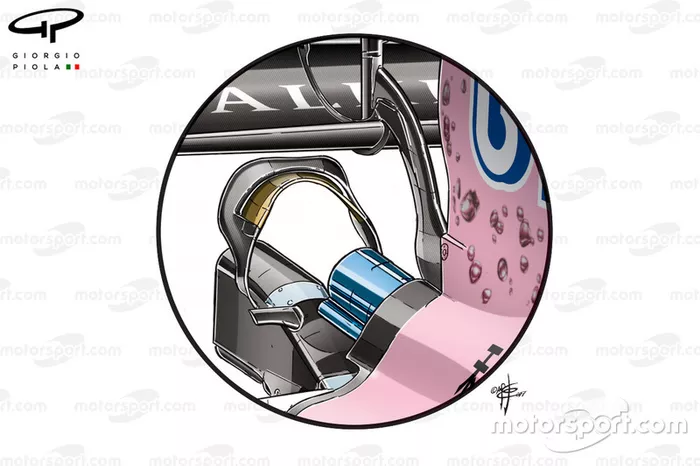
The team applied to the leading edge of the first winglet element on the monkey seat, reducing thermal transfer from the exhaust which is in close proximity.

The team mounted a kiel probe array behind the rear wheel in Brazil to study the behaviour and interaction of the diffuser and wheel wake.

Looking over the top of the front suspension at the bargeboards, floor and sidepods.

A close-up of the front wing which is split into two distinct sections, the outer of which, left in bare carbon, is shaped in order to manipulate the wake shed by the front tyre.

Mechanics work on the VJM10 with the covers off, leaving detailed areas of the car exposed.
35
We want your opinion!
What would you like to see on Motorsport.com?
Take our 5 minute survey.
- The Motorsport.com Team
Read and post comments
Read also :
Share Or Save This Story
Copy link
Share on Viber
Previous article Ocon asked Wolff for advice on Perez situation
Next article FIA clamps down on trick F1 steering systems
Top Comments
There are no comments at the moment. Would you like to write one?
View More & Comment

More from
Matt Somerfield

Gallery: How F1 tech evolved during the 2024 season
Formula 1
Formula 1
Gallery: How F1 tech evolved during the 2024 season
How McLaren’s rear wing push changed the game in F1
Formula 1
Formula 1
How McLaren’s rear wing push changed the game in F1
How 2026 F1 rules will help avoid identikit designs
Formula 1
Formula 1
How 2026 F1 rules will help avoid identikit designs

More from
Force India

Otmar Szafnauer reveals failed Kimi Raikkonen bid involving "Angry Birds" founders
Formula 1
Formula 1
Canadian GP
Otmar Szafnauer reveals failed Kimi Raikkonen bid involving "Angry Birds" founders
Esteban Ocon explains why he collided with Sergio Perez so often at Force India
Formula 1
Formula 1
Esteban Ocon explains why he collided with Sergio Perez so often at Force India

Former Force India F1 boss Fernley dies aged 70
Formula 1
Formula 1
Austrian GP
Former Force India F1 boss Fernley dies aged 70
Latest news

Tony Stewart: violent Talladega Truck wreck "knocked the wind out of me"
NASCAR Truck
NSTR NASCAR Truck
Talladega
11 min
Tony Stewart: violent Talladega Truck wreck "knocked the wind out of me"

Cleetus McFarland “pissed” after early Talladega NASCAR Truck crash
NASCAR Truck
NSTR NASCAR Truck
Talladega
30 min
Cleetus McFarland “pissed” after early Talladega NASCAR Truck crash
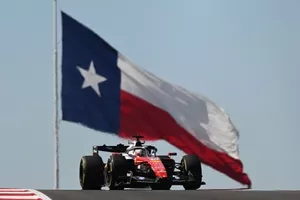
F1 United States GP live commentary and updates - Leclerc on top in FP2
Formula 1
F1 Formula 1
United States GP
1 h
F1 United States GP live commentary and updates - Leclerc on top in FP2
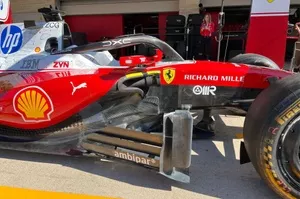
Exploring Ferrari's 'less than a tenth' US GP update package
Formula 1
F1 Formula 1
United States GP
1 h
Exploring Ferrari's 'less than a tenth' US GP update package
Feature
Discover prime content




Subscribe and access Motorsport.com with your ad-blocker.
From Formula 1 to MotoGP we report straight from the paddock because we love our sport, just like you. In order to keep delivering our expert journalism, our website uses advertising. Still, we want to give you the opportunity to enjoy an ad-free and tracker-free website and to continue using your adblocker.
You have 2 options:
- Become a subscriber.
- Disable your adblocker.
Subscribe now Already subscribed? Sign in here
Already disabled your adblocker?
Reload page
Manage Alerts
Subscribe