Top List
Formula 1
Tech gallery: How the Red Bull RB13 evolved throughout 2017
A selection of the best technical images of Red Bull’s 2017 challenger, the RB13, courtesy of Giorgio Piola, Sutton Images and LAT images.

Matt Somerfield
Edited: Dec 25, 2017, 2:20 PM
Copy link
Share on Viber

Giorgio Piola's F1 technical analysis
Giorgio Piola is the preeminent Formula 1 technical journalist. View our full selection of Giorgio's technical illustrative content

A glimpse at the rear of the RB13’s steering wheel shows the position and shape of the various gearshift and clutch paddles.
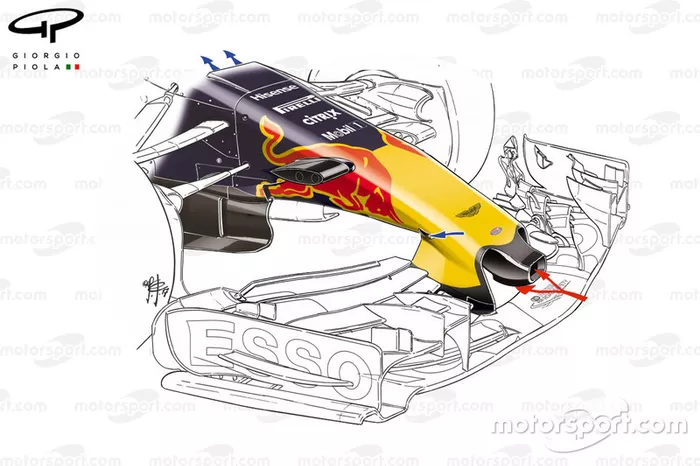
An overview of the RB13’s nose hole, which takes air in and ejects it straight out of the rearward hole, as the team tries to neutralise the nose tip from an aero point of view. The ‘S’ duct is fed airflow from the two Naca-style ducts either side of the nose (blue arrows).
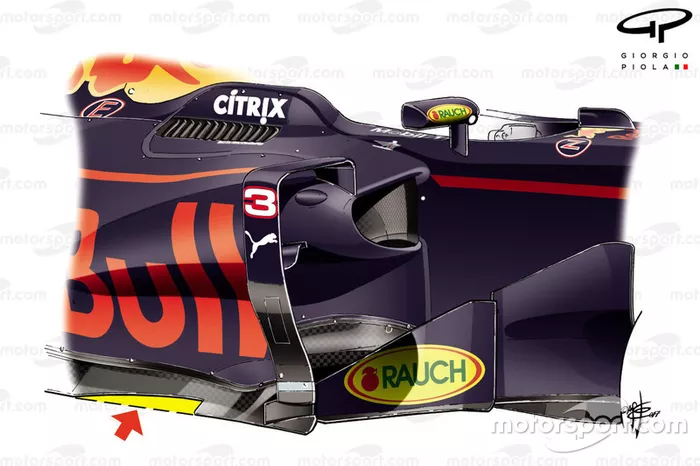
The initial floor utilised by Red Bull featured this large cutout (highlighted in yellow).

Red Bull’s rear wheel rim, which features a succession of horizontal ribs, not only has thermal transfer benefits between it and the tyres but also has an aerodynamic impact with air moving through the rim altered by the ribs.
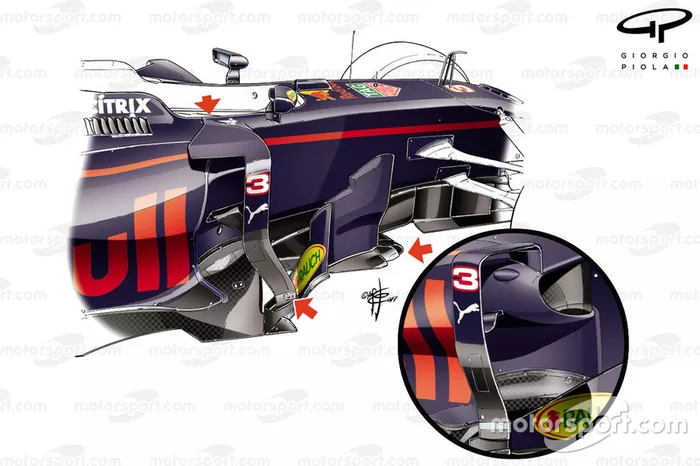
Changes made to the airflow conditioner included a revised position at their base and the introduction of a triangular flap that traverses the width of the sidepod, rather than just arching over the shoulder. Extra detail was also added to the bargeboard's footplate.
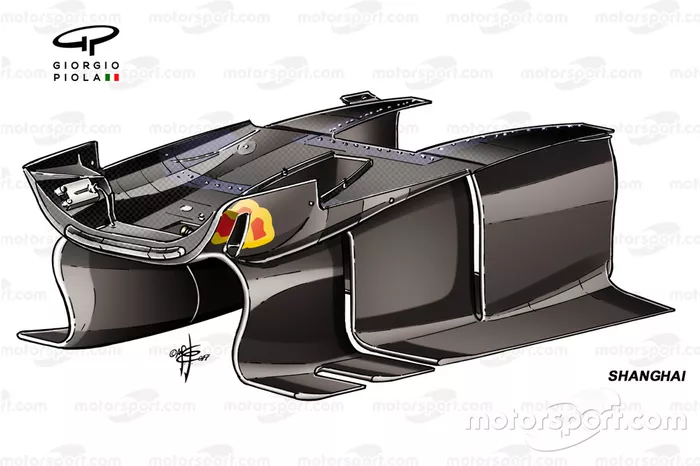
A revised turning vane design, with a division of the surface into two distinct elements, the forwardmost of which also has a slot in the footplate
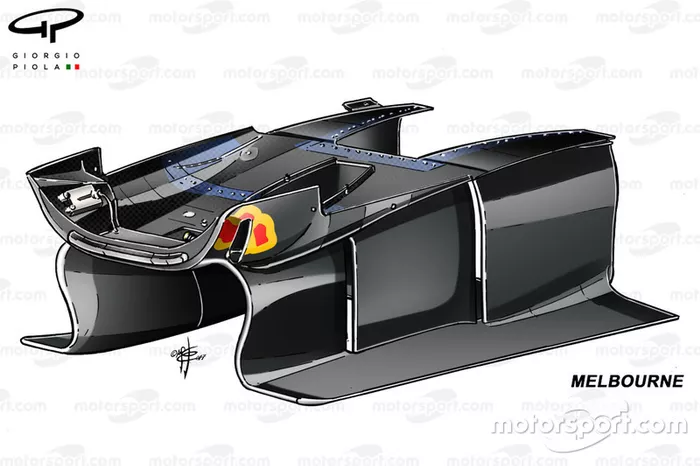
In comparison, here is the turning vane design employed prior to China.

The RB13 stripped down gives us insight into the installation of the power unit and cooling ancillaries.

Flo-viz painted on the front wing has migrated downstream onto the suspension and bargeboards.
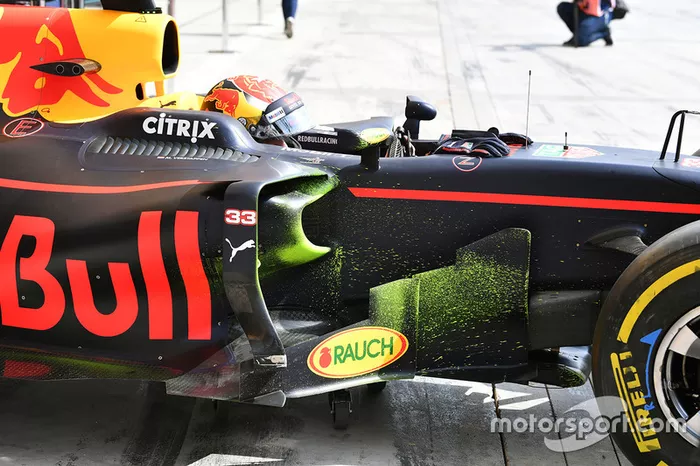

Front wing deflection tests were conducted by the team using chequered stickers on the endplates, lower section of the flap tunnel, strakes, flap adjustment and cascade (circled). A camera mounted on the nose monitors their movement during the course of a lap.

A sensor is mounted on the floor ahead of the rear tyre.
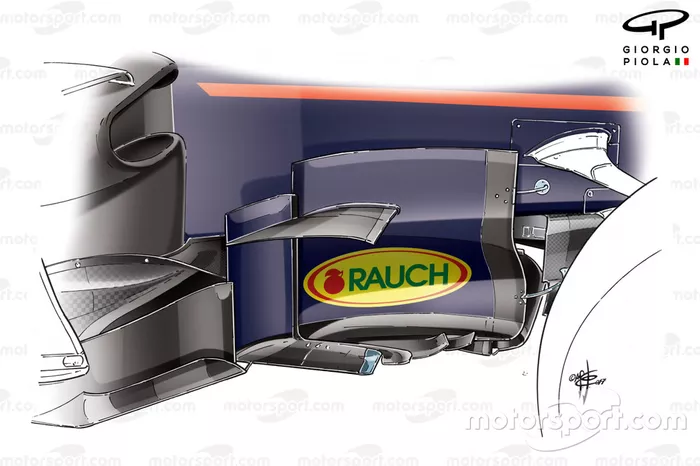
A much more complex bargeboard configuration was put into use in Spain, as the designers started to work the airflow around the sidepods and leading edge of the floor much harder. The leading edge of the first section of the bargeboard was brought forward, the footplate made much more complex and an additional horizontal vane was hung midway up the surface of the main bargeboards that straddled the second element.
The team revised the connecting point and width of the sidepod airflow conditioner slat in Spain.

Mechanics making some hasty repairs/modifications to the rear wing endplate louvres.


A high-downforce rear wing, with a steep angle of attack and four open-ended endplate louvres.
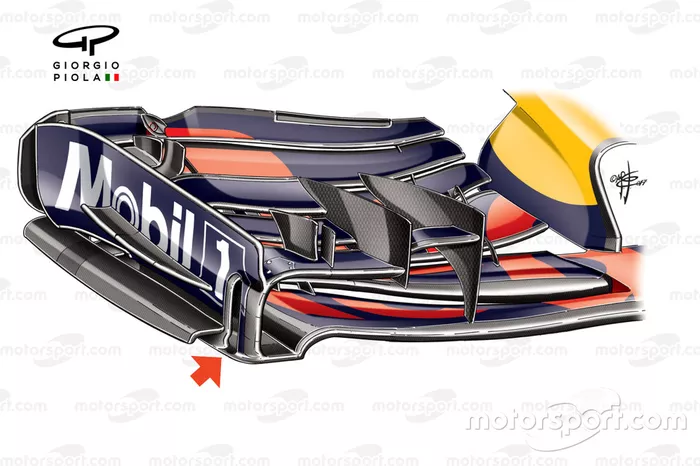
Note the vertical slot in the leading edge of the endplate (red arrow).

Red Bull tested but didn’t race a variation on the aero solutions around the sidepod in Canada - a detached sidepod conditioner (blue arrow), three vortex generators on the sidepod's shoulder (red arrows) and a wider cockpit canard (white arrow)

Looking back at the bargeboards, we can see the width of the horizontal canard that was added.

A close-up of the floor's boomerang extension and the shape of the flow conditioner's fixing point.

A rear view of the front wing, showing the detail of the strakes that populate its underside and the nose which features three separate channels for the elongated ‘S’ duct.
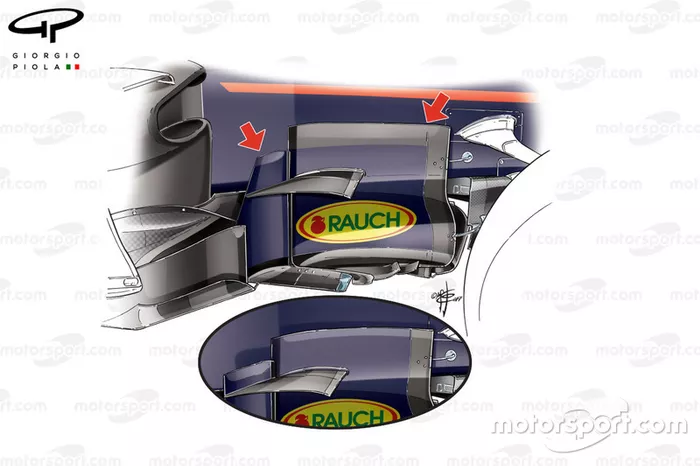
Changes made to the bargeboards included a different surface material on the upper edge of the main bargeboard and a change in shape for the secondary element.
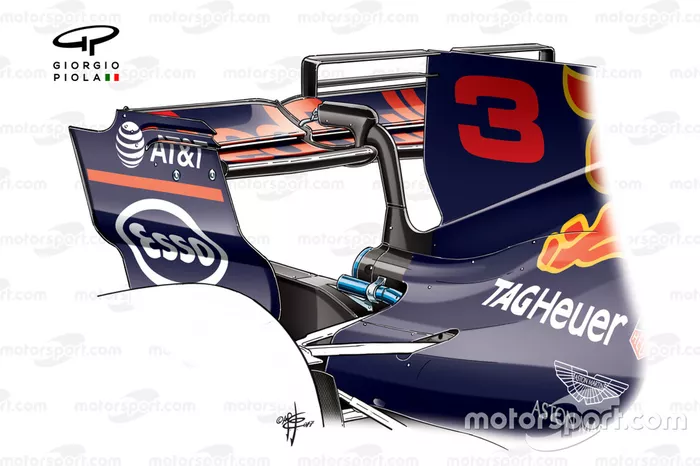
A lower-downforce rear wing for Azerbaijan, with less angle of attack and only two open ended louvres in the endplate.
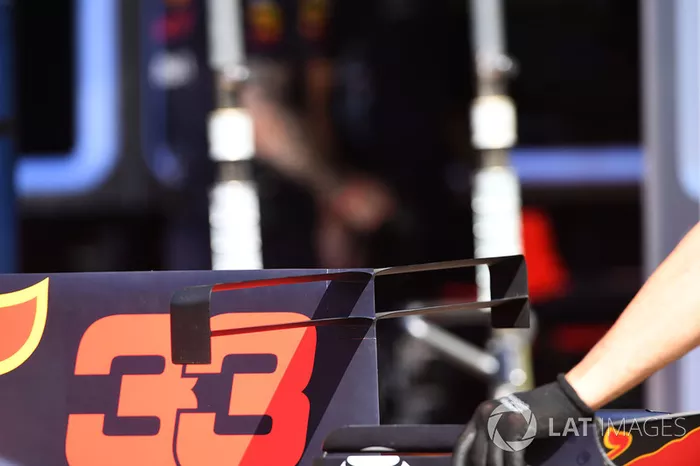
A close-up of the two-element T-wing.

One of the Red Bull mechanics takes a picture on his phone of the front brake duct fin, which was painted in flo-viz
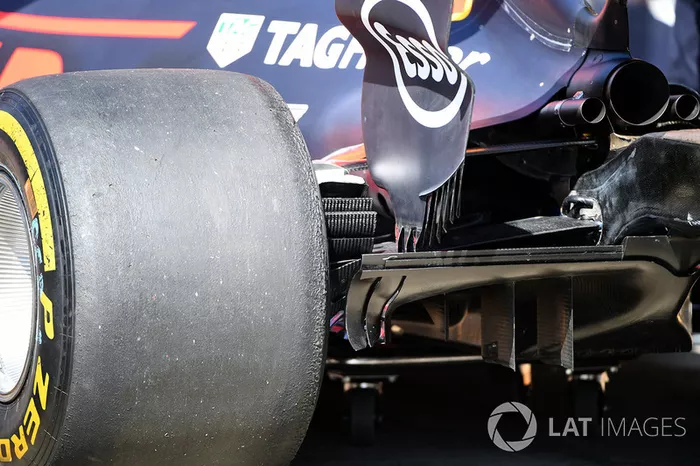
A close-up of the outer corner of the diffuser.

A close-up of the front wing shows the height of the Gurney placed on the upper flap's trailing edge.
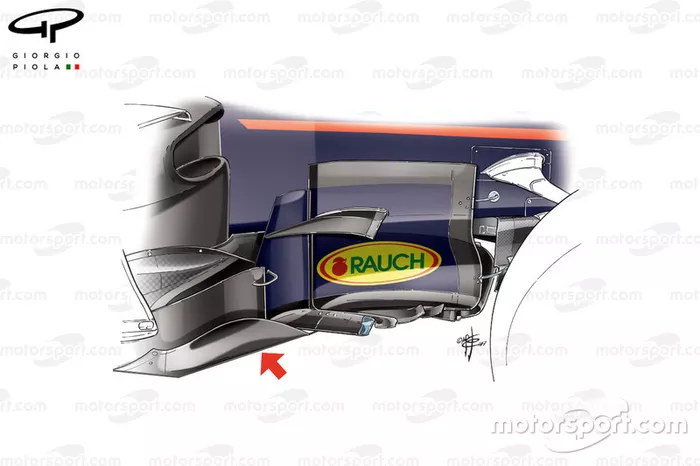
The team revised the floor boomerang (red arrow) for the British GP, increasing its overall height and optimising its shape.
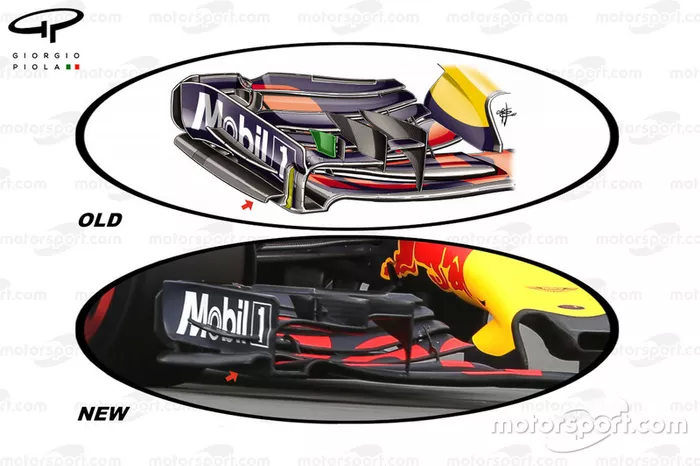
Red Bull made changes to its front wing for the British GP, removing the vertical slot in the endplate (yellow highlight) and raising the footplate arc (red arrow).

Daniel Ricciardo’s stricken RB13 is loaded onto the back of a recovery truck. Note the under wing strake detail, the horizontal winglets at rear of the turning vanes, the slots in the side of the floor
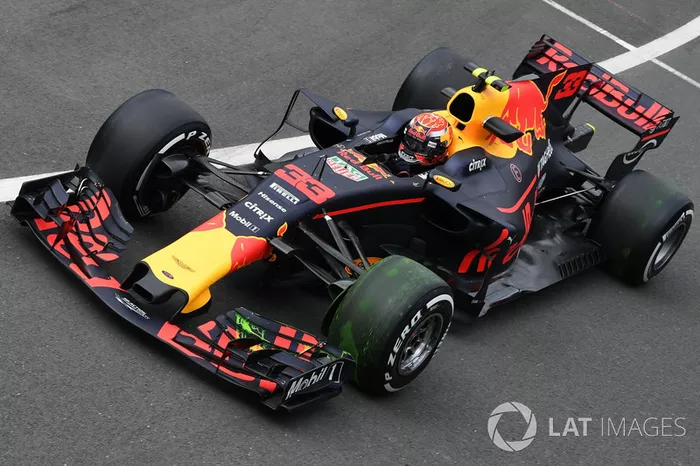
Flo-viz paint was applied to the underside of the front wing to assess whether the performance shown in Red Bull's simulation tools correlated with on-track data.

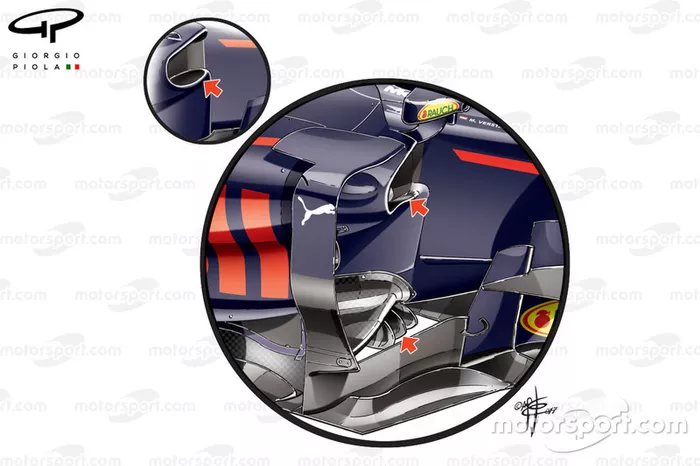
Red Bull made several changes to the RB13 in Hungary, including the creation of a new sidepod inlet shape (see inlet for comparison) and the addition of three strakes on the leading edge of the upturned floor, used to tidy up any turbulence and reenergise the airflow for better performance downstream.
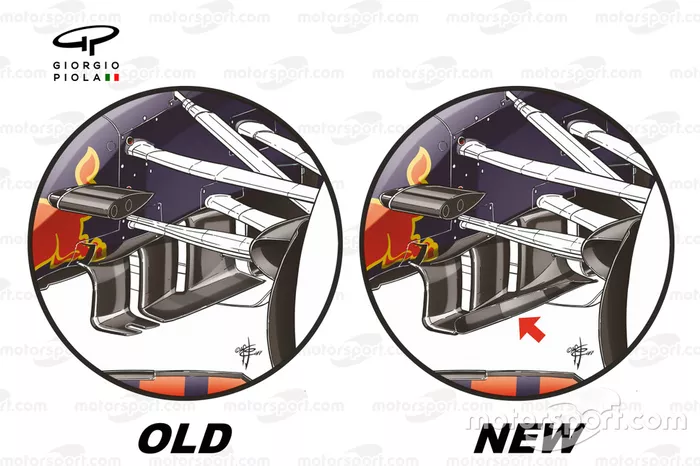
Red Bull chose to modify their turning vanes, adding a longitudinal flap on the outer edge of the footplate (arrowed).

The ever more complex area around the sidepods, including the updated inlet and leading edge to the floor.

The RB13’s front brake duct assembly, note the various inlets being employed to cool different components within the brake assembly, including the disc and caliper.

Flo-viz painted onto the rear wing of Daniel Ricciardo’s car as the team studied the behaviour of the wing in combination with the monkey seat.

A shot of the turning vanes before they are fitted to the underside of the chassis.
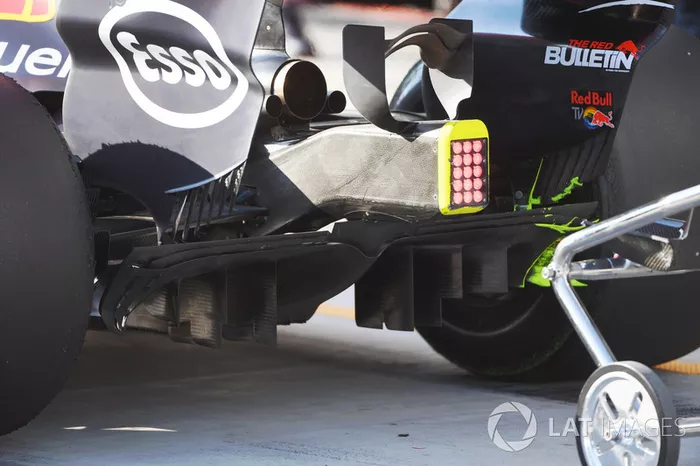
Red Bull tested a revised diffuser in Hungary, which featured a more outwardly curved profile at the outer edges.
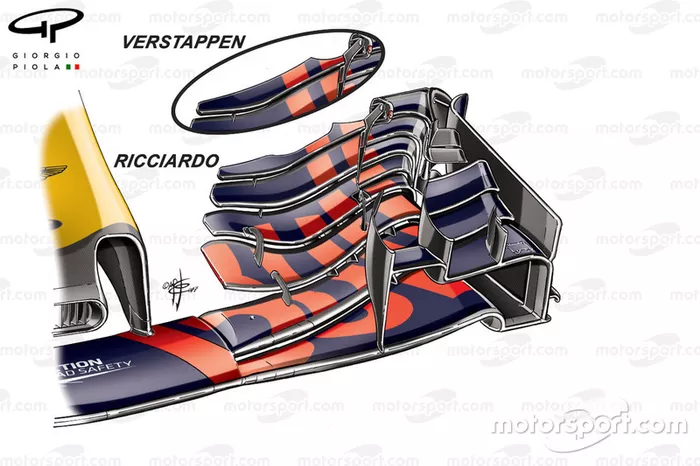
The Red Bull drivers decided to balance their RB13s differently for the challenges of Spa, with their front wings' upper flaps cut accordingly.

A close-up of the Red Bull’s front wing endplate, complete with vertical slot and upturned footplate.

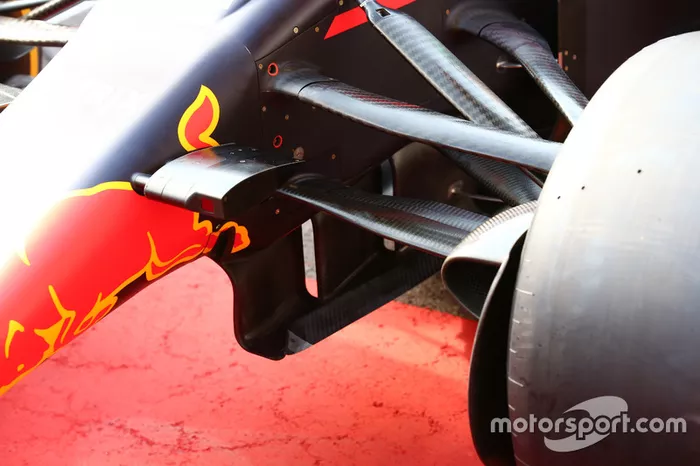
The under-nose/chassis turning vanes were improved to include the longitudinal vane on the outer edge of the footplate.

Note the three strakes added to the leading edge of the upturned floor.

The floor of the car shows the longitudinal floor slot and three strakes added to the front edge of the upturned floor.

In this shot of a disassembled rear brake assembly, note the use of different surface materials in order to manage the differing temperatures.
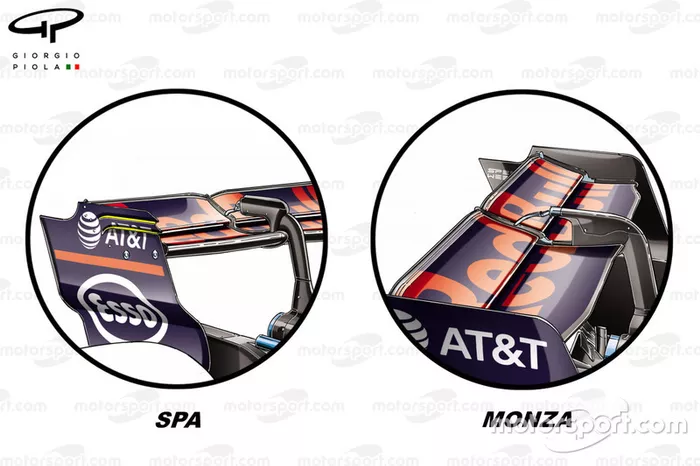
A comparison of the two low-downforce wings utilised by Red Bull in Belgium and Italy. Note the slightly less extreme angle of attack in Belgium saw the rear wing paired with two endplate louvres (highlighted in yellow), while the Italian GP version had none.

A close-up of the RB13’s third or ‘heave’ suspension element. Note the use of Belleville washer springs.

Red Bull conducted its own deflection tests in Italy, using a series of chequer-style reference points on the endplate in order that a hi-speed camera mounted on the nose could look across and capture footage of the endplate's movement.

Red Bull introduced these Ferrari-esque sidepod deflectors in Singapore. The main differences are the support structures which connect them to their respective flow conditioners and, in Red Bull’s case, the slat mounted ahead (red arrow)

Flo-viz painted on the slotted, double-element, hooped T-wing.

A close-up of the floor slots ahead of the rear tyre.

Flo-viz painted on the new sidepod deflectors as the team confirms that the aero surfaces are doing as expected.


Peering into the distance, we can see the slots placed in the floor ahead of the rear tyre.

These twin mirror supports were introduced in Hungary. Note the thermal imaging camera embedded in the mirror housing, which monitors the front tyre.
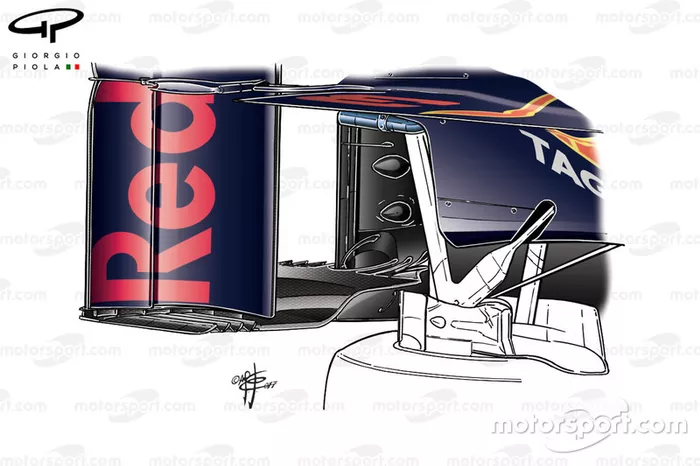
A look at the teardrop-shaped blisters on top of the RB13’s diffuser, which change the flow characteristics over that section of the floor.

A close-up of the sidepod deflector introduced in Singapore.

The under-chassis turning vanes of the RB13.
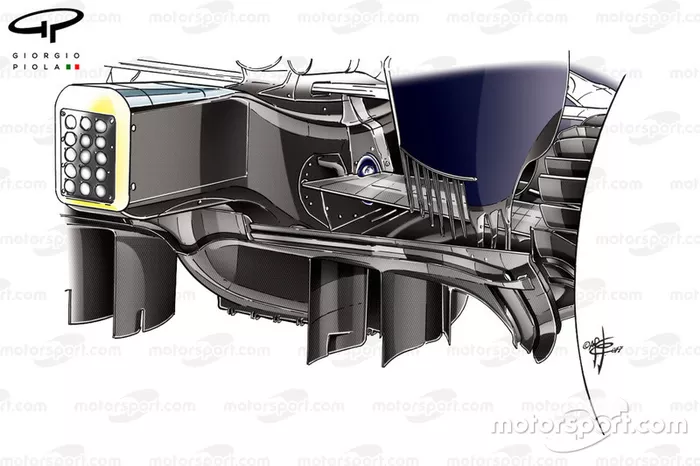
The RB13’s diffuser features a multi-element Gurney arrangement, which not only trims the upper edge of the diffuser but also the vertical walls.

A close-up of the front brake drum and blown axle outlet.

The wheel rim placed on the wheel hub without a tyre to check clearance tolerances.

A close-up of the flo-viz paint on the diffuser, giving a visual account of what the airflow is doing as it passes over the various surfaces.

The front brake duct is fed air to normalise temperatures ahead of the car heading to the circuit.

The RB13 outfitted with a high-downforce set-up rear wing and twin-element hooped T-wing complete with slots in the leading edge. At sea level teams would select similar downforce levels as they do in Azerbaijan, but such is the difference at high altitude that they’re forced to max out their selections.
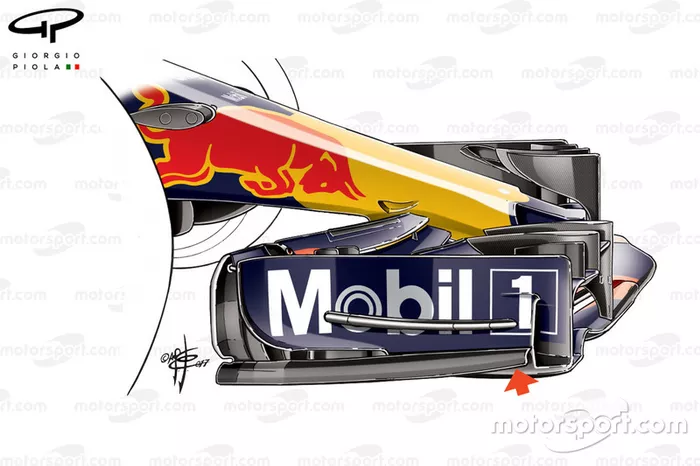
The footplate design used by Red Bull throughout 2017 with the front end lifted (arrowed).
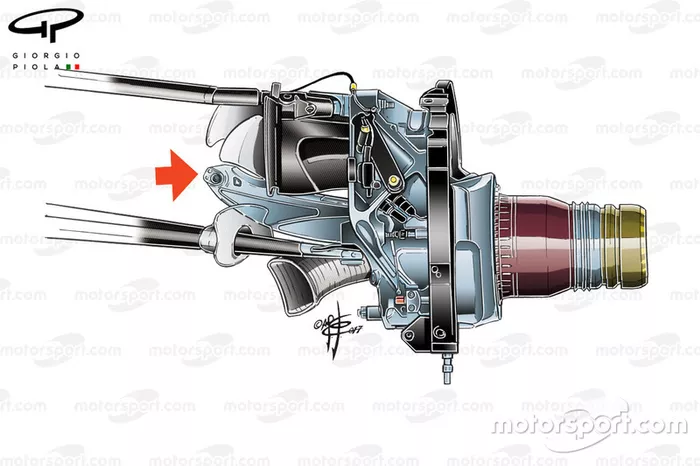
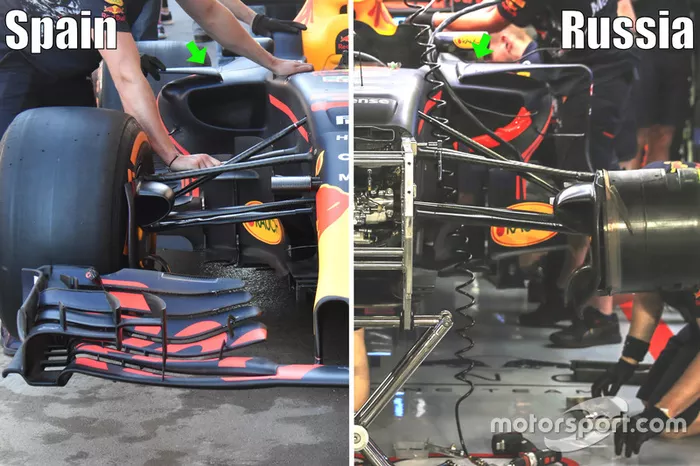
For several races, Red Bull used some of its free practice running to evaluate a new front suspension layout, complete with a different anchor point on the upright (arrowed)

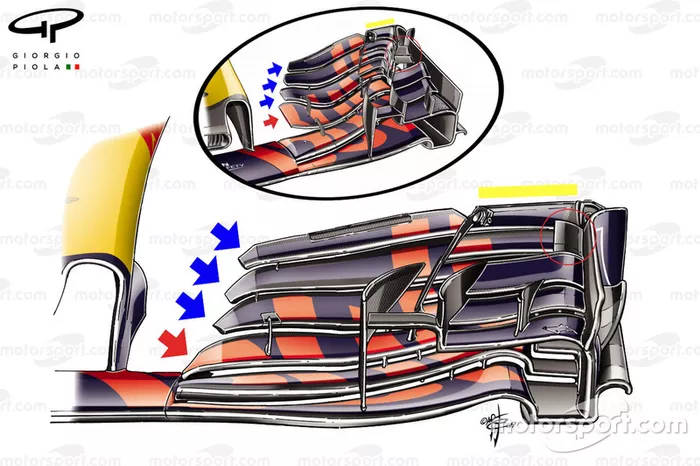
Red Bull tested a new front wing, which features several more conventional design elements. Note the use of downturned flap tips (arrows), when compared with the upturned design used throughout 2017. The outboard section of the wing was much wider (highlighted with a yellow line), while a less complex canard was employed (circled).

A close-up of the rearmost element of the bargeboard, its flootplate and the axehead extension that protrudes from it. Note also the slatted and louvred deflector introduced in Singapore.

A pair of kiel probe arrays are mounted behind the front wheels of the RB13 to measure the wake being generated.

A kiel probe array is mounted at the rear of the RB13 to study the impact of the rear tyre wake and its interaction with the diffuser.
73
We want your opinion!
What would you like to see on Motorsport.com?
Take our 5 minute survey.
- The Motorsport.com Team
Read and post comments
Read also :
Share Or Save This Story
Copy link
Share on Viber
Previous article F1 ended "grandmother" driving era in 2017 - Massa
Next article Vandoorne: Early 2017 performances were below my standard
Top Comments
There are no comments at the moment. Would you like to write one?
View More & Comment

More from
Matt Somerfield

Gallery: How F1 tech evolved during the 2024 season
Formula 1
Formula 1
Gallery: How F1 tech evolved during the 2024 season
How McLaren’s rear wing push changed the game in F1
Formula 1
Formula 1
How McLaren’s rear wing push changed the game in F1
How 2026 F1 rules will help avoid identikit designs
Formula 1
Formula 1
How 2026 F1 rules will help avoid identikit designs

More from
Red Bull Racing
Max Verstappen slams “unacceptable” bumps at Austin F1 track: “It's out of control”
Formula 1
Formula 1
United States GP
19 h
Max Verstappen slams “unacceptable” bumps at Austin F1 track: “It's out of control”

Red Bull called Christian Horner to thank him for F1 engine project after maiden win
Formula 1
Formula 1
United States GP
Red Bull called Christian Horner to thank him for F1 engine project after maiden win
Latest news
George Russell reveals he lost sleep over his own driving, not the F1 championship
Formula 1
F1 Formula 1
United States GP
2 min
George Russell reveals he lost sleep over his own driving, not the F1 championship
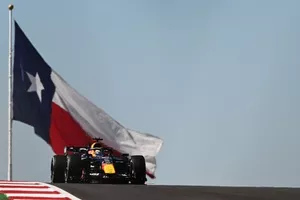
F1 United States GP live commentary and updates - FP1
Formula 1
F1 Formula 1
United States GP
49 min
F1 United States GP live commentary and updates - FP1

Max Papis announces departure as IndyCar chief steward
IndyCar
Indy IndyCar 1 h
Max Papis announces departure as IndyCar chief steward

Lamborghini Super Trofeo | Asia Race 2: Victory for Li/Sherlock, but Tregurtha crowned champion over Sceats/Wisniewski
Lamborghini Super Trofeo
LBST Lamborghini Super Trofeo
World Finals - Monza 2026
1 h
Lamborghini Super Trofeo | Asia Race 2: Victory for Li/Sherlock, but Tregurtha crowned champion over Sceats/Wisniewski
Feature
Discover prime content



Subscribe and access Motorsport.com with your ad-blocker.
From Formula 1 to MotoGP we report straight from the paddock because we love our sport, just like you. In order to keep delivering our expert journalism, our website uses advertising. Still, we want to give you the opportunity to enjoy an ad-free and tracker-free website and to continue using your adblocker.
You have 2 options:
- Become a subscriber.
- Disable your adblocker.
Subscribe now Already subscribed? Sign in here
Already disabled your adblocker?
Reload page
Manage Alerts
Subscribe