Analysis
Formula 1
Technical analysis: Mercedes adds another aero surprise
Formula 1 teams are locked in a constant technical battle to keep improving their cars in a bid to deliver success. Here, Giorgio Piola brings you the latest insight in to the innovation and evolution that appeared at the Canadian Grand Prix.
Edited: Jun 12, 2015, 4:10 PM
Copy link
Share on Viber

Giorgio Piola's F1 technical analysis
Giorgio Piola is the preeminent Formula 1 technical journalist. View our full selection of Giorgio's technical illustrative content
Mercedes has been leading on the Formula 1 track this year, but it also delivered something first in design terms at the Canadian Grand Prix too.
This was the first time it ran with an open brake drum, using a carbon disc with four holes in a row. But the most interesting aspect was how the team used the brake duct as an aerodynamic device.
Teams use the ducts at the back at create extra downforce, where those at the front are all about cleaning up the air flow and increasing efficiency.

Mercedes AMG F1 W06 detail
Photo by: Giorgio Piola
For Canada, Mercedes introduced a vertical long fin – that appears like a turning vane. It is an innovation rather than an evolution – and works well in conjunction with the aerodynamic profiles of the suspension wishbones.

Mercedes AMG F1 W06 detail
Photo by: Giorgio Piola
There were also some less visible changes at Mercedes too. On the engine cover there was a small bulge, which from the outside does not seem so critical.
However, it was important because it showed that underneath was a large cooler for the ERS.
This was in response to the problems the team faced last year, and comes with Canada and Austria being the two toughest tracks for energy recovery.

McLaren MP4-30 detail
Photo by: Giorgio Piola
The importance of front wing performance was highlighted again in Canada as teams made minor tweaks to their front wings.
McLaren changed the position of the front wing adjuster to help them fine tune their settings over the race weekend. The top version allows teams to change the top flap only, while the concept at the bottom means tweaks can be made to two sections.

Ferrari SF15-T detail
Photo by: Giorgio Piola
Ferrari also made tweaks to the fins – moving them closer to the centre and with a much bigger curve in a bid to better channel air around the car. The older version is pictured as an inset.

Williams FW37 detail
Photo by: Giorgio Piola
Williams and Sauber were the only teams to run with a monkey seat on the rear wing. This was not for added downforce though – it was to help with aerodynamic balance.
In Bahrain, for example, Williams had a problem with the rear wing stalling, so the monkey seat helped it work better.
Red Bull Racing RB11 detail
Photo by: Giorgio Piola
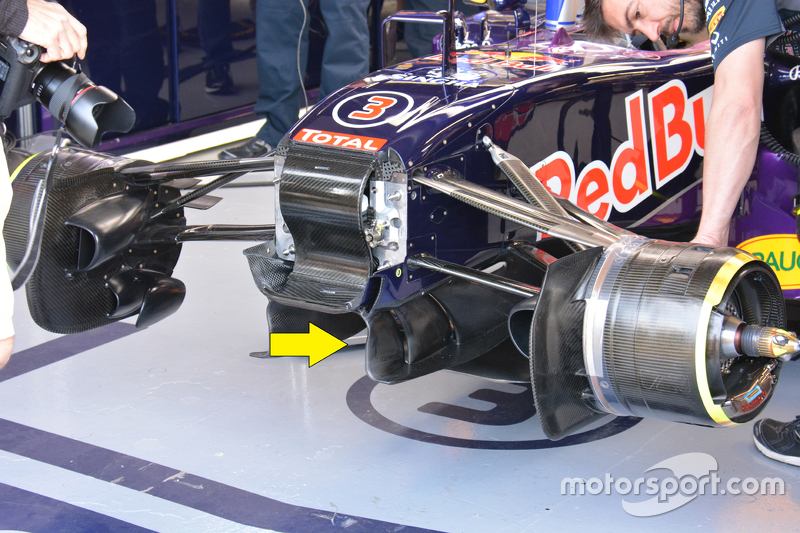
This image shows Daniil Kvyat's car. It features a triple-section turning vane that is very similar to Toro Rosso and Mercedes. Both drivers tried it on Friday, although only Kvyat raced with it.
We want your opinion!
What would you like to see on Motorsport.com?
Take our 5 minute survey.
- The Motorsport.com Team
Read and post comments
Read also :
Share Or Save This Story
Copy link
Share on Viber
Previous article McLaren still pushing for short nose in Austria
Next article Lotus: The Austrian Opportunity
Top Comments
There are no comments at the moment. Would you like to write one?
View More & Comment

More from
Mercedes
‘I’ll put a pillow under his butt’ – How Toto Wolff wants to solve Kimi Antonelli’s track limits problem
Formula 1
Formula 1
Singapore GP
‘I’ll put a pillow under his butt’ – How Toto Wolff wants to solve Kimi Antonelli’s track limits problem

George Russell calls Red Bull "the team to beat" in F1, but Kimi Antonelli adds a key caveat
Formula 1
Formula 1
Singapore GP
George Russell calls Red Bull "the team to beat" in F1, but Kimi Antonelli adds a key caveat
Latest news

Five key takeaways from F1's big African Grand Prix reveal in Rwanda
Formula 1
F1 Formula 1 55 min
Five key takeaways from F1's big African Grand Prix reveal in Rwanda

Niels Koolen makes switch to Abel Motorsports ahead of 2027 Indy NXT campaign
Indy NXT
IndL Indy NXT 2 h
Niels Koolen makes switch to Abel Motorsports ahead of 2027 Indy NXT campaign

GT World Challenge Portimao: All you need to know about season finale featuring Max Verstappen
GT World Challenge Europe Endurance
WCEE GT World Challenge Europe Endurance 2 h
GT World Challenge Portimao: All you need to know about season finale featuring Max Verstappen

13 Autosport retains unchanged lineup for 2027 IMSA campaign, eyes global expansion
IMSA
IMSA IMSA 3 h
13 Autosport retains unchanged lineup for 2027 IMSA campaign, eyes global expansion
Feature
Discover prime content

Subscribe and access Motorsport.com with your ad-blocker.
From Formula 1 to MotoGP we report straight from the paddock because we love our sport, just like you. In order to keep delivering our expert journalism, our website uses advertising. Still, we want to give you the opportunity to enjoy an ad-free and tracker-free website and to continue using your adblocker.
You have 2 options:
- Become a subscriber.
- Disable your adblocker.
Subscribe now Already subscribed? Sign in here
Already disabled your adblocker?
Reload page
Manage Alerts
Subscribe