Analysis
Formula 1 Bahrain GP
The background behind Red Bull's Bahrain DNFs
The dramatic late retirements of Max Verstappen and Sergio Perez from Formula 1's Bahrain GP triggered some intrigue about what caused their fuel pump issues.

Adam Cooper
Edited: Mar 23, 2022, 4:32 PM
Copy link
Share on Viber
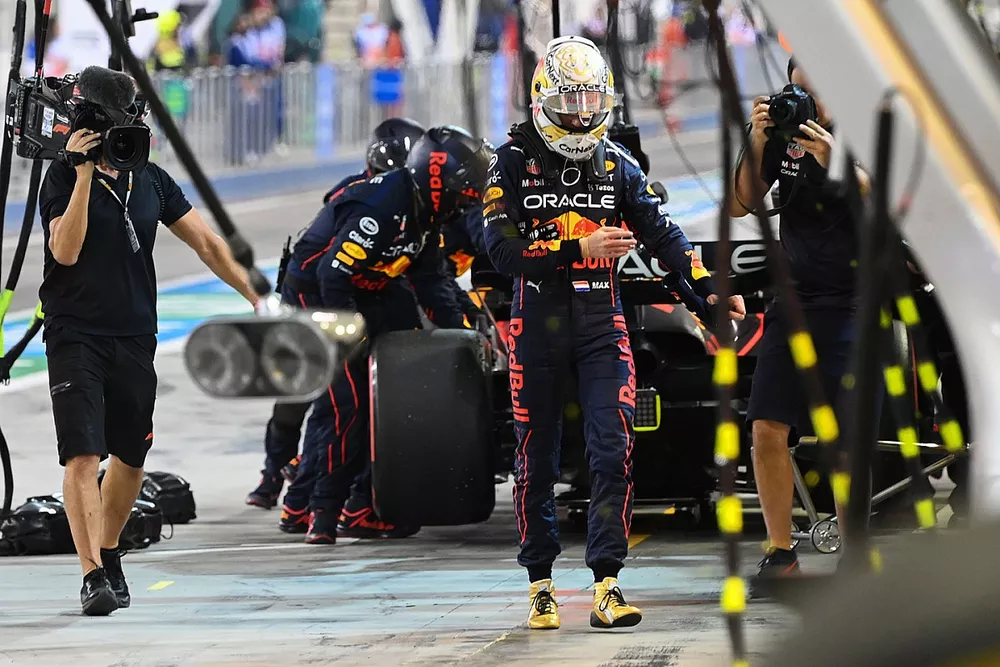
But with it emerging from investigations that the problems were not linked to standard supplied parts, there remains some questions about what really happened inside the RB18s.
It quickly became apparent that the power units of both men were starved of fuel, despite there being plenty of ExxonMobil's finest E10 in their respective tanks.
In other words, something in the fuel system of the RB18 had failed and was not picking up the last few litres that were supposed to get the cars to the flag.
The intriguing part of the story was that F1 fuel systems are now comprised of elements provided by the team, by the power unit manufacturer, and also by third parties who won FIA tenders to supply standard components to the whole grid – notably two types of fuel pump.
Thus the big question in the aftermath of the race was: Did one of the generic items fail in both cars, and thus the hugely frustrating double retirement was triggered by something that was not manufactured by Red Bull Technology or Honda?
And if that was the case, was there perhaps something in the packaging around it that the team or its engine partner were responsible for that somehow led to it failing on the two RB18s, and not on any other car?
Potentially, such a situation would be very similar to a Pirelli failure, which on the surface could be blamed on the tyre company, and yet on further investigation turns out to have been triggered by the way the team concerned operates the tyres.
Indeed, Red Bull motorsport boss Helmut Marko implied that the fault lay with a key component from an outside supplier.
"What we suspect is that there are problems with the fuel pump for both cars," he told Motorsport.com.
"But the fuel pump doesn't come from us, we just have to take it. And we never had this problem before, that's the strange thing."
However, team principal Christian Horner was not able to pinpoint any specific failure.
"What looked like a decent haul of points suddenly evaporated obviously in the last couple of laps there," he said.
"But it looks like a similar issue on both cars. We don't know exactly what it is yet, whether it's a lift pump, whether it's the collector or something along those lines, but we've got to get into it and understand exactly what's caused it."
Motorsport.com understands that none of the standard supplied pumps across the two cars were the cause of the retirements, and thus the issue must lie elsewhere.
So how and why do F1 cars feature such standard components in their hugely complicated fuel systems?
In simple terms, the fuel travels via a lift pump (or lift pumps) to a collector, then to a primer pump (aka mid-pump) that steps the pressure up, and then from the tank to a high pressure pump that feeds the V6.
As the new regulations were being formulated – originally for 2021 – it was agreed that the primer and high pressure pumps and some associated bits were areas where it made sense to utilise standard parts, largely for cost reasons by avoiding development expense.
In addition standard parts would allow the FIA greater control of what teams were doing, and given how sensitive fuel flow and usage is in regulatory terms, that was a key consideration.
Back in 2019 the FIA put out invitations to tender for two main fuel system elements, and the contracts were won by companies with long histories in the F1 pitlane.
In December that year the World Motor Sport Council noted: "Following the pre-selection of Magneti Marelli for the fuel primer pump, and of Bosch for the high pressure fuel pump and piping by the council on 30 July 2019, a phase of consultation with the teams, power unit manufacturers and the two prospective suppliers was conducted under the arbitration of the FIA technical department. Today, the council proceeded to final appointment of the two suppliers."
The wording here is important – it would be wrong to characterise those standard pumps as "FIA supplied" items. The governing body acted as the middle man, and the teams and PU manufacturers had their say in the finalisation of the choice.
The pumps are classified by the FIA in the 2022 regulations as SSCs, or standard supply components: "The primer pump(s), high pressure pump, fuel flow meters and pressure and temperature sensors are SSC, as mandated by the FIA and specified in the appendix to the technical and sporting regulations.
"All flexible pipes and hoses and their fittings between the primer pump(s) and the high-pressure pump are SSC, mandated by the FIA."
Fuel systems also contain some elements that are OSCs, or open source components, where teams make their own but have to show the designs to rivals and potentially allow them to be copied – the lift pump is one example, and it may yet emerge that it was the cause of the problems on Sunday.
"The standard parts are in that low pressure system," says AlphaTauri technical director Jody Egginton.
Christian Horner, Team Principal, Red Bull Racing, Max Verstappen, Red Bull Racing
Photo by: Carl Bingham / Motorsport Images
"And then there's team specific parts in that system. Some of those parts are OSC, so you supply details of those to the FIA, so other people can see them. But it's all pretty straightforward what you can and can't do, and it's well defined.
"It's a lot more controlled and regulated than it has been in the past, which is good. The range of things you can do now is limited, compared to a number of years ago.
"Some of the plumbing is specified as a standard supply part, or we supply details of lengths of piping and plumbing. The collector is car specific, as is the fuel cell. Mechanical parts are standardised, but with the bits around them you've got some level of freedom."
After testing of the new cars kicked off in Barcelona, some teams experienced issues related to the primer pump.
Few details emerged in public, although Haas boss Gunther Steiner noted that on the first day of testing "in the morning we had a fuel pump issue, internal leakage in the fuel tank, so the pressure wasn't right".
Ferrari is also believed to have had an issue at the Bahrain test. The problem was investigated understood, and in conjunction with the FIA, countermeasures were put in place across the teams.
A formal public indication that there were concerns came after qualifying in Bahrain in an unusual document from race control.
It told the teams with cars in Q3: "For this event only and in contradiction to the requirements of Article 40.6 of the FIA F1 sporting regulations, you will be allowed to delay the covering of your cars one hour later than required in order to inspect the SSC fuel primer pump."
In other words that extra hour before the cars went to bed overnight was provided expressly so that as a precautionary measure teams could look at the primer pump (cars not in Q3 could be inspected during the final session).
However, no overnight pump changes were noted by the FIA when the list of parts changed in parc ferme emerged just before the race.
"It was an extra inspection on the primer pump across the grid," said Egginton. "It's not specific to any team. And we had the opportunity to do that over the weekend, and I think will do for a couple of races, until people are happy with reliability.
"The FIA wanted to make sure that it wasn't something which is a common fault. We're pretty happy, we signed off a couple of pumps off in testing, we ran them here, we'll take the opportunity to sign other pumps off.
Max Verstappen, Red Bull Racing RB18
Photo by: Steven Tee / Motorsport Images
"But with the format of the weekend you've got less time to work on the car. So it's a sensible step to make sure that you're okay, not delving into things that you don't need to on a weekend. It's quite challenging for the guys now, to get the cars turned around. You've got less time available to you."
Intriguingly, just after the race Horner implied that the primer pump was not the issue that stopped the RB18s while confirming that the team did a pre-race inspection.
"Yes, we did," he said when asked if the team took the opportunity offered. "But I think that was a general concern rather than specific to Red Bull. We just need to get the cars back, get the fuel system apart and understand, because we know the fuel was was in there.
"I think there have been some other issues that we've been made aware of. It was just an inspection that we wanted to double check.
"So of course it's all subjective at the moment until we get the cars apart and understand exactly what's caused the issue, and I suspect it's similar on both cars, because it's too close and too similar a failure."
Read Also:
- Aston Martin still unsure on Vettel F1 return for Saudi Arabia
- Mercedes: No man’s land Bahrain F1 GP turned into "test session"
- Sainz reaches agreement over new Ferrari F1 contract
There's a good chance that whatever happened was temperature related. Sunday was the first time that the 2022 cars tackled a race distance with the new E10 fuel in real world conditions, with the drivers often behind other cars. Things like high brake and engine temperatures were an issue up and down the pitlane.
It was perhaps no co-incidence that the Red Bull failures happened just after the field had been under safety car conditions. In the past, we've seen cars to grind to a halt when something gets too hot when running slowly, especially early in the season.
Keeping fuel cool is always challenge for teams, for as the regulations note, "the use of any device on board the car to decrease the temperature of the fuel is forbidden".
That rule apparently hails from the atmospheric engine era, when cooler fuel created a performance advantage that doesn't apply as much to the current V6 turbos.
Fans now have to wait for an official analysis to emerge from Red Bull – and the team may be in a race to make any necessary fixes before next weekend's Saudi Arabian GP.
Max Verstappen, Red Bull Racing RB18, retires
Photo by: Mark Sutton / Motorsport Images
We want your opinion!
What would you like to see on Motorsport.com?
Take our 5 minute survey.
- The Motorsport.com Team
Read and post comments
Read also :
Share Or Save This Story
Copy link
Share on Viber
Previous article F1 Grand Prix race results: Leclerc wins wild Bahrain GP
Next article Binotto: Ferrari cannot afford wrong step in F1 development war
Top Comments
There are no comments at the moment. Would you like to write one?
View More & Comment

More from
Adam Cooper

RB: Tsunoda “mentally on a different level” in 2024
Formula 1
Formula 1
Japanese GP
RB: Tsunoda “mentally on a different level” in 2024
Andretti planning F2 and F3 entries to promote US talent to F1 team
Formula 1
Formula 1
Andretti planning F2 and F3 entries to promote US talent to F1 team

Andretti F1 team formally opens new Silverstone facility
Formula 1
Formula 1
Andretti F1 team formally opens new Silverstone facility
Latest news
Barcelona set to host IndyCar race in 2027 under multi-year deal
IndyCar
Indy IndyCar 7 h
Barcelona set to host IndyCar race in 2027 under multi-year deal
Winners and losers from a Chase-altering NASCAR Cup race at Phoenix
NASCAR Cup
NAS NASCAR Cup
Phoenix II
9 h
Winners and losers from a Chase-altering NASCAR Cup race at Phoenix

Heart of Racing rules Valkyrie GTP step next year ‘too soon’ for IMSA standout Barrichello
IMSA
IMSA IMSA 9 h
Heart of Racing rules Valkyrie GTP step next year ‘too soon’ for IMSA standout Barrichello
Sergio Perez: Debut Cadillac season "without a doubt one of my best years"
Formula 1
F1 Formula 1
United States GP
9 h
Sergio Perez: Debut Cadillac season "without a doubt one of my best years"
Feature
Discover prime content



Subscribe and access Motorsport.com with your ad-blocker.
From Formula 1 to MotoGP we report straight from the paddock because we love our sport, just like you. In order to keep delivering our expert journalism, our website uses advertising. Still, we want to give you the opportunity to enjoy an ad-free and tracker-free website and to continue using your adblocker.
You have 2 options:
- Become a subscriber.
- Disable your adblocker.
Subscribe now Already subscribed? Sign in here
Already disabled your adblocker?
Reload page
Manage Alerts
Subscribe