Formula 1
The details that set Haas's real F1 2022 car apart
Haas may have been the first Formula 1 team to reveal its 2022 livery, but it waited until Monday morning to finally show off its actual car in the flesh.

Matt Somerfield
Edited: Feb 23, 2022, 10:49 AM
Copy link
Share on Viber
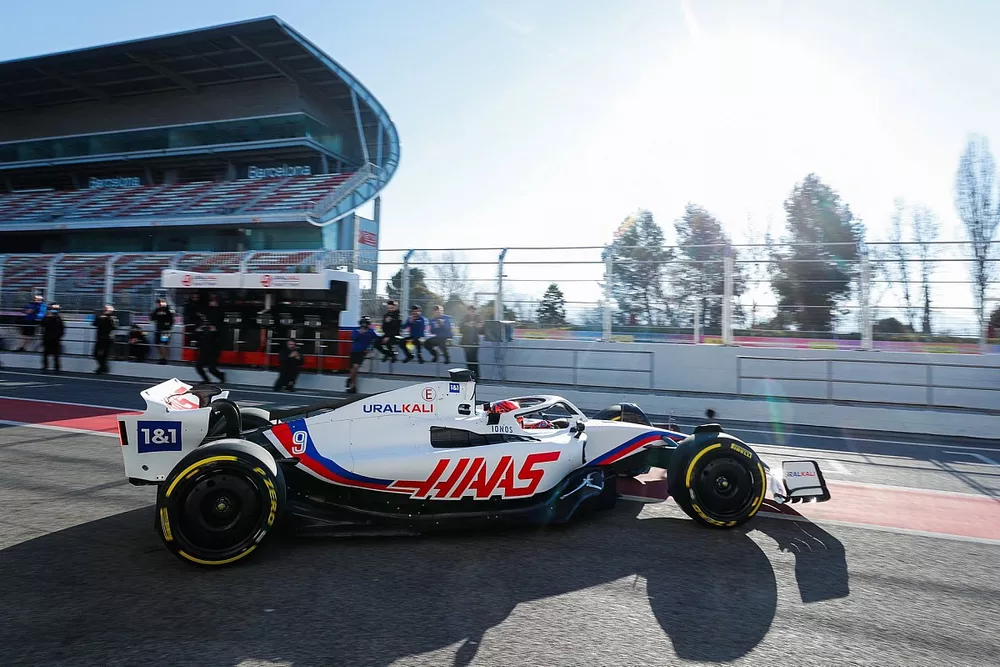
The American owned outfit never tried to hide the fact that the livery renders it released were anything other than from an early stage of development, so it was no surprise that what appeared at its Barcelona filming day is very different.
The front wing and nose are a more developed variant of the one seen from the launch, with the detached mainplane set ahead of the wide stub-style nose to help drive flow beneath the body, which has been narrowed in its cross section on its underside to help too (blue arrow).
Haas VF-22 details
Photo by: Haas F1 Team
The front wing flaps aren't as shapely as the renders, with a more purposeful design employed across their span.
This results in the adjustable section in the middle of the two upper flaps providing a notable division with the section that meets with the nose, as the angular and triangular separator (green arrow) will undoubtedly propagate a vortex and power the airflow downstream.
The front wing endplate is also different from the designs we've seen elsewhere, as the team has employed a wave-like leading edge (yellow line) that affects the entire geometry of the endplate.
Allied to this, we find that the trailing edge is also more shapely and is paired to a wishbone-style diveplane (red arrow).
The diveplane design is very interesting, as Haas has had to work hard to stay within the confines of the regulations whilst also creating a design that will clearly create a contrasting pressure gradient to the one that was intended by these regulations. This will also invoke a different response to the other flow structures being created by the various surfaces around it.
The floor tunnel entrance is similar in shape to what we saw from Mercedes, with the section closest to the chassis set at a much higher height from the outboard section.
Where the two designs deviate though is in the design of the floor strakes, with Haas opting to have its set out quite far forward but also at a height similar to that of the edge wing on the floor's perimeter.
The front edge of the floor has also been turned up to create a scroll, which exposes a skirt-like section ahead of the rear tyre, which the team is using to help direct the airflow across the face of the tyre, much like we saw under the guise of the previous regulations.
Haas VF-22 details
Photo by: Haas F1 Team
The VF-22's sidepods are also different from the renders released by the team, with much more of a Ferrari feel to them. However Haas's own DNA is thrown into the mix too.
A more conventionally shaped inlet is favoured as the main bodywork tapers outwards to a high sided flank, which then allows the team to capitalise on a similar convex shape in the central region, with a high waisted tail.
These attributes lead to a mid-size undercut beneath the inlet, with the main bodywork tapered down towards the floor to encourage the airflow to emerge in the coke bottle region at the rear of the car.
Much like Ferrari, the convex shaped upper surface of the sidepod is supplemented by a set of cooling gills, albeit Haas appears to have a more distinct panel section that will allow it to swiftly alter the amount of cooling that's desired for the conditions.
There's some clever tricks being employed in the vicinity of the sidepods too, as we welcome the hollow wing mirror assembly back that was first seen on the Ferrari SF71-H and has resulted in many different interpretations over the last few years.
Meanwhile, attached to the side of the cockpit bodywork we find some neat Viking horn-like vanes (blue arrow) sticking out that will likely help redirect the airflow coming off the halo.
Another pair of Viking horn-line vanes can also be found on the side of the airbox (green arrow), as the team assimilates the design seen on the Ferrari, whilst retaining the triangular roll hoop and airbox.
The engine cover also features a couple of interesting solutions, with a louvred cooling outlet on the cover's spine (red arrow) resulting in the team creating a shark fin sail.
Read Also:
- New Haas F1 car makes track debut in Barcelona
- Haas: No big change in Ferrari F1 relationship despite new office
- Haas explains development stages of 2022 F1 car
This is yet another example of the team working around the regulations in order to find a genuinely different approach, although we'll have to wait to see whether it's something that actually adds performance.
Just as we found on the Ferrari F1-75, the wastegate pipework is exposed before joining the main exhaust outlet right at the limit that the regulations permit, whereas other teams and manufacturers appear to have done so much earlier.
Nikita Mazepin, Haas VF-22
Photo by: Haas F1 Team
The car shown in these images is probably the closest we've seen so far in terms of the detail we can expect to see as the cars roll out for testing later in the week, as most of the teams will have hidden a great deal of detail when launching their cars over the last few weeks.
That means we have a fascinating time ahead, as new and interesting features will make their way onto the cars, with the teams looking to collect as much data as possible ahead of the first race.
We want your opinion!
What would you like to see on Motorsport.com?
Take our 5 minute survey.
- The Motorsport.com Team
Read and post comments
Read also :
Share Or Save This Story
Copy link
Share on Viber
Previous article McLaren predicts "successful decade" for F1 business
Next article Bottas feels "big responsibility" to be Alfa Romeo F1 leader
Top Comments
There are no comments at the moment. Would you like to write one?
View More & Comment

More from
Matt Somerfield

Gallery: How F1 tech evolved during the 2024 season
Formula 1
Formula 1
Gallery: How F1 tech evolved during the 2024 season
How McLaren’s rear wing push changed the game in F1
Formula 1
Formula 1
How McLaren’s rear wing push changed the game in F1
How 2026 F1 rules will help avoid identikit designs
Formula 1
Formula 1
How 2026 F1 rules will help avoid identikit designs

More from
Haas F1 Team
Charles Leclerc penalised for Liam Lawson clash; Kimi Antonelli and Oliver Bearman also punished after F1 Brazilian GP
Formula 1
Formula 1
Sao Paulo GP
Charles Leclerc penalised for Liam Lawson clash; Kimi Antonelli and Oliver Bearman also punished after F1 Brazilian GP
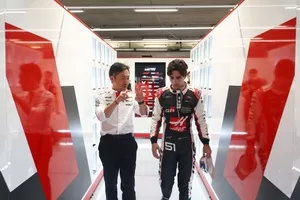
Haas justifies picking Rafael Camara over Ryo Hirakawa for F1 Brazilian GP
Formula 1
Formula 1
Sao Paulo GP
Haas justifies picking Rafael Camara over Ryo Hirakawa for F1 Brazilian GP

Latest news

Samantha Busch full speech as she accepts Kyle Busch's Most Popular Driver award
NASCAR Cup
NAS NASCAR Cup 6 h
Samantha Busch full speech as she accepts Kyle Busch's Most Popular Driver award

Kyle Busch posthumously wins NASCAR Cup Most Popular Driver Award
NASCAR Cup
NAS NASCAR Cup
Homestead-Miami
6 h
Kyle Busch posthumously wins NASCAR Cup Most Popular Driver Award

Jamie Little will not return to NASCAR broadcast booth in 2027
NASCAR Cup
NAS NASCAR Cup 10 h
Jamie Little will not return to NASCAR broadcast booth in 2027

Logano, Sargeant, and Muniz among Ford drivers taking part in Daytona exhibition race
General
Misc General 10 h
Logano, Sargeant, and Muniz among Ford drivers taking part in Daytona exhibition race
Feature
Discover prime content



Subscribe and access Motorsport.com with your ad-blocker.
From Formula 1 to MotoGP we report straight from the paddock because we love our sport, just like you. In order to keep delivering our expert journalism, our website uses advertising. Still, we want to give you the opportunity to enjoy an ad-free and tracker-free website and to continue using your adblocker.
You have 2 options:
- Become a subscriber.
- Disable your adblocker.
Subscribe now Already subscribed? Sign in here
Already disabled your adblocker?
Reload page
Manage Alerts
Subscribe