Formula 1
The latest Red Bull F1 wing changes helping its charge
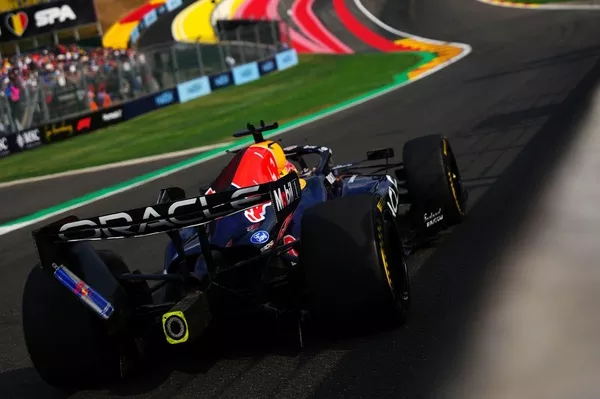
Red Bull’s RB19 may be the class of the field in Formula 1 this season, but the team is not holding back when it comes to trying to unlock even more performance from it.
Matt Somerfield Giorgio Piola
Edited: Apr 5, 2023, 7:38 AM
Copy link
Share on Viber
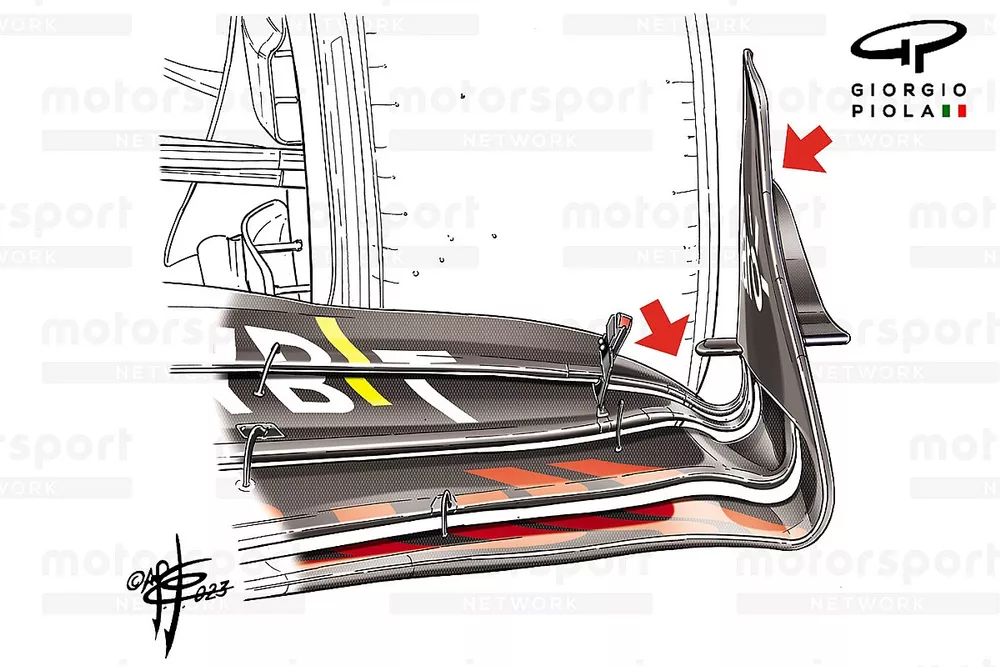
The squad duly arrived in Australia with a new layout for its front wing, which took into account a revised flap arrangement as well as tweaks to the endplate and diveplane areas.
This was aimed at helping balance the car with the various rear wing choices it has on offer.
The endplate is now more cambered across the top and middle section, which presents more of the diveplane to the oncoming flow (below, white arrows).
This likely helps improve the outwash effect too, which is another reason why it needs to work on a trade-off that sees it ‘load’ the inner portion of the wing, or at least more so than it has done with its other wing configurations.
In order for this trade-off to work, the new flaps, which are the two uppermost elements of the wing, are different across the middle of their span (yellow line, below).
There is more chord presented at the inboard end, whilst there’s more camber all the way to the outboard adjuster (note the crease and shade line in the upper flap, below).
Red Bull's efforts were not limited to the front wing though, as some changes were also made to the rear brake duct in order to improve cooling, whilst also improving how the local flow moves around that region of the car.
As is now commonplace, Red Bull doesn’t place its entire focus on the external inlet of its brake duct.
Instead, it has displaced the lead edge of the end fence in order that airflow is captured between it and the sidewall of the tyre.
As such, a number of mini fences are used to help control the airflow’s trajectory and align it with the internal ducting (inset).
The changes made by Red Bull are clearly an optimisation of what it already has in place, with its work conducted during CFD and wind tunnel studies pivotal in optimizing how these surfaces interact with the airflow.
Alpine halo fin
Alpine A523 halo winglets
Photo by: Uncredited
While much of the development work we have seen this year has revolved around wings, Alpine focused on a completely different area of its car for a Melbourne upgrade.
The Enstone-based outfit made changes to the fairing that shrouds the halo for the Australian Grand Prix.
The main triangular fin mounted on the top of the rear leg was increased in size, whilst the upper edge has been folded over in order to alter how the airflow will behave as it passes by.
This is aided and abetted by a new winglet that’s been mounted on the side of the halo (blue arrow), with similar designs seen elsewhere up and down the grid.
It’s clear that there’s some performance to be gained from having such a winglet and it’s unsurprising that Alpine has spent time and resources introducing its own.
Alpine chief technical officer Pat Fry said the improvement from the new components was bigger than some may expect.
“This [halo fairing], although it is a tiny bit of a car, it does actually have a reasonable effect on the rear of the car,” he said. “By normal standards, you'd call it a small step. But it's not insignificant.”
Read Also:
- 10 things we learned from the 2023 Australian Grand Prix
- Hamilton: Mercedes can close gap to Red Bull after Melbourne F1 podium
- What F1 GPS data reveals about Mercedes' threat to Red Bull in Australia
We want your opinion!
What would you like to see on Motorsport.com?
Take our 5 minute survey.
- The Motorsport.com Team
Read and post comments
Read also :
Share Or Save This Story
Copy link
Share on Viber
Previous article Hulkenberg: Albon's F1 Australian GP crash a “code brown” moment
Next article Norris: "Terrible" Pirelli tyres not up to F1 standards
Top Comments
There are no comments at the moment. Would you like to write one?
View More & Comment

More from
Matt Somerfield

Gallery: How F1 tech evolved during the 2024 season
Formula 1
Formula 1
Gallery: How F1 tech evolved during the 2024 season
How McLaren’s rear wing push changed the game in F1
Formula 1
Formula 1
How McLaren’s rear wing push changed the game in F1
How 2026 F1 rules will help avoid identikit designs
Formula 1
Formula 1
How 2026 F1 rules will help avoid identikit designs
Latest news

Jorge Martin: “I don’t feel I will struggle anymore” in MotoGP title run-in
MotoGP
MGP MotoGP
Indonesian GP
1 h
Jorge Martin: “I don’t feel I will struggle anymore” in MotoGP title run-in

"Extremely difficult": Calendar clashes threaten Marco Wittmann's DTM future
DTM
DTM DTM 1 h
"Extremely difficult": Calendar clashes threaten Marco Wittmann's DTM future

Feature
Discover prime content


Subscribe and access Motorsport.com with your ad-blocker.
From Formula 1 to MotoGP we report straight from the paddock because we love our sport, just like you. In order to keep delivering our expert journalism, our website uses advertising. Still, we want to give you the opportunity to enjoy an ad-free and tracker-free website and to continue using your adblocker.
You have 2 options:
- Become a subscriber.
- Disable your adblocker.
Subscribe now Already subscribed? Sign in here
Already disabled your adblocker?
Reload page
Manage Alerts
Subscribe