Analysis
Formula 1 British GP
The pre-race tweak that hampered Lewis Hamilton's British GP
Hamilton endured a difficult home grand prix, which included struggling in the first stint due to an incorrect wing setting made before the race

Gianluca D'Alessandro
Published: Jul 7, 2026, 4:05 PM
Copy link
Share on Viber
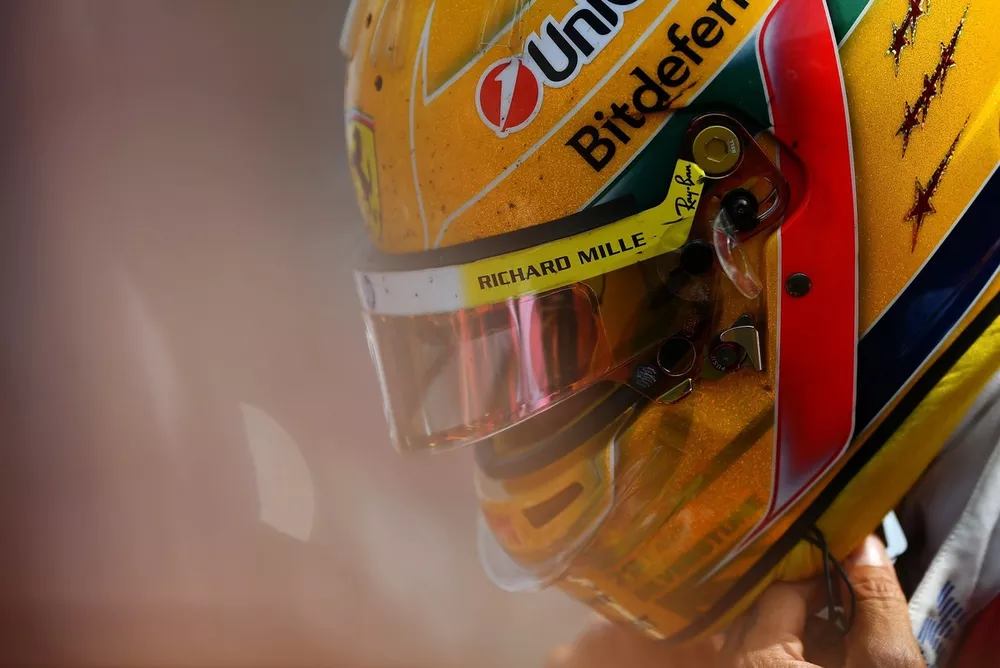
Lewis Hamilton, Ferrari
Photo by: James Sutton / LAT Images via Getty Images
Ferrari didn’t start its British Grand Prix weekend in the most optimistic of ways, as its engineers estimated a possible six tenths deficit to Formula 1’s dominant outfit Mercedes on the straights.
But then it took a completely unexpected turn, surprising even the drivers, as Lewis Hamilton took a shock pole last Friday for the sprint race.
Although victory eventually went to Mercedes rival Kimi Antonelli, it was still a respectable showing from Hamilton who took second before finishing third on Sunday, behind his race-winning team-mate Charles Leclerc.
Leclerc benefitted from a strong opening stint, overtaking pole man Antonelli on lap one, while also building a 10-second buffer on team-mate Hamilton who was hampered by a pre-race tweak.
“Charles did a great job today and all the magic I had on Friday simply vanished over the course of the weekend,” said the seven-time world champion.
"As for the balance, I noticed that Charles had increased the front load compared to qualifying, adding wing, while I felt the car was very oversteery with the differential settings we had.
Charles Leclerc, Ferrari, Lewis Hamilton, Ferrari
Photo by: Simon Galloway / LAT Images via Getty Images
“So I took wing off and, as a result, at the start of the race, I had huge understeer.”
While Leclerc therefore added more front load, Hamilton went the opposite way in an attempt to regain rear-end stability, taking load off the front end to restabilise the rear.
“I was completely missing the front end,” he added. “We went too low [on how much load to have] on the front wing and that is my responsibility and that of the engineering team.”
During the first stint he struggled to get the car to turn, not only in the slow sections such as Village and The Loop where a lot of rotation is needed, but also in faster areas like Stowe and Copse.
And unfortunately for Hamilton, losing time in Copse has a knock-on effect because a driver then carries that lost speed towards the bendy Maggots, Becketts and Chapel sequence that immediately follows.
By having too much understeer through that section only generates stress, to the point that at one stage, Hamilton had almost felt graining forming.
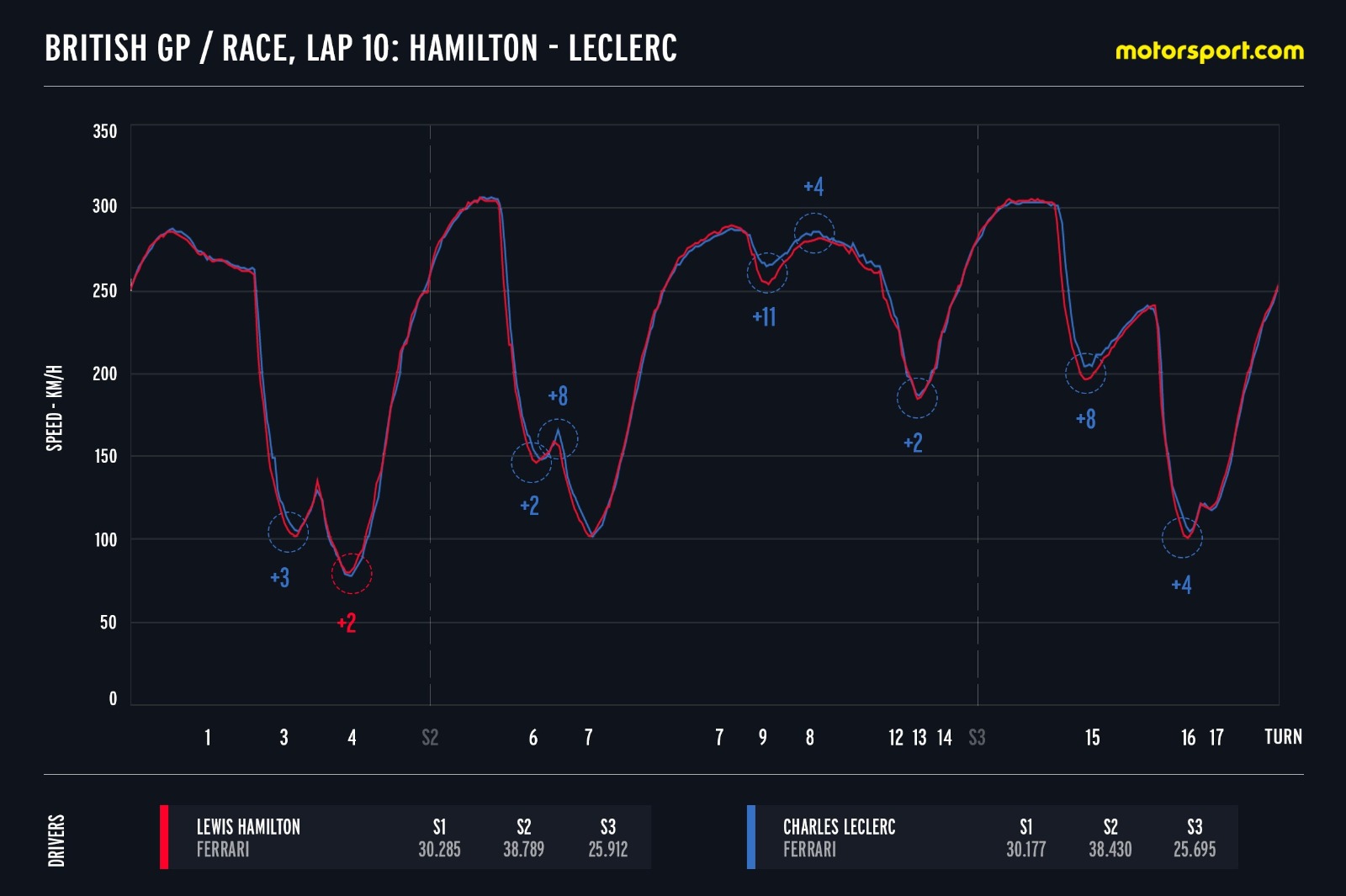
Hamilton versus Leclerc data
This is something F1’s tyre supplier Pirelli had highlighted, after collecting the data from long run programmes in Friday practice and the Saturday sprint.
“What we saw is that understeer actually stresses the front end too much,” said Pirelli’s motorsport chief Dario Maraffuschi.
“It does not generate temperature, but makes you more prone to increasing wear. So, from the tyre point of view, I believe it is not worth putting the car on a set-up tending toward understeer.”
Hamilton subsequently tried to change the balance by working with the engineers on the adjustments available via the steering wheel, intervening on the differential and engine braking, as well as on the way he approached various corners.
The Briton managed to mitigate the situation to an extent, so much so that his lap times progressively came down again and closer to those of Leclerc.
Hamilton said: “I couldn’t even get the car to turn until halfway through the first stint when I managed to make it turn a little better with some changes to the diff.
“But by then the gap was already huge. Then the five seconds at the pitstop and from there, it was just one problem after another.”
Read Also:
We want your opinion!
What would you like to see on Motorsport.com?
Take our 5 minute survey.
- The Motorsport.com Team
Read and post comments
Read also :
Share Or Save This Story
Copy link
Share on Viber
Previous article Should the British GP ending cause a change in F1 safety car rules?
Next article Ferrari faces Lewis Hamilton-Charles Leclerc decision after British GP victory, says Rob Smedley
Top Comments
There are no comments at the moment. Would you like to write one?
View More & Comment

More from
Gianluca D'Alessandro
The Pirelli test row shows why MotoGP riders need a stronger voice
MotoGP
MotoGP
The Pirelli test row shows why MotoGP riders need a stronger voice
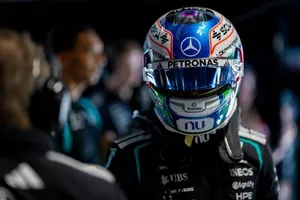
Mercedes reveals the "secret code" tactic behind Kimi Antonelli's Madrid-winning VSC call
Formula 1
Formula 1
Spanish GP
Mercedes reveals the "secret code" tactic behind Kimi Antonelli's Madrid-winning VSC call
More from
Lewis Hamilton
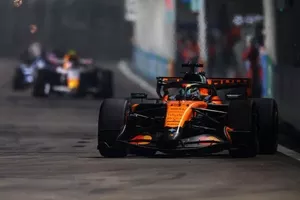
Oscar Piastri on his Singapore puncture: “Ironically, it probably helped”
Formula 1
Formula 1
Singapore GP
Oscar Piastri on his Singapore puncture: “Ironically, it probably helped”
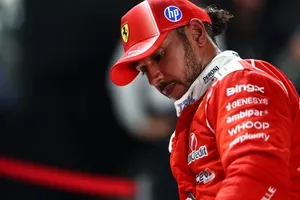
Why Ferrari caved in to Lewis Hamilton’s failed Singapore F1 gamble
Formula 1
Formula 1
Singapore GP
Why Ferrari caved in to Lewis Hamilton’s failed Singapore F1 gamble

More from
Ferrari
The figures that show Mercedes has lost its supremacy in F1 2026
Formula 1
Formula 1
United States GP
3 h
The figures that show Mercedes has lost its supremacy in F1 2026
Ferrari promotes F2 racer to F1 reserve driver role
Formula 1
Formula 1
Singapore GP
Ferrari promotes F2 racer to F1 reserve driver role

Latest news
Hockenheim in talks with F1 despite “virtually zero” public funding
Formula 1
F1 Formula 1 39 min
Hockenheim in talks with F1 despite “virtually zero” public funding

Philipp Eng and BMW to part ways after 11 years
IMSA
IMSA IMSA 1 h
Philipp Eng and BMW to part ways after 11 years
Frankie Muniz offers new details on 2027 NASCAR plans
NASCAR Truck
NSTR NASCAR Truck
Talladega
1 h
Frankie Muniz offers new details on 2027 NASCAR plans
Joan Mir remains on the sidelines as Honda forced to race with one rider in Australia
MotoGP
MGP MotoGP
Australian GP
2 h
Joan Mir remains on the sidelines as Honda forced to race with one rider in Australia
Feature
Discover prime content


Subscribe and access Motorsport.com with your ad-blocker.
From Formula 1 to MotoGP we report straight from the paddock because we love our sport, just like you. In order to keep delivering our expert journalism, our website uses advertising. Still, we want to give you the opportunity to enjoy an ad-free and tracker-free website and to continue using your adblocker.
You have 2 options:
- Become a subscriber.
- Disable your adblocker.
Subscribe now Already subscribed? Sign in here
Already disabled your adblocker?
Reload page
Manage Alerts
Subscribe