Feature
Formula 1
Special feature
Top 10 unexpected F1 polesitters
Shock Formula 1 polesitters are rare in any era given it is the purist measure of performance and brings the fastest drivers and fastest cars to the top. But, when they occur, the surprise can be seismic

Kevin Turner
Edited: Aug 20, 2026, 9:08 AM
Copy link

Share on Viber
Autosport Retro
Telling the forgotten stories and unearthing the hidden gems from years gone by.
The vast majority of Formula 1 poles fall to the teams and drivers everyone expects to see at the front. That makes sense as it’s usually the purist measure of performance and the best regularly deliver. But sometimes, weather conditions, car and track characteristics, or unforeseen circumstances produce something unusual.
For this list, we have picked out the most surprising F1 polesitters, based on the perceived level of the car or driver heading into the event, plus their relevant form elsewhere. Of course, it’s impossible to measure exactly how unexpected a performance can be and some onlookers will be more shocked than others, so this is far from a definitive list, but hopefully it is a fun one.
And a spoiler alert: Pastor Maldonado’s 2012 Spanish GP pole hasn’t made the list, partly because he wasn’t actually quickest in the session (that was Lewis Hamilton) and partly because we think that weekend belongs somewhere else…
Read Also:
10. Vittorio Brambilla, 1975 Swedish GP
Anderstorp's unusual circuit characteristics led to unusual results
Photo by: David Phipps / Sutton Images via Getty Images
March 751
The unusual Anderstorp circuit could throw up some odd results. Tyrrell’s 007 had qualified and finished 1-2 in 1974 and no one was entirely sure why. A year later it was the turn of March’s 751 in the hands of Brambilla to unexpectedly set the pace.
On a weekend when many teams struggled to find a balance, the 751 was consistently fast and Brambilla’s best of 1m24.630s was 0.38 seconds quicker than second-placed Patrick Depailler, who failed to match his 1974 pole time. Brambilla had qualified third at the previous race in Belgium, but the nature of his Swedish domination caused confusion.
“Just why everybody was so much inferior to Brambilla was the subject of much speculation all over the paddock all weekend,” reported Pete Lyons in Autosport.
“Brambilla was able to hold the 751 at a more or less neutral attitude through all the long bends. The others with their other cars couldn’t. The March was measurably faster through those bends. It seemed quite simple.”
The Italian barely even bothered going out in the last hour of practice and didn’t do morning warm-up!
Brambilla duly led the early stages of the race from what would be his only F1 pole but he didn’t run away from the field. That elusive balance left the March, understeer eventually overheating the front-left tyre. Brambilla fell back and then pitted for new rubber before his transmission failed, while Niki Lauda’s Ferrari – which had started fifth – won.
9. Keke Rosberg, 1983 Brazilian GP
Rosberg’s Rio pole was the last for a normally aspirated F1 car before the turbos were banished
Photo by: LAT Images via Getty Images
Williams FW08C
Having the reigning world champion as a surprise polesitter for the opening round of the following season might seem a bit strange. But, as Autosport pointed out, “the last thing anybody expected was a Cosworth car to head the front row of the grid”.
Rosberg had taken what would turn out to be the last title for the Cosworth DFV with a single win in 1982. Turbos were getting more and more powerful, particularly in qualifying when they could turn the boost up. And Rio was not regarded as the sort of track that would give the non-turbos a chance.
Rosberg, however, had been planning this surprise since testing the month before, though he thought someone would steal it. He recorded a 1m34.526s in his Williams FW08 and reckoned he could have gone faster. But no one else did, with Renault’s Alain Prost qualifying second on 1m34.672s.
Rosberg’s team-mate Jacques Laffite was 18th, 3.7s down, while the second-quickest Cosworth runner was Lauda in ninth, 1.5s behind Rosberg.
“It feels really good to have the pole at the first race of the year after all the rubbish you hear over the winter about having no chance with a Cosworth this year, being lucky to have won the championship and not going well this year,” said Rosberg.
The FW08 ended up as the eighth-fastest car of 1983 on raw pace and Rosberg’s Rio performance would be the last normally aspirated F1 pole before the turbos were banished for 1989.
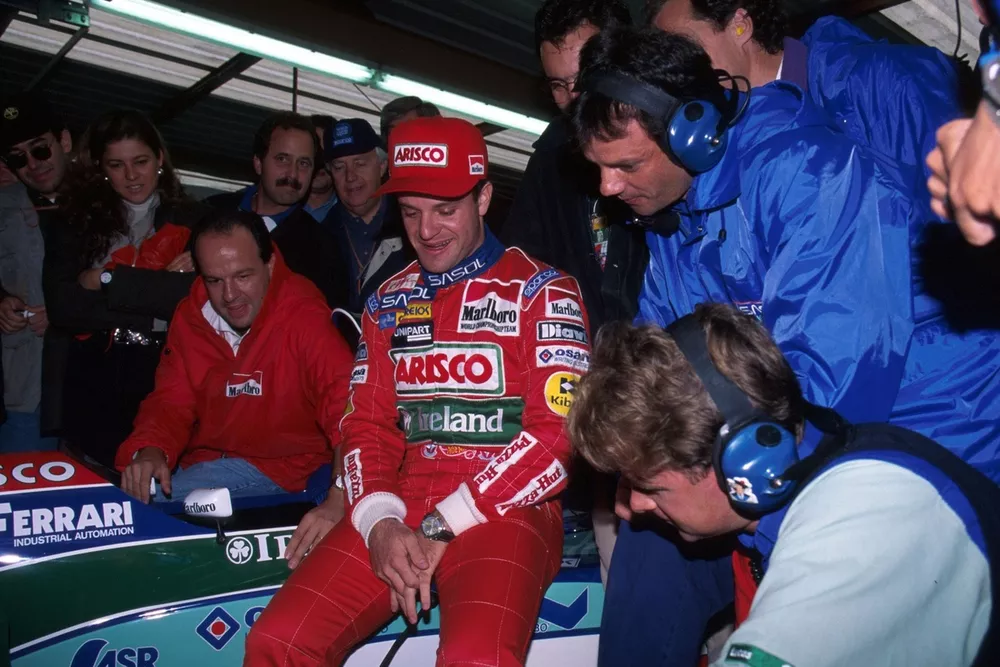
8. Rubens Barrichello, 1994 Belgian GP
Barrichello sits in the Jordan garage waiting to see if he keeps pole during Saturday qualifying
Photo by: Sutton Images
Jordan 194
Barrichello had been a top-six threat at times early in 1994, though his previous two grid slots arriving at Spa were 11th and 10th. But classic mixed Ardennes weather gave the young Brazilian a chance.
Friday’s session was wet but drying, and Barrichello gambled on a switch to slicks in the closing moments. He danced the Jordan 194 around in 2m21.163s to top the times by 0.331s, with championship leader Michael Schumacher’s Benetton second.
“The boys were just about to bolt on more wets when I decided to go for it,” said Barrichello. “The new chicane and the Bus Stop were really slippery, but slicks were the way to go. Just.”
Saturday’s qualifying was wet and Barrichello sat steadfastly in the pits, not wanting to help dry the track. This time Jean Alesi’s Ferrari went quickest but conditions didn’t improve enough and his best was nearly 4s away from robbing Barrichello of his and Jordan’s first F1 pole.
Read Also:
Incredibly, it was the first pole by a team other than McLaren, Williams, Benetton and Ferrari since 1987! Sadly, Barrichello would not finish the race.
Barrichello’s 1999 French GP pole in mixed conditions also deserves an honourable mention. But his Stewart SF3 had already shown flashes of pace and Barrichello’s quality in the wet had been well-established by days such as that at Spa in 1994.
7. Sebastian Vettel, 2008 Italian GP
Vettel stunned F1 with Italian GP pole - and did so again one day later with victory
Photo by: Charles Coates / Motorsport Images
Toro Rosso STR3
We’ve largely ignored the surprising poles of the 2003-09 era, when cars had to start the race with the fuel load they qualified with and thus some teams gambled on lighter loads to get higher up the grid. But Vettel’s first F1 pole was about much more than fuel weight.
Vettel had already impressed during his first full F1 campaign with Toro Rosso, the team previously known as minnow Minardi. But even so, his best qualifying effort in the aerodynamically efficient and Ferrari-engined STR3 prior to round 14 in Italy was sixth.
Read Also:
At Monza, Vettel was third in Q1 and then topped Q2 in a session a McLaren gamble to put Hamilton on intermediate tyres instead of wets backfired and left the Briton knocked out in 15th. The 21-year-old German was consistently brilliant and finished it off with a 1m37.555s Q3 effort, pipping McLaren’s Heikki Kovalainen by 0.076s.
“I didn’t like the car in the rain on Friday, so we made quite a big change in the set-up overnight,” said Vettel, who became F1’s youngest polesitter before going on to take a brilliant win on Sunday. “Right from the moment I first tried it in free practice it felt very good in the wet and gave me a lot of confidence.”
Read Also:
6. Lance Stroll, 2020 Turkish GP
Stroll put the 'pink Mercedes' on pole in wet, cold and slippery conditions
Photo by: Mark Sutton / Motorsport Images
Racing Point RP20
Mercedes dominated the 2020 season with the remarkable W11. Before round 14 of the COVID-hit season, only Hamilton and Valtteri Bottas had taken a pole, while Red Bull’s Max Verstappen had been their closest challenger.
Racing Point’s RP20, dubbed the ‘Pink Mercedes’ due to its similarity to the 2019 W10, was a consistent points threat and arguably the season’s third-best car. But it was 1.2% slower than the Mercedes, a margin that covered the top seven teams in 2025. Sergio Perez also tended to lead the team – as he would underline with a fine victory in the Sakhir GP – but it was Stroll who took his chance in Istanbul.
Verstappen looked the favourite to end the Mercedes run of poles, having topped all three practice sessions. He was then quickest in Q1 and Q2 on a wet track as well. The Dutchman looked good on the wet tyres but was less comfortable on the intermediate rubber that he and the Racing Points switched as the clock ticked down.
Perez grabbed provisional pole before Stroll, 12th and fourth in the first two segments of qualifying, managed 1m47.765s – a full 1.6s faster than his team-mate. Verstappen fell 0.3s short, while Hamilton and Bottas struggled to sixth and ninth respectively.
Stroll would go on to lead more than half of the GP in similar conditions, but ended up ninth as Hamilton came through to win and secure his seventh world title.
One thing that stops this climbing higher is that Stroll had shown flashes of wet-weather ability before, in particular qualifying fourth (and starting second) for Williams at Monza in 2017.
5. Nico Hulkenberg, 2010 Brazilian GP
Hulkenberg made the rest of the F1 field look average in 2010 Brazilian GP qualifying
Photo by: Glenn Dunbar / Motorsport Images
Car: Williams FW32
Hulkenberg won everything on his way to F1 and the Williams FW32 was strong on the sort of green track that rain at Interlagos created, but this was still an outstanding performance from the rookie. The combination’s average grid position over the first 17 rounds of 2010 had been 11.6…
Even in the wetter Q1 and Q2, Hulkenberg was merely competitive rather than stunning – 11th in the first part of qualifying, eighth in the second. But as the track dried a little more for Q3, the German found grip others didn’t.
And this was about more than just being out on track at the end of the session when the track was quickest. Hulkenberg set two laps (on slicks) good enough for pole, the second “monster of a lap, super-aggressive”, as he put it, 1.049s quicker than the Red Bull of second-place Vettel.
Hulkenberg was 1.7s faster than team-mate and fellow wet-weather ace Barrichello, who had actually made the call to try slicks first but was using less wing than his colleague.
“He made us all look pretty average there today,” said Mark Webber. “He found a different race track to the rest of us.”
Read Also:
4. Carlos Reutemann, 1972 Argentinian GP
Reutemann's maiden F1 pole came out of nowhere
Photo by: Sutton Images
Brabham BT34
The Brabham BT34 had not proved particularly potent in 1971. Graham Hill had only scored two points with it all season, though he had won the non-championship BRDC International Trophy at Silverstone in a mixed F1/F5000 field.
Rookie Reutemann had finished as runner-up in the 1971 European F2 championship, but it’s fair to say the combination of the newcomer and the BT34 was not everyone’s tip for pole at the 1972 season opener. Ferrari was quickest in unofficial practice, while McLaren and reigning champion Jackie Stewart also looked in the mix.
But in the final half-hour of practice, Reutemann went out – with Stewart behind – and edged away from the Tyrrell as they made their final pushes. The result was pole for the new home star, his 1m12.46s being more than a second quicker than anyone had managed the day before and 0.22s ahead of Stewart.
Autosport’s David Phipps also described Reutemann as “the star of the race”, the Argentinian running second to Stewart before his soft-compound Goodyear tyres started to wilt and he finished seventh. Reutemann wouldn’t qualify better than fifth for the rest of the season and would have to wait nearly three years for his second pole.
3. Andrea de Cesaris, 1982 USA GP West
De Cesaris was overcome with emotion after taking pole
Photo by: Sutton Images
Alfa Romeo 182
Lauda, in just his third GP after coming out of retirement, had looked in control at Long Beach. He would go on to win the race, but the McLaren driver was denied pole by a late lap out of the blue from the Alfa Romeo of de Cesaris.
“Rarely can a driver have put more into a single lap,” reckoned Autosport’s Nigel Roebuck, who also described the Alfa’s pole as “a shock”.
“Andrea came in to some kind of hero’s welcome from his crew, but a glance at the young Italian told you the extent of his effort,” continued Roebuck. “He was in a very emotional state, weeping and shaking in the enormity of the moment. A lot of inspiration went into that pole position lap.”
While the Alfa Romeo 182s of de Cesaris and Bruno Giacomelli had looked competitive around Long Beach, neither had troubled the top six in the car’s first outing in Brazil. And de Cesaris was coming off a 1981 season with McLaren in which he’d had more crashes than finishes, so outqualifying his replacement by 0.12s was rather attention-grabbing.
We’ve popped this here above the other surprise Alfa pole, Giacomelli’s effort at Watkins Glen in 1980. The Italian had qualified fourth at the previous two races, but taking his only F1 pole by 0.8s means he deserves a mention.
De Cesaris converted his Long Beach pole into the lead and initially edged away. But Lauda was never too far back, chipped away at the deficit and closed up as the leaders encountered traffic. When de Cesaris was held up by Raul Boesel, the leader shook his fist instead of changing gear and Lauda flashed by. De Cesaris later crashed out, distracted by seeing fire in his mirrors.
2. Kevin Magnussen, 2022 Brazilian GP
Magnussen profited from worsening conditions and a timely red flag to take a maiden F1 pole
Photo by: Sam Bloxham / Motorsport Images
Haas VF-22
The Haas VF-22 was, on average, the eighth-fastest car of 2022 and the team had been a point-less last in the standings the year before. Prior to the penultimate round in Brazil, Magnussen’s best starting position was fifth and he’d only occasionally been a Q3 contender.
As with several entries on this list, however, weather provided an opportunity. Magnussen, who had thought his F1 career was over until global events led to Nikita Mazepin losing his drive before the season began, did well to make it into Q3 – team-mate Mick Schumacher fell in Q1. He then led the rush to put in a lap before showers arrived.
Magnussen immediately managed a 1m11.674s lap, quicker than chaser Carlos Sainz’s Ferrari, while season dominator Verstappen suffered a lock-up and fell 0.2s short in his Red Bull. When George Russell beached his Mercedes and brought out red flags after going third quickest, an upset looked likely.
The session resumed with eight minutes remaining but the conditions were now worse and Magnussen secured his one and only F1 pole. “You’re kidding!” exclaimed the Dane when told he was told over the radio.
1. Giancarlo Fisichella, 2009 Belgian GP
The ninth-slowest car of the year taking pole is a deserving topper of this list
Photo by: Sutton Images
Force India VJM02
As one of the great drivers of mediocre machinery, Fisichella had two candidates for this list from his four F1 poles, the other being the 1998 Austrian GP. But he’d already hauled that year’s Benetton to fourth on the grid in Spain and Canada, and third in Monaco. The B198 was also the fourth-fastest car of 1998 and double spinner Fisichella was aided by being the last runner on a drying track at the A1 Ring.
The Force India VJM02 was, on average, the slowest car of 2009, albeit in a very tight season during which it received major upgrades. Fisichella’s qualifying efforts prior to round 12 at Spa read as: 18-18-20-18-20-13-19-16-18-16-16.
But in what Autosport described as “quite the most bizarre dry qualifying anyone could remember”, Fisichella topped Q1, was fourth in Q2 and then took pole by 0.087s from Jarno Trulli’s Toyota, which was faster but fuelled heavier.
“Fisichella probably had as little idea as the rest of the pitlane that he was going to deliver the performance of his life,” opined Autosport. “Something magical clicked into place.”
Fisichella had opted for the softer tyre option for qualifying, while other teams struggled to get the best out of it and opted for the harder medium. The updated VJM02 was also aerodynamically efficient for the relatively low-downforce circuit, which all helped to turn the formbook on its head during a season in which all the cars proved capable of battling for points.
Fisichella almost won the race, too, finishing a close second to Kimi Raikkonen’s Ferrari.
Read Also:
Pole and second place marked one of the great underdog performances in the modern era
Photo by: Sutton Images
We want to hear from you!
Let us know what you would like to see from us in the future.
Take our survey
- The Autosport.com Team
Read and post comments
Read also :

Author Kevin Turner
Kevin Turner is Autosport’s Chief Editor. While studying History at the University of York, Kevin began covering UK club events as a freelance reporter for Autosport and Motorsport News. He joined the Autosport staff as Editorial Assistant on the magazine in 2006, winning what is now known as the Motorsport UK Young Journalist of the Year Award. He became National Editor in 2008 and over the next few seasons covered a range of international events, including the Le Mans 24 Hours, as well as the British Touring Car Championship and British GT. Kevin became Features Editor before switching to edit Motorsport News in 2014.
He returned to Autosport in 2016 to become editor of the magazine, a dream job that is still part of his role.
He became Chief Editor in 2020, helping to plan content for autosport.com and Autosport’s podcast as well as seeing the magazine through the coronavirus pandemic. Kevin also led work on the special publication celebrating 70 years of Autosport and has been a judge on the Aston Martin Autosport BRDC Young Driver Award, formerly known as the McLaren Autosport BRDC Award, since 2008. He lives in Warboys with his wife and two children.
Read more
Previous article Sainz and Albon are giving Vowles a second chance at Williams
Next article The full circle moment given to Lawson at the 2026 Dutch GP
Top Comments
There are no comments at the moment. Would you like to write one?
View More & Comment
More from Kevin Turner

Fan Voting for the Autosport Awards is now open
Autosport Awards
AWD Autosport Awards 2 d
Fan Voting for the Autosport Awards is now open
Autosport magazine: Kimi Antonelli – world champion
General
MISC General 2 d
Autosport magazine: Kimi Antonelli – world champion
Top 10 F1 cars of the 1980s
Formula 1
F1 Formula 1 3 d
Top 10 F1 cars of the 1980s

Top 10 F1 cars of the 1970s
Formula 1
F1 Formula 1 10 d
Top 10 F1 cars of the 1970s
Top 10 F1 cars of the 1960s
Formula 1
F1 Formula 1 17 d
Top 10 F1 cars of the 1960s
Top 10 Italian F1 drivers
Formula 1
F1 Formula 1 19 d
Top 10 Italian F1 drivers
Top 10 F1 cars of the 1950s
Formula 1
F1 Formula 1
United States GP
24 d
Top 10 F1 cars of the 1950s

Autosport magazine: Hamilton at Ferrari – and champions crowned
General
MISC General 30 d
Autosport magazine: Hamilton at Ferrari – and champions crowned
Latest news
MotoGP Portuguese GP: Marquez crashes with title in sight; Bezzecchi wins sprint
MotoGP
MGP MotoGP
Portuguese GP
3 h
MotoGP Portuguese GP: Marquez crashes with title in sight; Bezzecchi wins sprint
MotoGP Portuguese Grand Prix: Bezzecchi on pole, Marquez second
MotoGP
MGP MotoGP
Portuguese GP
7 h
MotoGP Portuguese Grand Prix: Bezzecchi on pole, Marquez second
Why F1's planned 2030 changes are a good compromise between old and new
Formula 1
F1 Formula 1
Las Vegas GP
7 h
Why F1's planned 2030 changes are a good compromise between old and new
Antonelli and Russell set for Mercedes talks over Las Vegas GP qualifying mix-up
Formula 1
F1 Formula 1
Las Vegas GP
7 h
Antonelli and Russell set for Mercedes talks over Las Vegas GP qualifying mix-up
Subscribe and access Autosport.com with your ad-blocker.
From Formula 1 to MotoGP we report straight from the paddock because we love our sport, just like you. In order to keep delivering our expert journalism, our website uses advertising. Still, we want to give you the opportunity to enjoy an ad-free and tracker-free website and to continue using your adblocker.
You have 2 options:
- Become a subscriber.
- Disable your adblocker.
Subscribe now Already subscribed? Sign in here
Already disabled your adblocker?
Reload page
Manage Alerts
Subscribe