Formula 1
Why Alpine went old-school with its F1 aero testing
Formula 1 fans have well got used to seeing cars covered in luminous colours in practice as teams use flow-vis to evaluate airflow.

Jonathan Noble
Edited: Sep 12, 2023, 6:58 AM
Copy link
Share on Viber
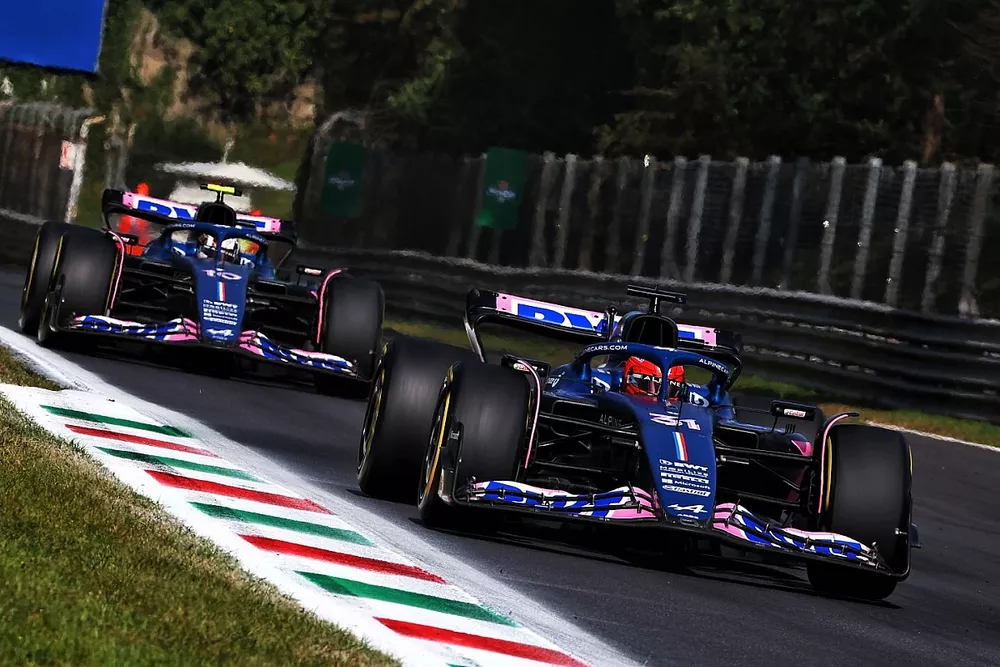
It does not matter if it is bright green, yellow, blue or orange paint, flow-vis has become almost the universal way for teams to evaluate aero parts.
However, Alpine raised a few eyebrows at last weekend's Italian Grand Prix when it appeared to roll back the clock and do something a bit more old-school with its aero testing.
Instead of using flow-vis to check on a revised low downforce Monza-specific beam wing, it fitted strips of yarn tufts across the rear of the new component (main image above), as well as the rear wing main plane (see below).
Alpine A523 technical detail
Photo by: Giorgio Piola
This use of tufts seemed to be something that had long been consigned to grand prix racing's history books, as F1 technology and understanding of airflow has moved on considerably over the years.
However, there was a very good reason for Alpine to go down this route, and it all relates to exactly what kind of aero understanding teams are trying to get from practice running.
Ferrari SF-23 rear wing with flow-vis paint
Photo by: Giorgio Piola
With flow-vis (see above), the information that teams want to get is how the airflow is structured over the entire car, or how it is impacted by a specific component.
Flow-vis is a fluorescent powder that is mixed with light oil, normally paraffin before it is painted liberally on a specific part of the car.
When the car is out on track, the flow-vis is moved by the airflow and spreads across the car – leaving behind clear evidence of flow structures and also highlighting areas where there has perhaps been some separation.
When the car is returned to the pits, teams can then take pictures of how the flow-vis has behaved, and this is then analysed by the aerodynamicists to try to better understand if parts are acting in the way anticipated.
This is very much an after-the-event analysis though.
What flow-vis does not give you is how the aerodynamics are working at a specific point out on track, or at a set speed.
The benefit of the tuft testing, as Alpine did, is that it can be used to better comprehend how airflow is reacting at every moment out on the circuit.
High-resolution cameras are fitted to the car to focus on the tufts and these capture video footage of how the individual strands are behaving when it is running.
The direction that the strands are flowing in will indicate airflow direction and pressure changes – as well as highlighting potential stall issues – and can be compared at various speeds and different corners.
If the tufts are doing exactly what is wanted when flat out on the straights, but then are doing something totally undesired through low-speed corners, then this will be exposed much better through tuft testing than with flow-vis.
The decision to go with old-school tufts or modern flow-vis is therefore a simple choice between wanting to know what the airflow is doing, or what it has done.
Alpine A523 diffuser detail
Photo by: Uncredited
We want your opinion!
What would you like to see on Motorsport.com?
Take our 5 minute survey.
- The Motorsport.com Team
Read and post comments
Read also :
Share Or Save This Story
Copy link
Share on Viber
Previous article Gasly wants action over F1 paddock fan intrusion
Next article The unexpected factor in F1's tyre tender decision
Top Comments
There are no comments at the moment. Would you like to write one?
View More & Comment

More from
Jonathan Noble

Brundle awarded OBE in King’s New Year’s honours
Formula 1
Formula 1
Brundle awarded OBE in King’s New Year’s honours
The new rules dilemma that will define the 2025 F1 season
Formula 1
Formula 1
The new rules dilemma that will define the 2025 F1 season
Verstappen issues Red Bull title warning in push for RB21 progress
Formula 1
Formula 1
Australian GP
Verstappen issues Red Bull title warning in push for RB21 progress
More from
Alpine
"Colapinto never hit the apex" – Audi's take on contentious Nico Hulkenberg penalty in Brazilian GP
Formula 1
Formula 1
Sao Paulo GP
"Colapinto never hit the apex" – Audi's take on contentious Nico Hulkenberg penalty in Brazilian GP

A fond farewell to a few WEC favourites
WEC
Monza
A fond farewell to a few WEC favourites
Pierre Gasly on Franco Colapinto fan pressure: “Once you deal with Helmut Marko, anything else is no pressure”
Formula 1
Formula 1
Sao Paulo GP
Pierre Gasly on Franco Colapinto fan pressure: “Once you deal with Helmut Marko, anything else is no pressure”
Latest news
Carson Hocevar and Cleetus McFarland win LeMullets 2026 in epic finish
General
Misc General 4 h
Carson Hocevar and Cleetus McFarland win LeMullets 2026 in epic finish
TV ratings released for NASCAR Cup season finale
NASCAR Cup
NAS NASCAR Cup
Homestead-Miami
10 h
TV ratings released for NASCAR Cup season finale
Chase Elliott's car chief leaves Hendrick for NASCAR Truck crew chief role
NASCAR Truck
NSTR NASCAR Truck
Homestead
11 h
Chase Elliott's car chief leaves Hendrick for NASCAR Truck crew chief role
Feature
Discover prime content

Top 10 F1 cars of the 1970s
Formula 1
By Kevin Turner
Top 10 F1 cars of the 1970s

Subscribe and access Motorsport.com with your ad-blocker.
From Formula 1 to MotoGP we report straight from the paddock because we love our sport, just like you. In order to keep delivering our expert journalism, our website uses advertising. Still, we want to give you the opportunity to enjoy an ad-free and tracker-free website and to continue using your adblocker.
You have 2 options:
- Become a subscriber.
- Disable your adblocker.
Subscribe now Already subscribed? Sign in here
Already disabled your adblocker?
Reload page
Manage Alerts
Subscribe