Feature
Formula 1
Analysis
Why F1 still owns only one grand prix
Formula 1 proved it could successfully promote its own grand prix but, almost four years later, the more interesting question is why it hasn’t repeated the model elsewhere
Jennifer Frisinger
Published: Aug 4, 2026, 8:20 AM
Copy link

Share on Viber
Autosport Business
Covering industry news and insight into the business of motorsport
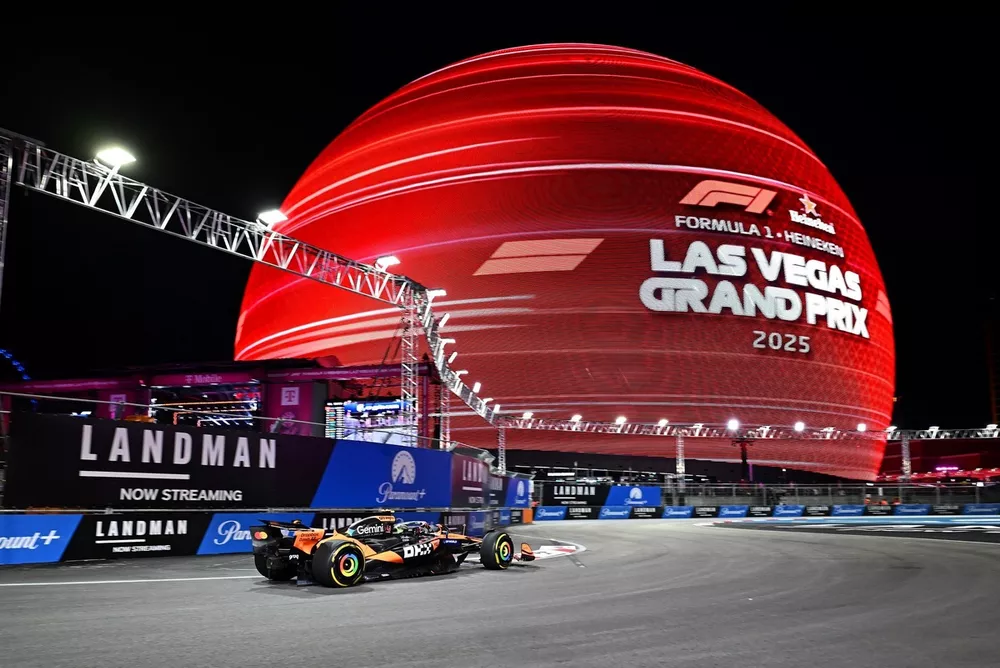
Formula 1's decision to extend the Las Vegas Grand Prix through 2037 came as little surprise, given the race has become one of the championship's grandstand events. The more interesting development was what didn't accompany the announcement.
Four years after Liberty Media broke with decades of commercial practice by promoting the race itself, F1 still directly promotes only one grand prix across its 24-race season. That wasn't how executives framed the project when it launched. Then Liberty Media CEO Greg Maffei said F1 had "ideas about what great promoters should do," while Stefano Domenicali suggested Las Vegas would become a blueprint for future grands prix.
Instead, Las Vegas has remained an exception; the race was only part of the investment.
Grand Prix Plaza changed the economics of F1's presence in Las Vegas. Unlike temporary street circuits, where most commercial activity is concentrated around race week before the infrastructure disappears, the 39-acre complex gives F1 a permanent, year-round business. Corporate events, karting, exhibitions, hospitality experiences and fan attractions continue generating revenue long after the championship has left town.
Permanent circuits operate very differently. Venues such as Silverstone, Spa-Francorchamps and Suzuka host other racing series, track days, conferences, museums and hospitality businesses throughout the year. The difference is that F1 does not own those commercial operations, it simply arrives for the grand prix before moving on to the next venue.
Under F1's traditional commercial model, race promoters pay the championship organisers for the right to host a grand prix. From there, they are responsible for marketing the event, selling tickets, securing local sponsorship and delivering a race weekend that attracts enough fans to make the numbers work. F1 receives its hosting fee, while the promoter carries much of the financial risk. If ticket sales disappoint or corporate hospitality falls short, it is the promoter, not F1, that absorbs most of the impact.
The numbers also explain why F1 has little incentive to replace the traditional promoter model. Race promotion accounted for 27% of its revenue in 2025, behind media rights at 31% and sponsorship at 22%. F1 never needed to replace the promoter model because the promoter model was never the problem.
While Silverstone is open about needing F1 to sustain its business, the circuit has multiple other revenue streams all year round
Photo by: Alastair Staley / LAT Images via Getty Images
What makes Las Vegas different is not simply that F1 promotes the race. It also owns the commercial infrastructure that continues generating revenue all year round, with the grand prix the centrepiece of the year.
Liberty Media's financial reporting reflects that shift. Grand Prix Plaza generated $33million in rental income during 2025 alone, while F1 also attributed growth in "other revenue" to activities including karting, corporate events and fan experiences at the site. The facility has become an operating business rather than simply the home of one annual race.
Silverstone, by contrast, monetises its facility as a circuit operator. Las Vegas allows F1 to monetise the destination itself.
Las Vegas no longer looks like an experiment in self-promotion for F1, as it represents a different kind of investment, combining race promotion with ownership of a year-round commercial asset. That may also explain why F1 has shown little appetite to repeat the model elsewhere.
The challenge is not promoting another race given F1 already has promoters around the world willing to pay substantial hosting fees. The challenge is finding another location where owning the surrounding commercial infrastructure delivers a better long-term return
Replicating Las Vegas would require more than simply taking over race promotion at an existing grand prix or creating an all-new race somewhere in the world. Liberty Media invested approximately $500m acquiring land and constructing Grand Prix Plaza before the first race was held. Few host cities can offer the combination of available real estate, year-round visitor demand and commercial opportunities needed to justify that level of investment.
Las Vegas attracts more than 40m visitors annually and hosts one of the world's largest convention industries, providing a constant flow of potential customers for the hospitality, exhibitions and event spaces that sit behind the race. At temporary street venues, many of those commercial opportunities disappear once the grandstands come down.
The investment also changes how F1 measures returns, given Grand Prix Plaza generates income throughout the year, extending the return on a half-billion-dollar investment well beyond race weekend, and few existing grands prix offer comparable conditions.
The Grand Prix Plaza is used for different purposes throughout the year
Photo by: Sam Bloxham / LAT Images via Getty Images
Out of the existing calendar, Monaco and Singapore occupy prime locations where acquiring large parcels of land would be prohibitively expensive. Permanent venues such as Silverstone have developed diversified businesses of their own, generating income from hotels, museums, driving experiences, conferences, track days and other racing series throughout the year. What they generally lack is Las Vegas' unique combination of international convention business and destination entertainment economy.
The challenge, therefore, is not promoting another race given F1 already has promoters around the world willing to pay substantial hosting fees. The challenge is finding another location where owning the surrounding commercial infrastructure delivers a better long-term return than the existing promoter model.
In that sense, Las Vegas may not be the blueprint many expected in 2023. It may instead be the only market where F1 could justify becoming both race promoter and long-term owner of the commercial infrastructure surrounding the event.
The commercial success of the race itself reinforces that conclusion. Since its debut in 2023, the Las Vegas GP has generated an estimated $3.2billion in cumulative economic impact for Southern Nevada, while the 2024 event alone contributed approximately $934m to the local economy.
Four years ago, Las Vegas appeared to signal a fundamental shift in how F1 would approach race promotion. Today it looks more like a shift in how F1 thinks about ownership.
Rather than demonstrating that F1 should promote more races itself, Grand Prix Plaza illustrates the value of owning commercial assets that continue generating revenue long after the chequered flag has fallen. The future may not lie in F1 owning more grands prix, but in finding more opportunities where the race is only part of the investment.
Read Also:
F1 hasn't shut the door on hosting another grand prix, but finding a location and space to fulfil its criteria will be a tall order
Photo by: Glenn Dunbar / LAT Images via Getty Images
We want to hear from you!
Let us know what you would like to see from us in the future.
Take our survey
- The Autosport.com Team
Read and post comments
Read also :
Previous article Why Lindblad hasn’t felt the pressure in F1
Next article Why McLaren has been coy about introducing its rotating F1 rear wing
Top Comments
There are no comments at the moment. Would you like to write one?
View More & Comment
More from Jennifer Frisinger
Three Circuits, Three Strategies: How promoters are pricing F1's sprint expansion
Formula 1
F1 Formula 1
Singapore GP
1 mo
Three Circuits, Three Strategies: How promoters are pricing F1's sprint expansion
How F1 learned to grow without growing
Formula 1
F1 Formula 1 3 mo
How F1 learned to grow without growing
How the F1 cost cap has put extra emphasis on the upgrade debate
Formula 1
F1 Formula 1
British GP
4 mo
How the F1 cost cap has put extra emphasis on the upgrade debate
Why everyone suddenly wants a piece of Alpine
Formula 1
F1 Formula 1 4 mo
Why everyone suddenly wants a piece of Alpine
What the Bahrain and Saudi cancellations reveal about how F1's money works
Formula 1
F1 Formula 1
Bahrain GP in Malaysia
7 mo
What the Bahrain and Saudi cancellations reveal about how F1's money works
How the cost of a slow start is felt financially in F1
Formula 1
F1 Formula 1
Japanese GP
7 mo
How the cost of a slow start is felt financially in F1
Why under the F1 cost cap regulatory mistakes carry compound interest
Formula 1
F1 Formula 1
Bahrain Pre-Season 2
9 mo
Why under the F1 cost cap regulatory mistakes carry compound interest
The Cadillac calculus F1 has made that weighs up $450m today vs billions tomorrow
Formula 1
F1 Formula 1 9 mo
The Cadillac calculus F1 has made that weighs up $450m today vs billions tomorrow
Latest news
What's next for Herta after F1 2027 snub?
Formula 1
F1 Formula 1
Las Vegas GP
8 h
What's next for Herta after F1 2027 snub?
Rovanpera: New 2027 WRC cars will see "everybody start from zero"
WRC
WRC WRC 9 h
Rovanpera: New 2027 WRC cars will see "everybody start from zero"

Richards set to step down as Motorsport UK chairman
General
MISC General 11 h
Richards set to step down as Motorsport UK chairman

Did Aprilia throw away the 2026 MotoGP title or was Marquez simply too good?
MotoGP
MGP MotoGP
Portuguese GP
12 h
Did Aprilia throw away the 2026 MotoGP title or was Marquez simply too good?
Subscribe and access Autosport.com with your ad-blocker.
From Formula 1 to MotoGP we report straight from the paddock because we love our sport, just like you. In order to keep delivering our expert journalism, our website uses advertising. Still, we want to give you the opportunity to enjoy an ad-free and tracker-free website and to continue using your adblocker.
You have 2 options:
- Become a subscriber.
- Disable your adblocker.
Subscribe now Already subscribed? Sign in here
Already disabled your adblocker?
Reload page
Manage Alerts
Subscribe