Formula 1 Spanish GP
Why flexi-wing tests didn’t prove to be F1’s “magic bullet”
New tests introduced to clamp down on aero-elasticity in Formula 1 had a greater effect than some claimed, but the impact on the pecking order was negligible
Stuart Codling Jake Boxall-Legge
Edited: Jun 6, 2025, 3:14 PM
Copy link
Share on Viber
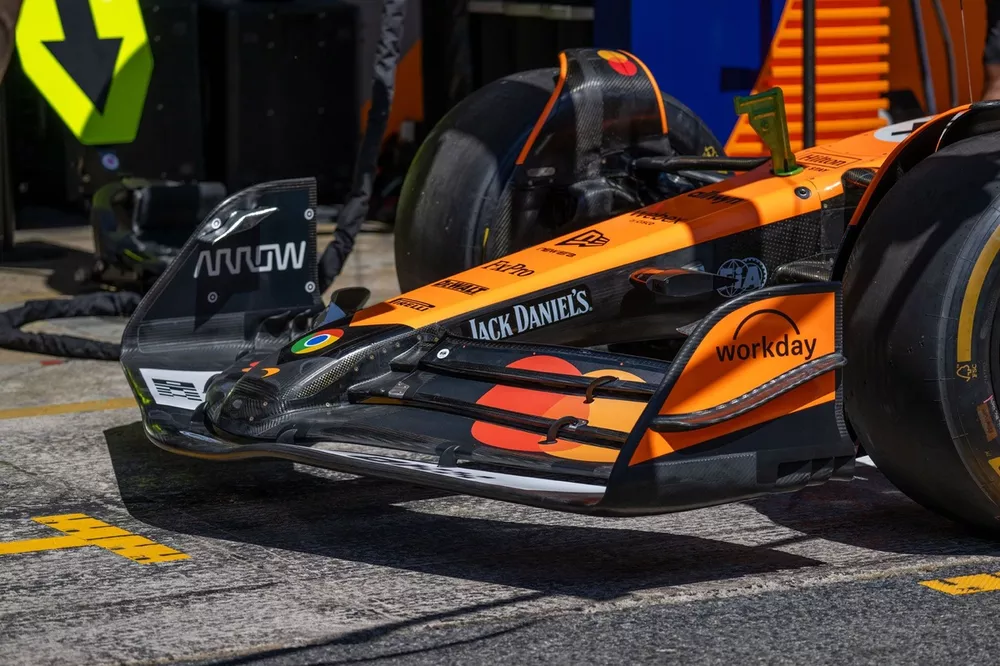
McLaren MCL39 technical detail
Photo by: Antonia Vandersee / circuitpics.de
Formula 1’s flexi-wing furore has been simmering for months, but came to a ragged and inconsequential termination during the Spanish Grand Prix weekend when new deflection tests were applied – and not much changed.
The tests clamped down on the amount of flex permitted on the front wings of F1’s machinery, and followed a similar tightening of the regulation around aero-elasticity in rear wings earlier this season.
Red Bull had been among the cheerleaders for the new tests, even pushing for them to be introduced earlier in the belief that McLaren’s dominance was rooted in exploiting aero-elasticity for performance gain. Reality then dealt expectation the smack of firm government.
But while the overall spread of performance between teams remained broadly similar, Lewis Hamilton (for one) was overstating the matter when he declared the change “a waste of money."
The key change in the new test was the permitted deflection of the wing planes when a force of 1,000 Newtons was applied on each side – 10mm rather than the previous threshold of 15mm. This move was signalled well in advance, with the FIA announcing the new rules in January as the latest in a series of clampdowns on aero-elasticity.
Ferrari SF-25 front wing detail
Photo by: Filip Cleeren
Since no component can be infinitely stiff, a degree of flex is inevitable – but materials can be designed and constructed in a way that they deflect by a roughly prescribed amount in order to eke out various performance benefits. But while rear-wing flexibility primarily affects top speed, lower drag is very much a secondary-order benefit of inducing flex on the front wing.
The primary benefit of an aero-elastic front wing in the current ground-effect era is to smooth out the mid-corner balance changes to which these cars are prone. So the effect of the new testing regime was always going to be subtle – and in some cases circuit-dependent.
Also, the picture in Barcelona was muddied by some teams introducing development steps with new front-wing geometries. Since there is no longer any regular F1 testing here, there is no way to directly compare ‘before’ and ‘after’ performance on the 2025 cars.
“I was interested to actually see if things would have unfolded like we anticipated, and they did,” said McLaren team principal Andrea Stella.
While it’s clear that McLaren, among several teams, had been pushing the boundaries of aero-elasticity, it had already evaluated a front wing thats complied with the new tests. Lando Norris ran it in practice at Imola and, the team claims, felt no difference at all.
Oscar Piastri, McLaren, Andrea Stella, McLaren
Photo by: Peter Fox / Getty Images
“We always thought the impact would have been relatively negligible because when we saw the numbers associated to this change of aeroelastic effect, there were small numbers in terms of downforce and in terms of variation of the downforce with speed,” Stella added.
“So, when we tested this wing in Imola, if we hadn't told Lando that it was a different wing, he wouldn't have spotted it. And when we simulated in the simulator or in the offline simulation, numerically it was almost zero.
“So, we were not expecting a change of the packing order as a function of the technical directive that was released for this race. In terms of wasting the money or not, this is not a point of view that we actually reflected upon because the TD has been there for a long time, so this was long planned.”
If the impact on drag has been “negligible,” there have been more subtle ramifications up and down the grid depending on individual car characteristics. Without the smoothing effect afforded by more flexible front wings, there’s a greater tendency towards oversteer in fast corners and understeer in slow corners.
Cars already suffering balance problems in those areas will, therefore, have found the change exacerbates them. But it was not something that amounted to great chunks of lap time.
Read Also:
Formula 1Lewis Hamilton slams F1 Spanish GP flexi-wing changes as "a waste of money"
Formula 1Why F1 flexi-wing changes failed to shake up the Spanish GP order
The fact that simulations had flagged this up well in advance begs the question as to why some voices continued to fuel expectations of substantial change. F1 has long been a sport of marginal gains – and losses.
“Maybe sometimes we try to believe there is a magic bullet in Formula 1 that's going to solve everything,” said Mercedes team boss Toto Wolff. “But it's not the case.”
We want your opinion!
What would you like to see on Motorsport.com?
Take our 5 minute survey.
- The Motorsport.com Team
Read and post comments
Read also :
Share Or Save This Story
Copy link
Share on Viber
Previous article “Say what you think”: How McLaren manages its drivers while leading both F1 championships
Next article How Adrian Newey is “provoking” Aston Martin
Top Comments
There are no comments at the moment. Would you like to write one?
View More & Comment

More from
Stuart Codling

Why it's now Oliver Bearman versus Rafael Camara for the next Ferrari vacancy
Formula 1
Formula 1
United States GP
2 h
Why it's now Oliver Bearman versus Rafael Camara for the next Ferrari vacancy
F1 Singapore GP live commentary and updates: Max Verstappen cruises to victory
Formula 1
Formula 1
Singapore GP
F1 Singapore GP live commentary and updates: Max Verstappen cruises to victory

More from
Mercedes

Kimi Antonelli ready to "finish the job" as first F1 title chance beckons at US GP
Formula 1
Formula 1
United States GP
12 h
Kimi Antonelli ready to "finish the job" as first F1 title chance beckons at US GP

The figures that show Mercedes has lost its supremacy in F1 2026
Formula 1
Formula 1
United States GP
The figures that show Mercedes has lost its supremacy in F1 2026
Latest news

Belgian firm to take over Renault/Alpine engine facility in Viry
WEC
WEC WEC 27 min
Belgian firm to take over Renault/Alpine engine facility in Viry
Jorge Martin the slowest Aprilia in Australia practice: “I'm used to riding with the Ducati here”
MotoGP
MGP MotoGP
Australian GP
1 h
Jorge Martin the slowest Aprilia in Australia practice: “I'm used to riding with the Ducati here”

2027 Winter Series calendar: Three series across five circuits
General
Misc General 1 h
2027 Winter Series calendar: Three series across five circuits
Ducati says Aprilia “can do whatever they want” amid team order talks in MotoGP
MotoGP
MGP MotoGP
Australian GP
1 h
Ducati says Aprilia “can do whatever they want” amid team order talks in MotoGP
Feature
Discover prime content




Subscribe and access Motorsport.com with your ad-blocker.
From Formula 1 to MotoGP we report straight from the paddock because we love our sport, just like you. In order to keep delivering our expert journalism, our website uses advertising. Still, we want to give you the opportunity to enjoy an ad-free and tracker-free website and to continue using your adblocker.
You have 2 options:
- Become a subscriber.
- Disable your adblocker.
Subscribe now Already subscribed? Sign in here
Already disabled your adblocker?
Reload page
Manage Alerts
Subscribe