Analysis
Formula 1
Why Mercedes’ latest update is its boldest step yet
When Mercedes unveiled an aggressive new update ahead of the Austrian Grand Prix, it raised a few eyebrows because it marked the team’s biggest change of the season.
Giorgio Piola Matt Somerfield
Edited: Jul 3, 2018, 11:45 AM
Copy link
Share on Viber
Giorgio Piola's F1 technical analysis
Giorgio Piola is the preeminent Formula 1 technical journalist. View our full selection of Giorgio's technical illustrative content
But closer analysis of the changes to the sidepods and rear wings has revealed just how ingenious and well-considered the developments have been, and why there has been some pretty clever lateral thinking to incorporate them.
Never has the statement ‘go big, or go home’ been more apt, as the update introduced by Mercedes in Austria is, at least from a technical perspective, a statement to behold.
The opening eight races of the season saw Mercedes make only minor alterations to its 2018 challenger, as it looked to extract the best it could out of what it had. Meanwhile, back at the factory, the design team was clearly focusing its efforts on something much bolder - a total revamp of the W09’s sidepods.

As can be seen in the image (above), extensive modifications have been made to the W09’s sidepods, as the cooling inlet has been pushed back and more bodywork added to improve flow around the centre of the car.
The alterations will likely result in a change to its low-to-high-speed handling characteristics, and hopefully make it a car for all tracks and conditions.
It is possible that these changes are as a direct result of the work done by the Mercedes engine division, with its latest update designed to work in-line with its power unit.
The sidepods, which on first appearance may look similar to the concept first introduced by Ferrari in 2017, are merely a reinterpretation of that idea based on the restrictions posed by using what is considered the conventional position for the upper side impact protection spar (below, right inset, Mercedes W05).

The position of this has been fundamental to the different design approaches we have seen in recent seasons.
Regulation Rewind
The side impact protection spars became specification items in 2014 (ie. all teams use the same design), as the FIA looked to cut costs.
In the years preceding this, the designers began utilising more and more complex designs, reducing the spar’s footprint, whilst still meeting the absorption rates required to pass the crash tests.
In achieving their goals with the side impact spars, the designers could begin to look at more radical designs for their sidepod bodywork, such as the ‘U-Pod’ employed by McLaren in 2011 (above, left inset), or the extremely narrow sidepod designs championed by Red Bull during its championship-winning years.
The regulations introduced in 2017 afforded much more freedom in the area ahead of the sidepod for bodywork, something that Ferrari pounced on, placing its upper side impact protection spar in a lower, more forward position (main image, blue arrow).
In 2018, Ferrari made improvements to its original concept but was also joined by Haas, Red Bull and Williams, as they too looked to alter the behaviour of the airflow in the middle of the car.
There are two key reasons for this:
- The inlet is placed in a periscope position, protected by aerodynamic devices ahead of it, which prevent the upwash from the front wing and turbulence created by the front tyre becoming an issue. Turbulent airflow left unmanaged can contain destructive energy, which results in inefficient cooling.
- Placing the inlet in a higher position also allows the bodywork beneath it to be redesigned for aerodynamic profiling. Of course the overall shape of the sidepod is dictated by the ancillary power unit components within but, it’s a tradeoff, one that aerodynamics often triumph over.
Mercedes and Ferrari comparison
Photo by: Giorgio Piola
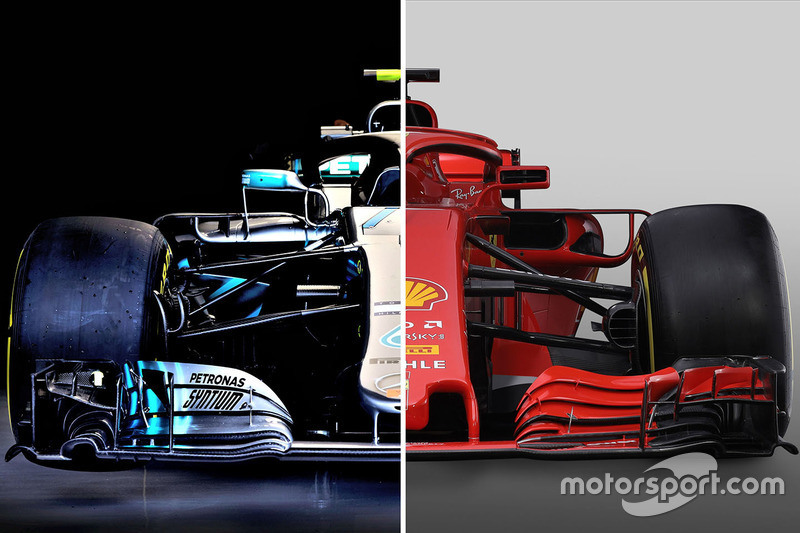
It’s important to note that these kinds of ideas do not work in isolation, for they are concepts that are interlinked with other key design parameters, such as the front suspension, which disturbs the airflow en route to the sidepods.
Ferrari has clearly lowered its front suspension, clearing the airflow’s pathway to the sidepod, whereas Mercedes opted to raise its, giving it more potential freedom to the bargeboards and floor. The fact that two cars are so close in performance shows that both solutions have their advantages and drawbacks.
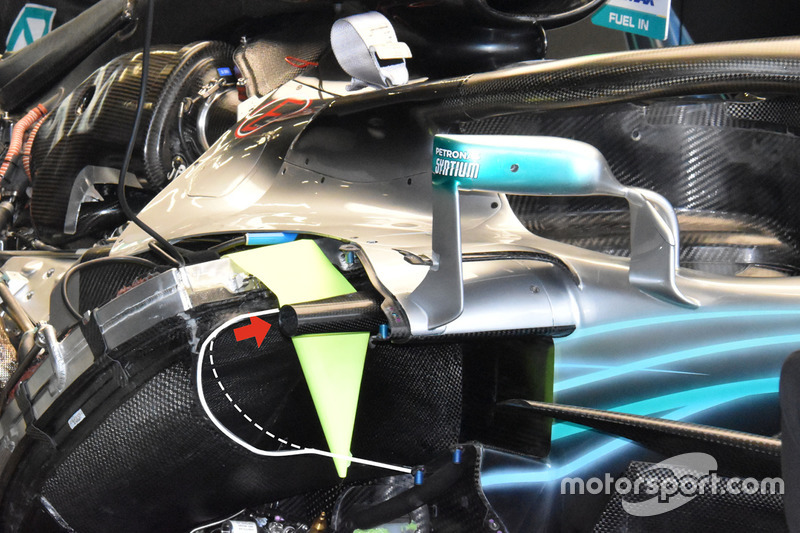
Mercedes has been unable to relocate the inlet into the higher position favoured by Ferrari, as its side-impact spar is already in the highest position possible. Moving this would require a new crash test and need new chassis to be prepared.
As such, it has worked around the issue – cutting away a section of the inlet housed within the sidepod to increase its flow potential (dotted white line denotes where the old inlet edge lay).
This also means that the inlet can now be stepped back, as the surrounding bodywork obfuscates it, shielding it from any damaging flow structures that might otherwise reduce performance.
Numerous optimisations have been made in conjunction with this new sidepod concept, including changes to the bargeboards, the floor’s axehead and corresponding shortening of the deflector panel above, plus the inclusion of an additional mirror support and a new chassis canard.
New rear wing design too

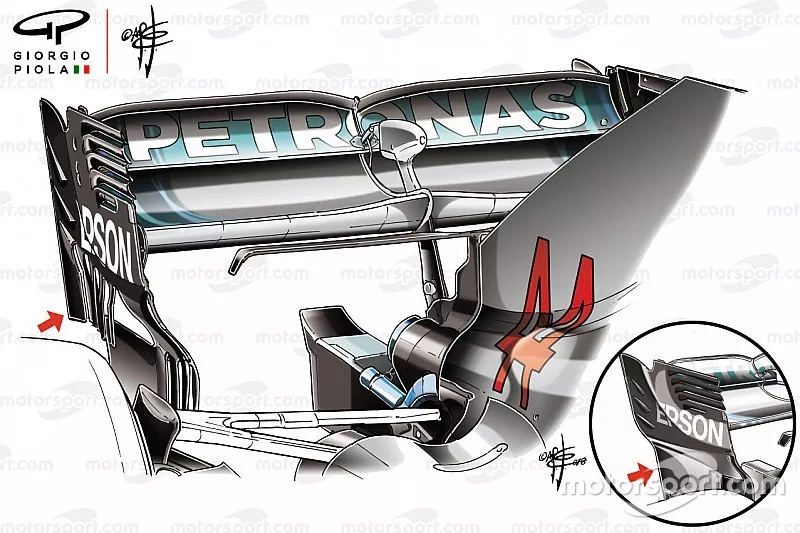
Not content with this radical overhaul of the car’s midriff, the team also paid close attention to the rear of the car too, introducing a new rear wing.
The design takes inspiration from a solution that McLaren has been using since the start of 2017 (below) and utilises the wording minutiae in the regulations to add these overhanging strakes in a box area that’s supposed to create the transition between the wider upper section of the wing to that of the narrower lower section.

We want your opinion!
What would you like to see on Motorsport.com?
Take our 5 minute survey.
- The Motorsport.com Team
Read and post comments
Read also :
Share Or Save This Story
Copy link
Share on Viber
Previous article Promoted: How Bose helps Hamilton to keep his focus
Next article Russell: Leclerc's Sauber success helping F1 juniors like me
Top Comments
There are no comments at the moment. Would you like to write one?
View More & Comment
More from
Giorgio Piola
The fascinating story behind McLaren's most iconic F1 car
Formula 1
Formula 1
The fascinating story behind McLaren's most iconic F1 car

Emilia Romagna GP: F1 technical images from Imola's pitlane
Formula 1
Formula 1
Emilia Romagna GP
Emilia Romagna GP: F1 technical images from Imola's pitlane

The F1 downforce choices that proved key at the Saudi GP
Formula 1
Formula 1
Saudi Arabian GP
The F1 downforce choices that proved key at the Saudi GP

More from
Mercedes
How will Kimi Antonelli become F1 world champion at Mexico GP?
Formula 1
Formula 1
United States GP
40 min
How will Kimi Antonelli become F1 world champion at Mexico GP?
F1 United States GP: Kimi Antonelli takes dominant victory - but no title
Formula 1
Formula 1
United States GP
1 h
F1 United States GP: Kimi Antonelli takes dominant victory - but no title

Latest news

Complete NASCAR Cup points standings after 2026 Talladega II
NASCAR Cup
NAS NASCAR Cup
Talladega II
5 min
Complete NASCAR Cup points standings after 2026 Talladega II
Official race results: NASCAR Cup Talladega Chase race
NASCAR Cup
NAS NASCAR Cup
Talladega II
36 min
Official race results: NASCAR Cup Talladega Chase race
How will Kimi Antonelli become F1 world champion at Mexico GP?
Formula 1
F1 Formula 1
United States GP
40 min
How will Kimi Antonelli become F1 world champion at Mexico GP?
Kyle Larson wins wild Talladega NASCAR Cup race after charging from 11th on final lap
NASCAR Cup
NAS NASCAR Cup
Talladega II
57 min
Kyle Larson wins wild Talladega NASCAR Cup race after charging from 11th on final lap
Feature
Discover prime content


Subscribe and access Motorsport.com with your ad-blocker.
From Formula 1 to MotoGP we report straight from the paddock because we love our sport, just like you. In order to keep delivering our expert journalism, our website uses advertising. Still, we want to give you the opportunity to enjoy an ad-free and tracker-free website and to continue using your adblocker.
You have 2 options:
- Become a subscriber.
- Disable your adblocker.
Subscribe now Already subscribed? Sign in here
Already disabled your adblocker?
Reload page
Manage Alerts
Subscribe