Formula 1 Qatar GP
Why Qatar is buying into troubled Audi F1 programme
Like many oil-producing nations, the Gulf state is diversifying – but still betting that the internal combustion engine has a future

Stuart Codling
Published: Nov 29, 2024, 3:36 PM
Copy link
Share on Viber
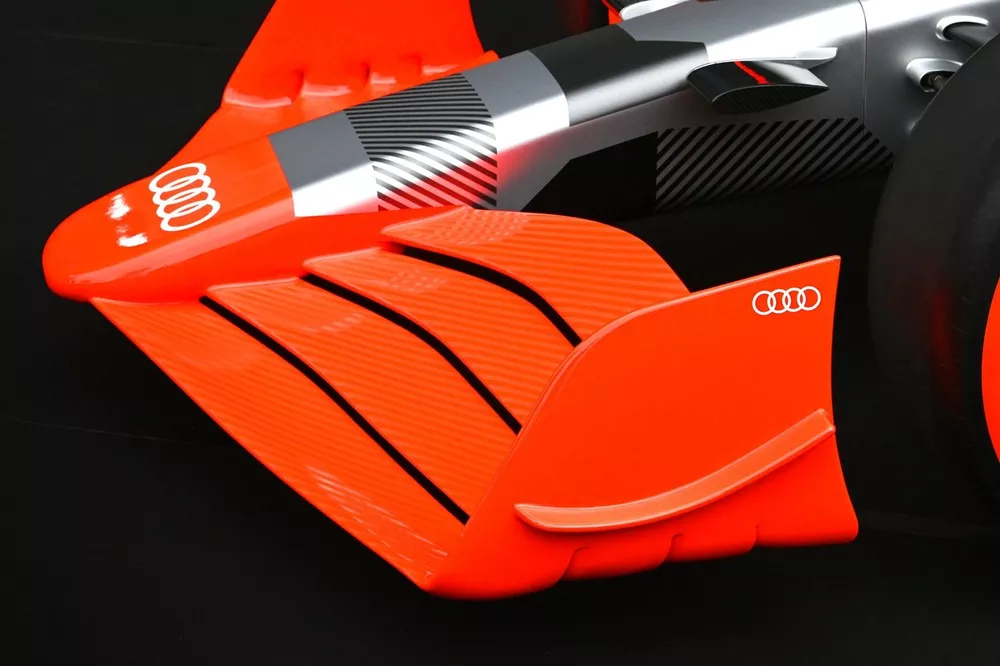
The front wing of the new Audi Sport F1 concept car
Photo by: Mark Sutton / Motorsport Images
"Be fearful when others are greedy – and greedy when others are fearful." The famous words of US investment guru Warren Buffett aptly sum up the Qatari Investment Authority's reasons for taking a shareholding in Audi's Formula 1 team.
Qatar's sovereign wealth fund has been investing in Audi's parent, the Volkswagen Group, since 2009 and currently owns 17% – making it one of the largest individual shareholders.
Given that VW recently reported a 60% drop in profits, against a backdrop of plummeting sales in China as well as Europe, some might question the wisdom of putting more money into an entity when the booked value of your existing investments has gone down.
But the Qatari buy-in answers a specific need for both parties. For Audi and VW it represents an opportunity to stop conspicuous spending on F1 at a time when the group is under pressure in Germany over plans to shut down factories and make tens of thousands of workers redundant – regardless of Audi CEO Gernot Dollner's claim that the QIA deal has nothing to do with the Group's financial issues.
At the same time the numbers involved in the deal – reportedly $350 million for a 30% stake – demonstrate the financial value of remaining committed to F1 rather than walking away. Audi can de-risk its existing investment while staying in the game.
Unquestionably this is yet another course correction for Audi's ailing F1 programme, and one which has been forced upon it by circumstances. When it announced its entry just over two years ago, the initial plan was to gradually increase its shareholding of Sauber to 75%, with billionaire TetraPak heir Finn Rausing retaining 25% via his Islero Investments vehicle.
Gernot Dollner, CEO of AUDI AG and Chairman of the Board of Directors of Sauber Motorsport AG, Mohammed Al-Sowaidi, CEO of QIA
Photo by: Audi
This seemed logical at a time when Audi envisaged its focus to be on the 2026 engine programme, largely leaving Sauber to deal with the chassis side. But Audi's appointed CEO, former McLaren team principal Andreas Seidl, soon realised the team stood little chance of progressing from the back of the grid without more energy and funding from Audi, so he persuaded the board to sanction a total buy-out by 2026.
That was announced last March but Seidl and chairman Oliver Hoffmann (also an Audi appointee) became involved in a behind-the-scenes power struggle which led to their removal. Meanwhile, despite a technical restructure initiated by Seidl in the summer of 2023, Sauber remains anchored to the bottom of the constructors' standings.
For Qatar, the investment represents further diversification away from fossil fuels and the potential for a healthy profit, given the growing global interest in F1 and the ever-increasing value of the teams participating in it – a factor of greater financial stability in the post-Bernie Ecclestone era.
Established nearly 20 years ago, Qatar's sovereign wealth fund now has nearly $500bn in assets under its control, ranging from minority stakes from the likes of Credit Suisse and Heathrow Airport Holdings to outright ownership of Harrods and the football team Paris St Germain. F1 is a small element within a broad portfolio.
In context, then, VW's struggles are but a footling splash of red ink on the balance sheet. The entire car industry is in the grip of an existential crisis and with chaos comes opportunity. While several manufacturers have, like Audi, committed to going all-electric in the near future, including premium brands such as Jaguar and Maserati (both formerly involved in F1), others are pushing back against pressure from governments worldwide to electrify – citing weak demand in core markets.
A significant proportion of mainstream car buyers are still hesitant about or outright hostile to EVs owing to range anxiety, lack of charging infrastructure, and in some cases fringe political beliefs such as climate change denial or the suspicion that EVs are part of deep-state conspiracies to limit personal freedom of movement.
A less hysterical form of this hesitancy is also playing out in Formula 1 as the stakeholders struggle to reconcile a future of greater electrification with racing's core values of noise and visceral spectacle.
Audi CEO Gernot Döllner and Mattia Binotto, CEO and CTO, Stake F1 Team KICK Sauber speak at a press conference
Photo by: Andy Hone / Motorsport Images
While the likes of Qatar, Bahrain, Saudi Arabia and the United Arab Emirates are looking to diversify their economies away from dependence on fossil-fuel production, F1 and the automotive industry remain areas of opportunity.
Bahrain's Mumtalakat sovereign wealth fund owns the McLaren Group outright although it has recently agreed to sell McLaren Automotive – to CYVN Holdings, an Abu Dhabi state-owned investment group. Aramco, Saudi Arabia's state-owned petrochemical giant, sponsors the Aston Martin F1 team as well as being a partner of F1 itself.
This is not Qatar's first dalliance with a team shareholding. In 2009 its sovereign wealth fund went some way down the road to acquiring an interest in Williams – enough to reach a deal to establish a Williams Technology Centre in the Qatar Science Park, and for Sheikh Khalid bin Hamad Al-Thani to test-drive an FW31 during a promotional event at the Losail Circuit.
Ultimately the talks foundered since principal shareholders Sir Frank Williams and Sir Patrick Head did not want to sell out just yet.
These Gulf states are in effect hedging their automotive bets, talking up opportunities for greater electrification in the industry while exploring the possibilities of synthetic fuels. While many politicians and environmentalists aspire to full electrification by 2030, the reality is that the internal combustion engine will by necessity survive this arbitrary mark in the calendar. As fossil fuels grow increasingly scarce, the hope is that new technologies will furnish a sustainable replacement.
Production at scale is the holy grail of the sustainable-fuel industry. Several proofs-of-concept exist – including former Williams, McLaren and Mercedes engineer Paddy Lowe's Zero Petroleum, coincidentally a current Sauber sponsor – but the process of conjuring hydrocarbons from air and water requires a great deal of energy which has to come from somewhere.
Nevertheless, the need to provide some form of alternative to full electrification in the overall transport mix is urgent. F1 has committed to running all cars on 100% sustainable fuel by 2026, a project in which Aramco is heavily involved.
Audi CEO Markus Duesmann during the Audi press conference at Auto Shanghai 2023
Photo by: Audi Communications Motorsport
F1 has also recently announced major investments in sustainable aviation fuel with its logistics partner, DHL, and more recently with Qatar's state-owned national airline.
Digging into the details of these arrangements, it's interesting to note that sustainable aviation fuel is presently so scarce that F1 is relying on a piece of paperwork legerdemain known as 'book and claim' – enabling it to cite carbon reductions even if planes carrying F1 cargo aren't necessarily running on sustainable fuel.
Given that Formula E is understood to have contractual exclusivity with the FIA as the world's premier electric single-seater series until late in the next decade, F1 has an existential need to retain the internal combustion engine in some form. Likewise, there is money to be made in the wider automotive industry from keeping existing ICU-powered vehicles on the road even as the oil runs out.
The present turmoil in the global car market demonstrates that a gap exists between what consumers want and legislators dream. It is somehow fitting that Audi, which chiefly committed to F1 because of the greater electrification element within the 2026 engine regulations, should be bailed out by a country eager to kick its oil habit.
Both stand to benefit if the internal combustion engine gets a stay of execution.
We want your opinion!
What would you like to see on Motorsport.com?
Take our 5 minute survey.
- The Motorsport.com Team
Read and post comments
Read also :
Share Or Save This Story
Copy link
Share on Viber
Previous article F1 Qatar GP: Leclerc beats Norris and Piastri to top only practice session
Next article F1 must "put forward correct proposal" for Cadillac anti-dilution fee - Vowles
Top Comments
There are no comments at the moment. Would you like to write one?
View More & Comment

More from
Stuart Codling
"Colapinto never hit the apex" – Audi's take on contentious Nico Hulkenberg penalty in Brazilian GP
Formula 1
Formula 1
Sao Paulo GP
"Colapinto never hit the apex" – Audi's take on contentious Nico Hulkenberg penalty in Brazilian GP
What the Brazilian GP revealed about F1's ability to cope with rain
Formula 1
Formula 1
Sao Paulo GP
What the Brazilian GP revealed about F1's ability to cope with rain
Latest news

2026 MotoGP Portuguese Grand Prix – How to watch, session times & more
MotoGP
MGP MotoGP
Portuguese GP
48 min
2026 MotoGP Portuguese Grand Prix – How to watch, session times & more
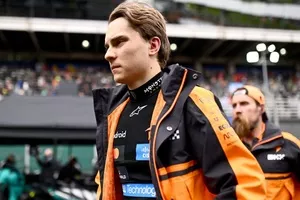
Oscar Piastri set for grid penalty at F1 Las Vegas GP
Formula 1
F1 Formula 1
Las Vegas GP
7 h
Oscar Piastri set for grid penalty at F1 Las Vegas GP
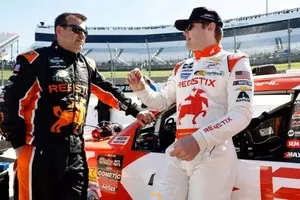
Rodney Childers pushes back on NASCAR CEO's claims about car comparisons
NASCAR Cup
NAS NASCAR Cup 10 h
Rodney Childers pushes back on NASCAR CEO's claims about car comparisons

“He’s beaten Alpine on his own” - Racing Bulls on why it kept Liam Lawson
Formula 1
F1 Formula 1
Las Vegas GP
14 h
“He’s beaten Alpine on his own” - Racing Bulls on why it kept Liam Lawson
Feature
Discover prime content



Subscribe and access Motorsport.com with your ad-blocker.
From Formula 1 to MotoGP we report straight from the paddock because we love our sport, just like you. In order to keep delivering our expert journalism, our website uses advertising. Still, we want to give you the opportunity to enjoy an ad-free and tracker-free website and to continue using your adblocker.
You have 2 options:
- Become a subscriber.
- Disable your adblocker.
Subscribe now Already subscribed? Sign in here
Already disabled your adblocker?
Reload page
Manage Alerts
Subscribe