Analysis
NASCAR Cup COTA
Analysis: NASCAR can't seem to win when racing in the rain
NASCAR has once again found itself facing a mountain of criticism but this time the sanctioning body has only itself to blame.

Jim Utter
Edited: May 24, 2021, 6:35 PM
Copy link

Share on Viber



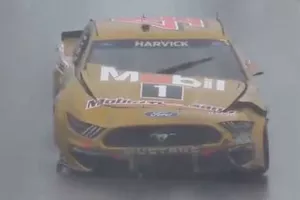
Let me make one thing perfectly clear: I don’t for one minute actually believe NASCAR called Sunday’s inaugural Cup Series race at Circuit of the Americas when it did simply to ensure Chase Elliott would win the event.
That’s absurd on its face.
However, by its actions during the race – and failing to adhere to lessons it said it learned about racing in the rain last season – NASCAR opened the door to all the criticism its receiving, including the ridiculous conspiracy theories.
I’ve covered NASCAR since early in the 1998 season and there have been at least two road courses on its Cup Series schedule the entire time.
Not until very recently had I ever seen NASCAR attempt to run an event while it was raining significantly. Wet weather tires have been around for years but in practice they had been reserved for conditions when a track was wet but in the process of drying, never with the intention of conducting an entire race while it was raining.
That was until the last few seasons, when despite heavy rain and standing water all over the course, NASCAR had decided to allow Xfinity Series races to continue despite the hazardous conditions.
Trial and error
The issue came to a head – at least we thought then – last fall at the Charlotte Roval when the Xfinity race was run nearly entirely in the rain. The race featured 10 cautions and a nearly 39-minute red-flag for standing water on the track.
After numerous complaints from drivers – including road-course ace A.J. Allmendinger who won the event – NASCAR said it had learned from the experiment and would not allow conditions to get so treacherous before calling a halt to the action.
That was then.
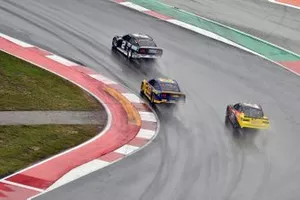
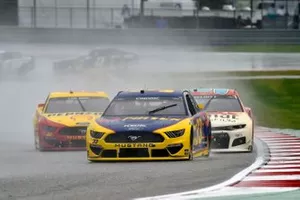
On Sunday, an almost similar scenario began playing out in the Texas Grand Prix with rain beginning shortly after the race’s start and conditions only worsened as it went on.
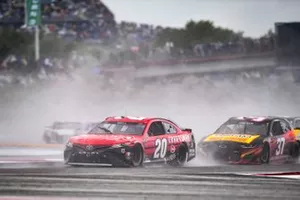
By the second stage, it was clear the 3.41-mile, 20-turn course was being inundated with water. Views from inside of competitors’ front windshields showed virtually nothing – not a comforting thought when they were traveling upwards of 140 mph at times.
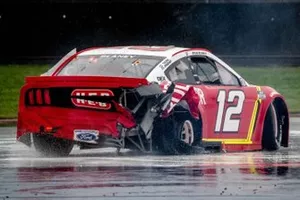
While NASCAR waited and waited hoping – I guess – for conditions to improve, two violent wrecks unfold on Laps 19 and 25 which gave NASCAR no choice but to put out a red-flag and address the racing conditions.
In the second incident, Martin Truex Jr. got into the back of Michael McDowell, which brought Truex’s car to a near-halt. Cole Custer, unable to see only a few feet in front of him, plowed into the back of Truex’s car at full speed and lifted it off the ground.
Thankfully, none of the drivers were injured.
NASCAR allowed teams to pit to address visibility issues on the cars and ordered all future restarts to be single-file.
The race resumed and conditions seemed to improve for a while.
With less than 20 laps remaining, the rain again became much heavier and once again standing water was evident all over the course. Many of the series’ top drivers were complaining of a lack of visibility.
Inexplicably, NASCAR soldiered on.
Finally, after Kurt Busch hydroplaned off the track and Austin Cindric – who had run a stellar race as a part-time entry – spun out, NASCAR threw the caution, and eventually another red-flag.
As the weather conditions continued with no apparent sign of improving, NASCAR finally called the event official after 54 of the scheduled 68 laps.
The problem? Chase Elliott, who was going to be short on fuel and forced to pit if the race went its scheduled distance, was leading, handing him a victory he might otherwise may not had been able to earn on the track.
With the win being Elliott’s first of the season and which allowed Hendrick Motorsports to tie Petty Enterprises for the most Cup series wins in NASCAR history, criticism of the timing of the call came quickly on social media.
NASCAR responds
That was on top of the ongoing criticism from NASCAR’s earlier reluctance to halt the race in the face of worsening track conditions.
After the race, Scott Miller, NASCAR’s vice president of competition, admitted the sanctioning body could have reacted sooner.
“I would kind of own the fact that maybe we did let it go a little bit too long before we did something,” he said. “It’s a learning experience for all of us. We will learn. We will be better next time.”
I don’t doubt NASCAR will learn from the events of Sunday’s race, but the bigger issue is that it said it had done that following last fall’s Xfinity race at the Charlotte Roval, which took place under nearly identical conditions.
Why were those lessons apparently not learned and why did NASCAR decide to push the envelope again on Sunday when it came to racing in the rain?
And, what has changed in the last couple years that has prompted NASCAR to want to run races in increasingly bad weather conditions?
Even some fans who have advocated NASCAR to race in the rain were criticizing it for creating dangerous conditions on Sunday. But to be honest, some of them also criticized NASCAR for pulling the plug with Elliott in the lead.
So, take from that what you will.
After the race, Elliott was asked what he thought the right call would be in the situations that occurred on Sunday.
“I mean, at the end of the day I’m not the one making the calls. I don’t want to make the calls,” he said. “I can sit there and look at it and have an opinion, but it’s not my call.”
Elliott is exactly right.
It’s NASCAR’s call. It’s their responsibility to conduct the race while officiating the rules it has set out for all competitors to follow.
Read Also:
- Harvick 'never felt more unsafe' after racing in the rain at COTA
- Kyle Busch calls COTA track conditions 'treacherous'
For some unknown reason of late, when it comes to racing in the rain, NASCAR has decided to go where it has never gone before.
And each time it does, it has seen the very predictable consequences – bad wrecks, biting criticism from its participants and being subjected to farcical conspiracy theories.
NASCAR continues to say it will learn from its mistakes.
One wonders, though, why this lesson in particular seems so difficult to master.
We want your opinion!
What would you like to see on Motorsport.com?
Take our 5 minute survey.
- The Motorsport.com Team
Read and post comments
Read also :
Share Or Save This Story
Copy link
Share on Viber
Previous article Kyle Busch calls COTA track conditions 'treacherous'
Next article The best of Chevy's 800 NASCAR Cup wins? 'The next one'
Top Comments
There are no comments at the moment. Would you like to write one?
View More & Comment

More from
Jim Utter

Erik Jones agrees to multi-year contract extension with Legacy Motor Club
NASCAR Cup
NASCAR Cup
Erik Jones agrees to multi-year contract extension with Legacy Motor Club
Goodyear's option tires at Richmond "were like Mario Kart with a star"
NASCAR Cup
NASCAR Cup
Richmond II
Goodyear's option tires at Richmond "were like Mario Kart with a star"
NASCAR: Austin Dillon move was "really close to crossing the line"
NASCAR Cup
NASCAR Cup
Richmond II
NASCAR: Austin Dillon move was "really close to crossing the line"
Latest news
MotoGP Australian GP: Marco Bezzecchi leads Aprilia 1-2-4-5 in Friday Practice
MotoGP
MGP MotoGP
Australian GP
1 h
MotoGP Australian GP: Marco Bezzecchi leads Aprilia 1-2-4-5 in Friday Practice
Max Verstappen slams “unacceptable” bumps at Austin F1 track: “It's out of control”
Formula 1
F1 Formula 1
United States GP
8 h
Max Verstappen slams “unacceptable” bumps at Austin F1 track: “It's out of control”
Kimi Antonelli ready to "finish the job" as first F1 title chance beckons at US GP
Formula 1
F1 Formula 1
United States GP
9 h
Kimi Antonelli ready to "finish the job" as first F1 title chance beckons at US GP

How to watch NASCAR at Talladega II: Weekend schedule, start time, entry list, TV
NASCAR Cup
NAS NASCAR Cup
Talladega II
9 h
How to watch NASCAR at Talladega II: Weekend schedule, start time, entry list, TV
Subscribe and access Motorsport.com with your ad-blocker.
From Formula 1 to MotoGP we report straight from the paddock because we love our sport, just like you. In order to keep delivering our expert journalism, our website uses advertising. Still, we want to give you the opportunity to enjoy an ad-free and tracker-free website and to continue using your adblocker.
You have 2 options:
- Become a subscriber.
- Disable your adblocker.
Subscribe now Already subscribed? Sign in here
Already disabled your adblocker?
Reload page
Manage Alerts
Subscribe