Commentary
NASCAR Cup Indianapolis
Opinion: The clock has run out on NASCAR's overtime experiment
It’s time NASCAR ended an experiment that has proven to be an abysmal failure: the idea of extending races in order to achieve an orchestrated result.

Jim Utter
Edited: Jul 24, 2017, 1:31 PM
Copy link

Share on Viber




Notice I didn’t not say “predetermined result,” but rather an “orchestrated” one.
And that is exactly what utilizing the overtime line – or green-white-checkered finish or any other scheme to extend the length of a race – has become.
Of course, NASCAR’s stated goal is a laudable one – “to ensure a green-flag finish.”
But that statement assumes that every race is supposed to end that way and anyone who has spent any time following motorsports knows that’s not the case.
So, any method created for the sole purpose of “ensuring a green-flag finish” is done so to orchestrate the finish of a race in a way other than how it would naturally play out.
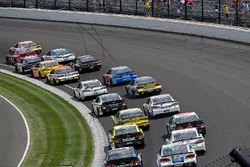
Sunday’s Brickyard 400 at Indianapolis Motor Speedway was the final straw for me. The race went into overtime when a wreck developed and the caution was displayed before the leader reached the overtime line.
With darkness approaching thanks to a late start time and nearly two-hour rain delay, the race went into a second overtime when – again – a wreck developed and the caution was displayed before the leader reached the overtime.
In the second overtime, just after Kasey Kahne cleared Brad Keselowski for the lead, yet another wreck erupted behind them and well before either had reached the overtime line. Yet this time, NASCAR held displaying the caution for several seconds until after Kahne reached the line, which effectively ended the race.
NASCAR's explanation
After the race, Steve O’Donnell, NASCAR’s executive vice president and chief racing development officer, was asked whether if the goal is to end under green, would it not make sense to have a quick caution trigger before the leader hits the overtime line?
Here was his answer, “No, it wouldn't, because again, like we’ve said, we want to make the attempt. But we want to do that under the regular regulations of how we call (the race). So, we look at that as our last attempt. We look at each (overtime) as our last attempt. If it can play out, it can play out.”
The problem is this: If the object is to allow the race to play out to its natural conclusion, then why have the OT rule (or any other similar scheme) in the first place?
And why proclaim the idea that there can be “unlimited overtimes” if your intention is to try to make each one the last one?
And yes, darkness may have legitimately ended the race before the third overtime could start. But, so what? If the race was called for darkness, Kahne would still be the winner.
I don’t for one minute believe NASCAR officials sit in race control trying to find a way to manipulate the result of a race for a specific purpose.
However, the decision on when to call a caution is an arbitrary one to begin with. Creating a system that forces NASCAR to make more of those decisions just increases the arbitrariness of the finish.
There is no simple solution here because there is always some element who believes they are entitled to see a specific result – “a green-flag finish.”
But there is one solution that comes as close to having a race play out to its natural conclusion – ending the race at its advertised distance.
Webster’s defines a race as “a contest of speed” and also “a set course or duration of time.”
That idea worked for NASCAR for almost 60 years.
It’s clear what we have now simply doesn’t.
Click on image to watch Steve O’Donnell, NASCAR’s executive vice president and chief racing development officer explain after the race:
We want your opinion!
What would you like to see on Motorsport.com?
Take our 5 minute survey.
- The Motorsport.com Team
Read and post comments
Read also :
Share Or Save This Story
Copy link
Share on Viber
Previous article Johnson wrecks out of Brickyard 400 in three-wide battle for the win
Next article Dale Earnhardt Jr. signs multi-year deal with NBC
Top Comments
There are no comments at the moment. Would you like to write one?
View More & Comment

More from
Jim Utter

Erik Jones agrees to multi-year contract extension with Legacy Motor Club
NASCAR Cup
NASCAR Cup
Erik Jones agrees to multi-year contract extension with Legacy Motor Club
Goodyear's option tires at Richmond "were like Mario Kart with a star"
NASCAR Cup
NASCAR Cup
Richmond II
Goodyear's option tires at Richmond "were like Mario Kart with a star"
NASCAR: Austin Dillon move was "really close to crossing the line"
NASCAR Cup
NASCAR Cup
Richmond II
NASCAR: Austin Dillon move was "really close to crossing the line"
Latest news
Dodge’s NASCAR Cup car unveil will include celebrity exhibition race during Snowball Derby
NASCAR Cup
NAS NASCAR Cup 2 h
Dodge’s NASCAR Cup car unveil will include celebrity exhibition race during Snowball Derby
Nikita Johnson targets Alex Palou’s rookie benchmark with Coyne ahead of 2027 IndyCar debut
IndyCar
Indy IndyCar 3 h
Nikita Johnson targets Alex Palou’s rookie benchmark with Coyne ahead of 2027 IndyCar debut
Max Verstappen reveals he is considering 2027 Daytona 24 Hours entry
Formula 1
F1 Formula 1
Las Vegas GP
7 h
Max Verstappen reveals he is considering 2027 Daytona 24 Hours entry
Tsunami RT announces 2027 IMSA Michelin Endurance Cup entry in GTD
IMSA
IMSA IMSA 8 h
Tsunami RT announces 2027 IMSA Michelin Endurance Cup entry in GTD
Subscribe and access Motorsport.com with your ad-blocker.
From Formula 1 to MotoGP we report straight from the paddock because we love our sport, just like you. In order to keep delivering our expert journalism, our website uses advertising. Still, we want to give you the opportunity to enjoy an ad-free and tracker-free website and to continue using your adblocker.
You have 2 options:
- Become a subscriber.
- Disable your adblocker.
Subscribe now Already subscribed? Sign in here
Already disabled your adblocker?
Reload page
Manage Alerts
Subscribe