Formula 1
F1 explains plan for active aero to improve racing for 2026
Formula 1 is looking at using active aerodynamics under the 2026 technical regulations to make up for the downforce lost when behind another car to improve following performance.

Luke Smith
Edited: Jan 21, 2023, 4:12 AM
Copy link
Share on Viber
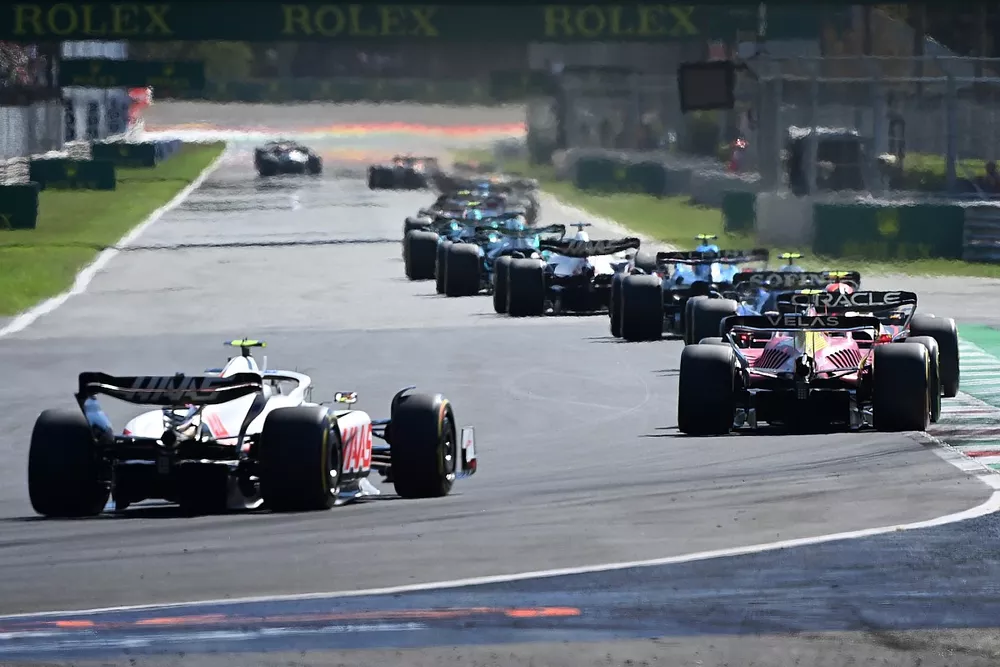
F1 overhauled its technical ruleset for the 2022 season in a bid to reduce the amount of downforce lost when cars were following each other, allowing them to get closer and attempt more overtakes.
The changes were widely praised by the F1 drivers, while Pirelli reported the number of overtakes in F1 had risen from 599 over the 2021 season to 785 last year.
But attention is already moving towards the next major technical rule changes, due in 2026 when F1 also introduces its next generation of power units.
Active aerodynamics are being evaluated as a way to improve the efficiency of the cars, but they could also be used to influence the competition on track and stop runaway wins.
Speaking at Autosport International last week, F1 chief technical officer Pat Symonds said the following performance of the 2026 cars would be "even better than the '22 cars".
DRS is set to remain part of the rules package, but Symonds explained how the active aerodynamics could be used to augment downforce and make up for the amount lost when it is closely following a car in front.
"We won't lose DRS, because there's totally active aerodynamics on the '26 car," said Symonds.
"DRS is drag reduction. What I've always felt we should do is have downforce augmentation. Because what does the car behind do? Yes, it loses some drag, but what really holds it is the fact it lost downforce.
Verstappen used Jeddah's long DRS zones to pass Leclerc for the Saudi GP win last season
Photo by: Zak Mauger / Motorsport Images
"Our idea now is to augment the downforce back to where it should have been if the leading car wasn't there."
The target would be to allow for even closer on-track battles, which Symonds said was the focus as opposed to ensuring there is an overtake.
"Everyone talks about overtaking, but for us, overtaking was the end of the battle," said Symonds.
"It's the battle that's interesting, it's the unpredictability - is he going to get past? And I know a lot of people criticise DRS, and that was the trouble with DRS, it can make a pass too easy.
"Conversely, when you don't have it, the Imola race when the FIA were very reluctant to activate DRS, you do get some dull races. It's a matter of getting it right."
Read Also:
- How F1's new rules era has impacted front wing philosophy
- Aston Martin: Rule loopholes have allowed "clever innovations" on 2023 F1 car
- When F1 'holiday' races kept drivers busy through the winter
Teams are set to be presented with a first look at the planned chassis regulations for 2026 at a meeting later this month.
Although Symonds said the 2026 car would be "quite conventional", he revealed the technical team started with a blank canvas that saw it explore a number of radical avenues.
"When we studied the '26 project, we did have another clean sheet of paper, and we investigated all sorts of things," he said.
"We actually went right back to a skirted ground effect car to get some kind of idea where the ultimate was. We looked at fan cars, all sorts of weird things.
"But the '26 car will be quite conventional, because that's the way we want it to be."
We want your opinion!
What would you like to see on Motorsport.com?
Take our 5 minute survey.
- The Motorsport.com Team
Read and post comments
Read also :
Share Or Save This Story
Copy link
Share on Viber
Previous article How one wrong simulation answer triggered key mistake with Mercedes' W13 design
Next article Alfa Romeo announces launch date for 2023 F1 car
Top Comments
There are no comments at the moment. Would you like to write one?
View More & Comment

More from
Luke Smith
1998 Belgian GP: When the Schumachers went to war
Formula 1
Formula 1
1998 Belgian GP: When the Schumachers went to war

The race that transformed perceptions of Red Bull
Formula 1
Formula 1
The race that transformed perceptions of Red Bull

Hamilton in the process of selecting Brad Pitt’s co-star for F1 movie
Formula 1
Formula 1
Hamilton in the process of selecting Brad Pitt’s co-star for F1 movie
Latest news

NASCAR warned nearly the full field at Talladega for minimum speed violations
NASCAR Cup
NAS NASCAR Cup
Talladega II
4 min
NASCAR warned nearly the full field at Talladega for minimum speed violations
Carson Hocevar credits tow truck driver for saving his race at Talladega
NASCAR Cup
NAS NASCAR Cup
Talladega II
4 h
Carson Hocevar credits tow truck driver for saving his race at Talladega
Brad Keselowski to address questions about NASCAR future and RFK exit at Martinsville
NASCAR Cup
NAS NASCAR Cup
Martinsville II
5 h
Brad Keselowski to address questions about NASCAR future and RFK exit at Martinsville

Hamlin says Chevy teams 'suck at the teat' of Hendrick on superspeedways
NASCAR Cup
NAS NASCAR Cup
Talladega II
8 h
Hamlin says Chevy teams 'suck at the teat' of Hendrick on superspeedways
Feature
Discover prime content


Subscribe and access Motorsport.com with your ad-blocker.
From Formula 1 to MotoGP we report straight from the paddock because we love our sport, just like you. In order to keep delivering our expert journalism, our website uses advertising. Still, we want to give you the opportunity to enjoy an ad-free and tracker-free website and to continue using your adblocker.
You have 2 options:
- Become a subscriber.
- Disable your adblocker.
Subscribe now Already subscribed? Sign in here
Already disabled your adblocker?
Reload page
Manage Alerts
Subscribe