Formula 1
F1 Reliability Better Than Ever In 2011
By: GMM
GMM
Published: Jun 29, 2011, 1:20 PM
Copy link
Share on Viber

Technical reliability in Formula One has taken a great leap forward in 2011.
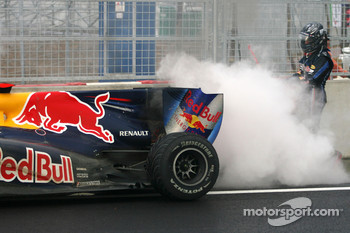
Sebastian Vettel, Red Bull Racing had his engine blew up
Photo by: xpb.cc
Last Sunday at Valencia was the first-ever 24-car finish in F1 history, with every competitor entered in the world championship making it to the chequered flag.
And Germany's Die Welt newspaper noted that in the eight races so far this season, there were only 18 technical failures, compared to 38 at the same point one year ago.
"Reliability is at least as important as speed," said Red Bull team principal Christian Horner, "and to be the best requires a combination of both."
But Jarno Trulli, a veteran driver who has spent the last season and a half at the back of the field with Team Lotus, is not so sure perfect reliability is good for F1.
"When I started racing (in F1), a driver knew how he'd start a race but not how he would finish it.
"This implies two things," he wrote in a column for La Repubblica. "The first is that the chances for a small team to get in the points have sensibly reduced; the second is a further loss of appeal for F1."
We want your opinion!
What would you like to see on Motorsport.com?
Take our 5 minute survey.
- The Motorsport.com Team
Read and post comments
Read also :
Share Or Save This Story
Copy link
Share on Viber
Previous article Red Bull Set For Renault F1 Engine Deal Extension
Next article Track Says F1 Barcelona Axe Reports 'Invented'
Top Comments
There are no comments at the moment. Would you like to write one?
View More & Comment
More from
GMM

The season is still very long - Rosberg
Formula 1
Formula 1
The season is still very long - Rosberg

Jules Bianchi's father speaks of family's continued hopes
Formula 1
Formula 1
Jules Bianchi's father speaks of family's continued hopes

Sauber under no illusions about constructors' position
Formula 1
Formula 1
Chinese GP
Sauber under no illusions about constructors' position

More from
Sebastian Vettel

Sebastian Vettel gives update on F1 future as he opens up on life after retirement
Formula 1
Formula 1
Azerbaijan GP
Sebastian Vettel gives update on F1 future as he opens up on life after retirement
Sebastian Vettel: F1 must combine “things we love” with sustainable future
Formula 1
Formula 1
Sebastian Vettel: F1 must combine “things we love” with sustainable future

More from
Red Bull Racing
Christian Horner blames Dietrich Mateschitz’s death for the “painful” end of his F1 reign
Formula 1
Formula 1
Singapore GP
23 min
Christian Horner blames Dietrich Mateschitz’s death for the “painful” end of his F1 reign
Fred Vasseur "not sure" if Red Bull is currently F1's best team
Formula 1
Formula 1
Singapore GP
2 h
Fred Vasseur "not sure" if Red Bull is currently F1's best team
Latest news
Christian Horner blames Dietrich Mateschitz’s death for the “painful” end of his F1 reign
Formula 1
F1 Formula 1
Singapore GP
23 min
Christian Horner blames Dietrich Mateschitz’s death for the “painful” end of his F1 reign
F1 signs historic 10-year Rwanda deal to host African Grand Prix
Formula 1
F1 Formula 1 57 min
F1 signs historic 10-year Rwanda deal to host African Grand Prix
Fred Vasseur "not sure" if Red Bull is currently F1's best team
Formula 1
F1 Formula 1
Singapore GP
2 h
Fred Vasseur "not sure" if Red Bull is currently F1's best team
Feature
Discover prime content

Subscribe and access Motorsport.com with your ad-blocker.
From Formula 1 to MotoGP we report straight from the paddock because we love our sport, just like you. In order to keep delivering our expert journalism, our website uses advertising. Still, we want to give you the opportunity to enjoy an ad-free and tracker-free website and to continue using your adblocker.
You have 2 options:
- Become a subscriber.
- Disable your adblocker.
Subscribe now Already subscribed? Sign in here
Already disabled your adblocker?
Reload page
Manage Alerts
Subscribe